
I was wrong. MLO is now available on the Ubiquiti U7 Pro and I tested it! – MBReviews Leave a comment
I’ve retested the U7 Pro Max very not too long ago and I used to be upset by the gradual progress that Ubiquiti made in the direction of the event of the MLO. Nicely, they did launch a beta firmware that helps it and I additionally managed to lastly make it work on the shopper finish, so I needed to run some exams on the U7 Professional.
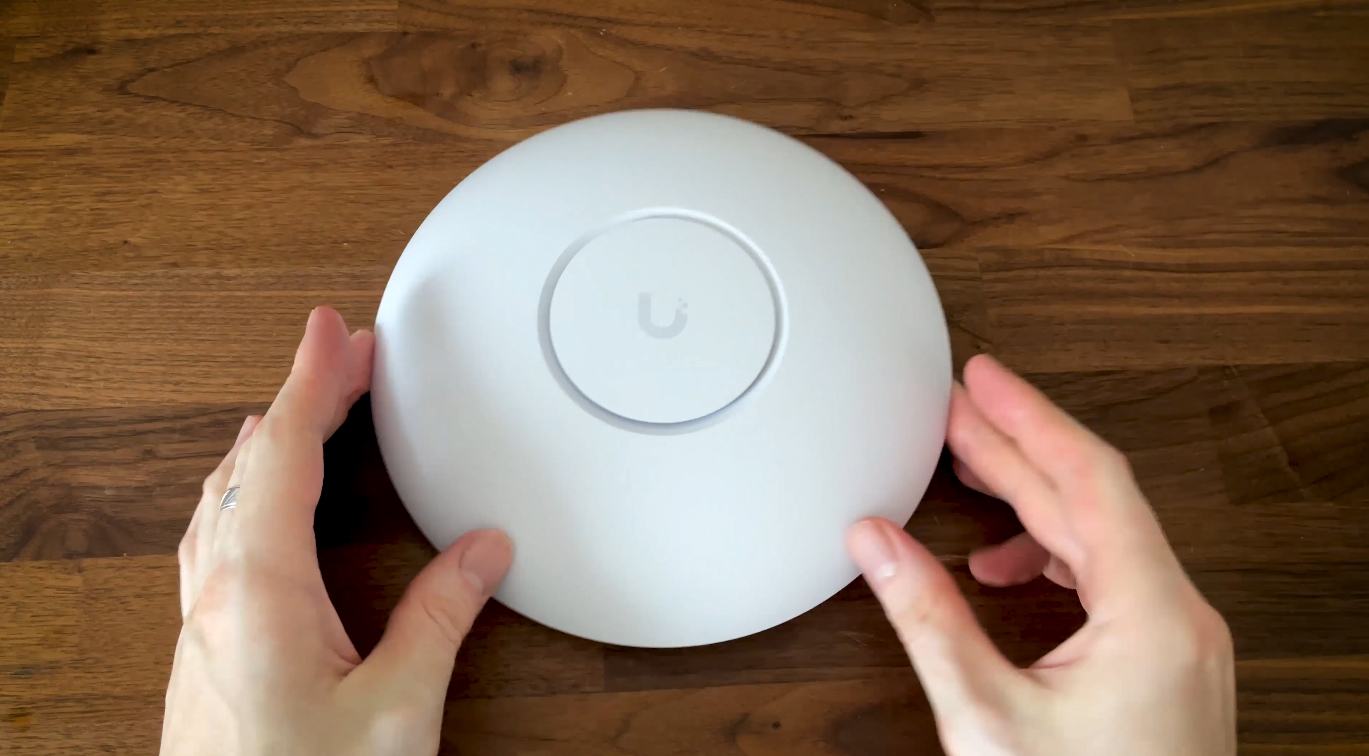
I hoped that the U7 Professional Max MLO check could be obtainable shortly after, however I’m not certain whether or not there may be sufficient curiosity from the customers (it’s extraordinarily time-consuming). Additionally, I’ve already run some exams on the Zyxel NWA130BE which was a lot faster than the Ubiquiti WiFi 7 entry level to unlock this cool characteristic, so test it out as nicely.
When you haven’t watched that video, know that I relied on a Qualcomm FastConnect 7800 adapter from MSI, and I did should run an unofficial driver replace since regardless of claiming the help for MLO from the get-go, MSI didn’t actually allow it. In the mean time I posted the article (three months after the video and the precise check, MSI has made the unofficial firmware replace official).
I used Home windows 11 with the experimental replace 24h2, however know that the Linux v 6.11 is now absolutely launched and will help MLO as nicely. Once more, three months later, issues have gotten considerably higher by way of MLO help.
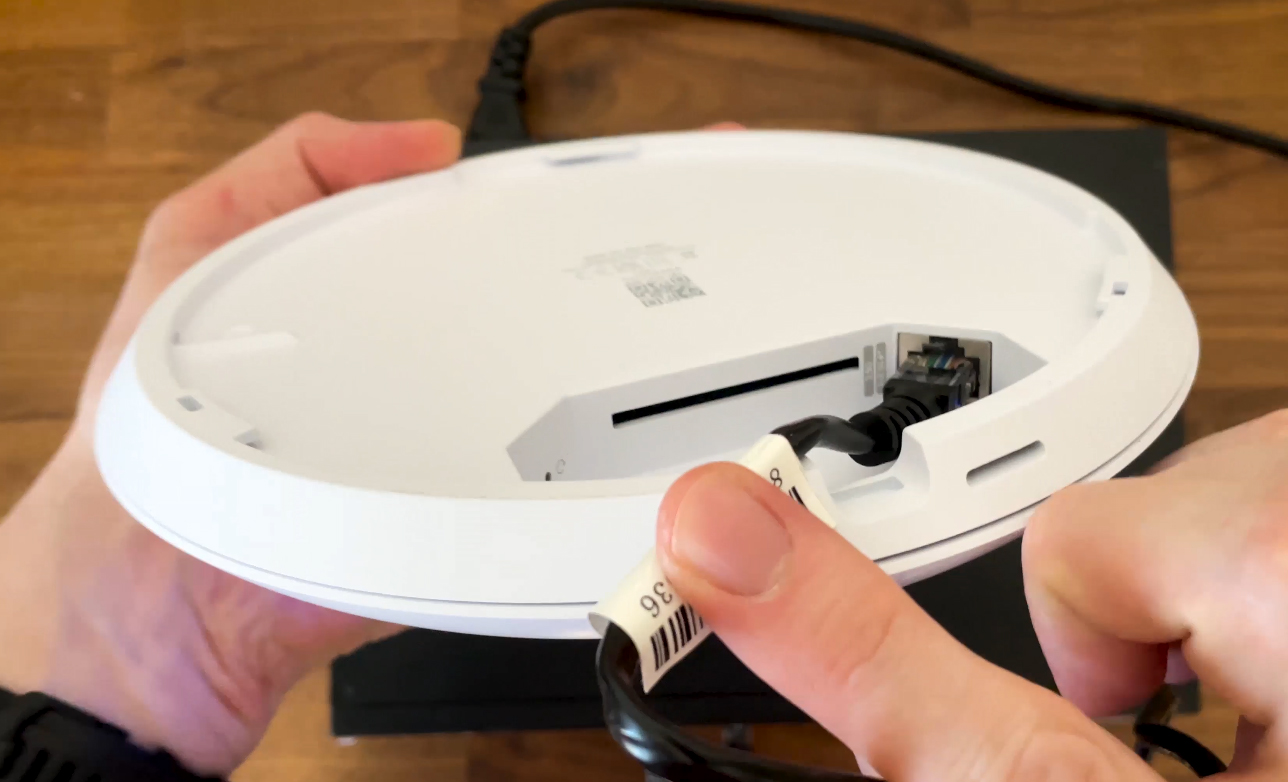
The Ubiquiti U7 Professional is proscribed by a 2.5GbE port, however I nonetheless used a 10GbE server simply to ensure no bottlenecking will happen. And, to energy up the entry level, I relied on the Zyxel XS1930 swap which suports PoE++ and does have a number of 10GbE Ethernet ports obtainable. Regardless of its age, it’s nonetheless a beast of a tool. Now, let’s see how straightforward it’s to arrange MLO.
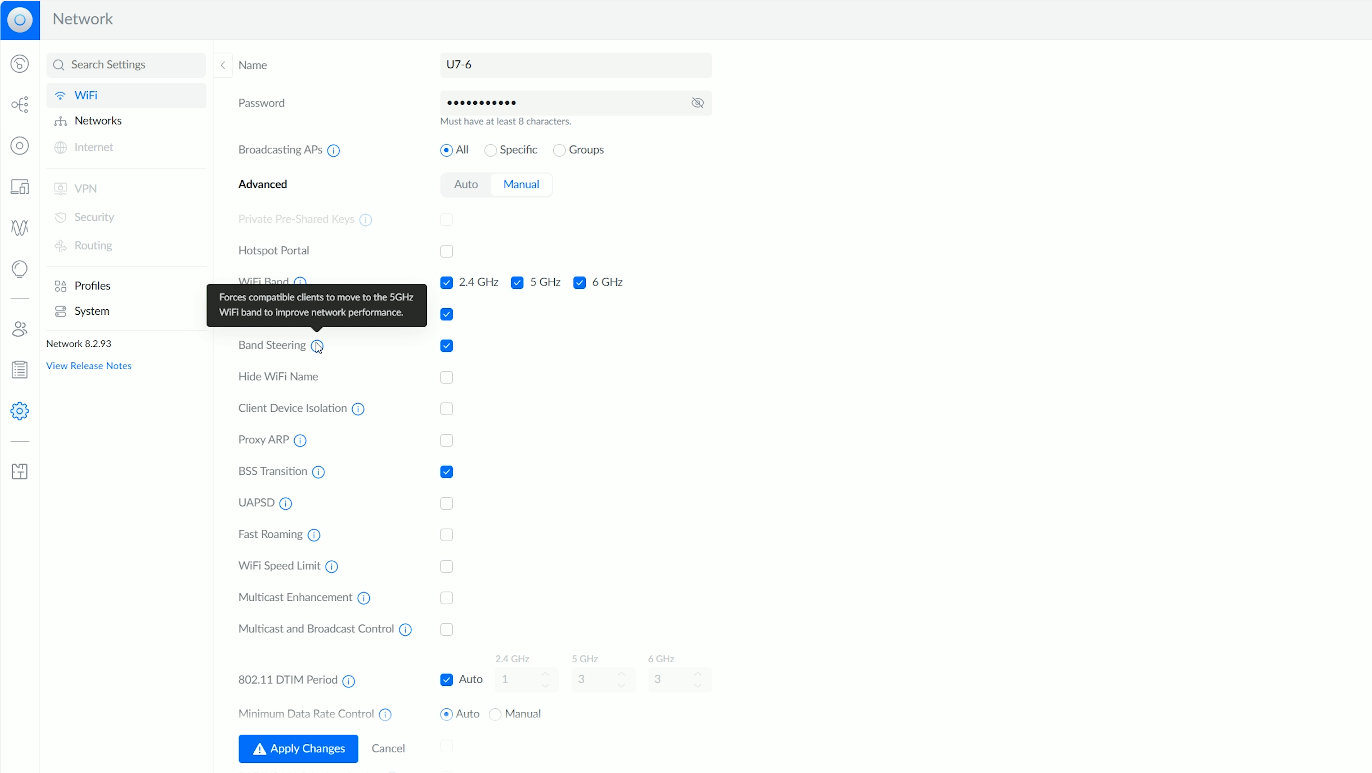
When you haven’t enabled the entry to the beta firmware variations, then MLO won’t be enabled but, however I managed to get my arms on the newest firmware which is v7.1.24 and I might discover the MLO characteristic underneath Settings and WiFi. Scroll a bit decrease and MLO will likely be there subsequent to the three WiFi Bands. Allow MLO and select which radio bands will likely be aggregated. You possibly can go for any mixture of two and even all three on the identical time.
Then, from the Radios part, you’ll be able to configure the channel and the channel bandwidth for every radio. Earlier than seeing the outcomes that I bought, we have to speak concerning the WiFi 7 adapters as a result of not all are the identical, nor will they carry out identically.
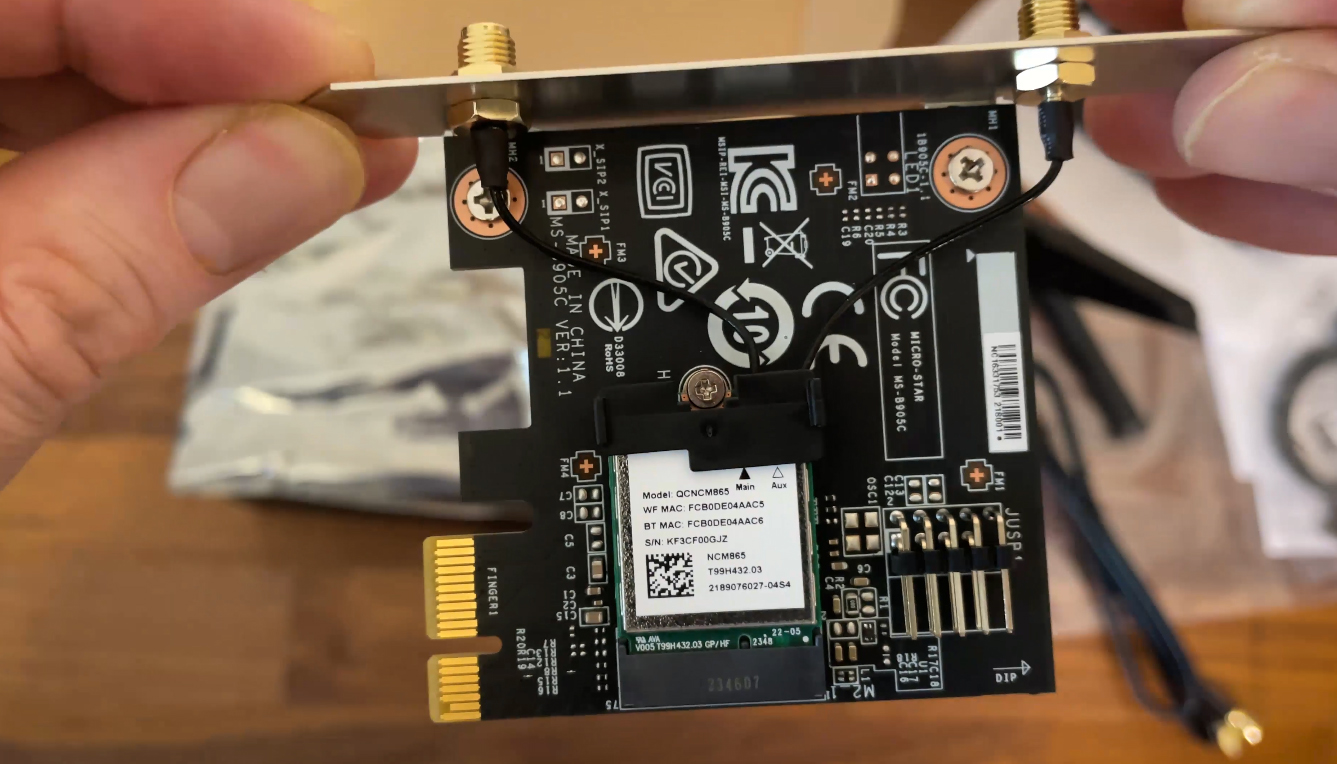
It appears that evidently the consensus is that the Qualcomm FastConnect 7800, the one which I’m utilizing is the most effective one up to now as a result of it’s makes use of the MLMR, so we do get true multi-radio information switch, supporting simultaneous Tx/Tx and Rx/Rx over a number of hyperlinks. On the identical time, as Mediatek states, the hyperlinks are statically assigned and can’t swap to different frequencies dynamically, one thing that the Intel BE200 can as a result of it makes use of the eMLSR mode, an abbreviation from the Enhanced Multi-Hyperlink Single Radio.
The title offers it away that the regardless of the flexibility to hearken to a few hyperlinks on the identical time, we’re nonetheless coping with a single radio information switch. As I mentioned once I examined the Zyxel NWA130BE, I believe the Qualcomm method is nearer to the what MLO was initially envisioned, not that the Intel BE200 is unhealthy, fairly the opposite, apparently having the ability to present the next throughput if sure circumstances are met. Now let’s see the outcomes.
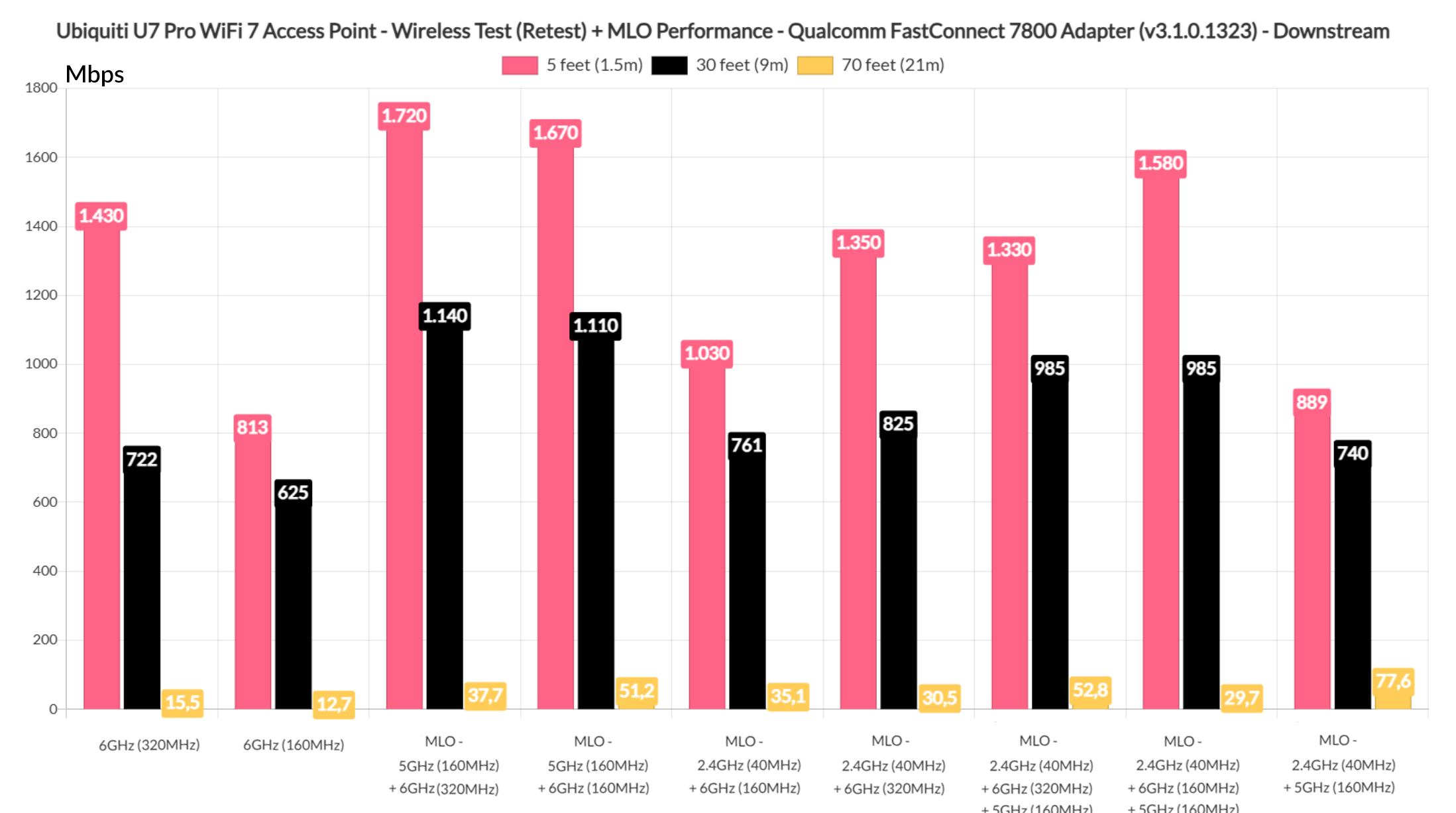
I needed to partially retest the U7 Professional for recent information as a result of the newest firmware updates labored in favor of a greater single-client throughput each upstream and downstream. We do see a much better throughput at 5 and 30 toes utilizing solely the 6GHz radio and the 320MHz, however even the downgrade to 160MHz didn’t have a heavy affect, particularly lengthy vary.
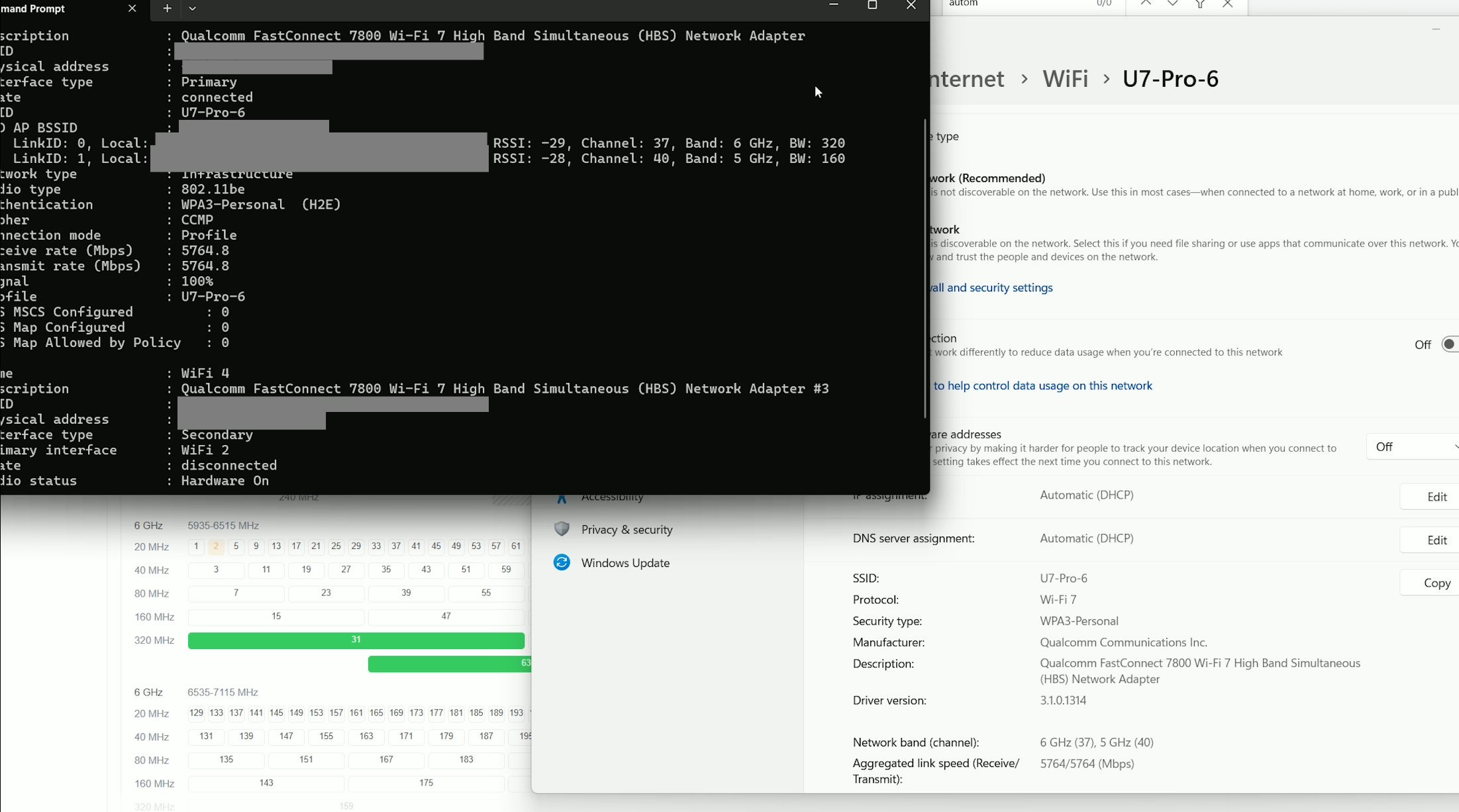
That being mentioned, I configured the MLO to make use of the 5GHz on 160MHz and the 6GHz utilizing the 320MHz channel bandwidth. And the Home windows 11 was capable of affirm that the 2 radio bands had been certainly aggregated.
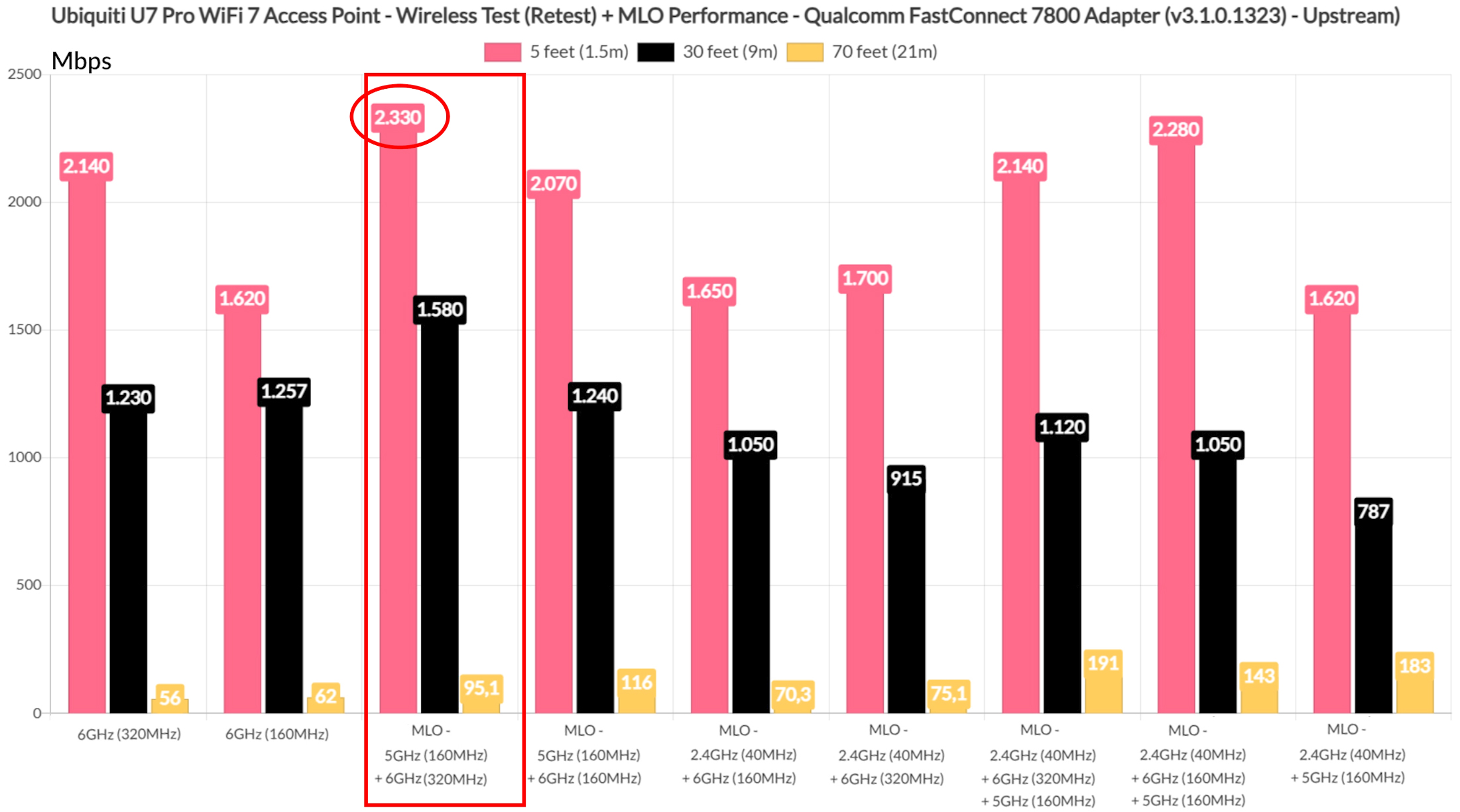
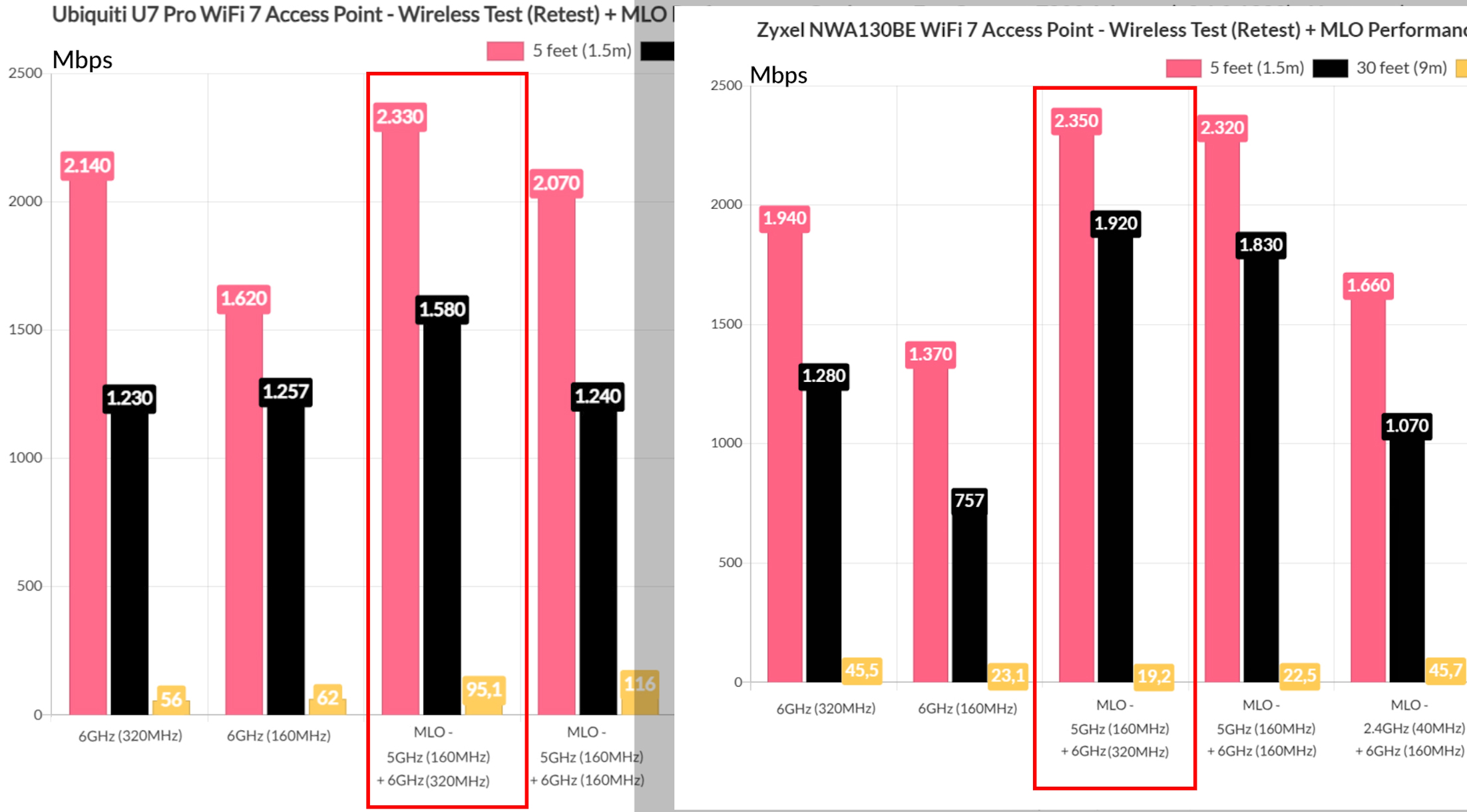
They had been, in fact and the efficiency is fascinating, reaching the max potential throughput throughout the 2.5GbE restrict at 5 toes, and we additionally see an enchancment at 70 toes.
When in comparison with the NWA130BE, the U7 Professional is healthier when the sign attenuation went close to 80dB, however the Zyxel entry level provided a greater throughput at 30 toes. After switching the channel bandwidth to 160MHz, we see a decline in throughput close to the entry level, however a slight improve at 70 toes, so the vary is a bit higher. The NWA130BE carried out a lot better right here.
On the following step, I configured MLO to mixture the 6GHz radio band with the two.4GHz radio, the latter utilizing the 40MHz channel width, whereas the previous remained on the 160MHz. And, when in comparison with the bottom efficiency, there may be little enchancment, solely at 70 toes. So, I enabled the 320MHz channel bandwidth on the 6GHz. This time, we do see a slight bump at 5 toes, however the remaining confirmed values decrease than the bottom 6GHz efficiency.
Let’s transfer ahead and embody all three radio bands underneath the MLO, organising the 6GHz to make use of the 320MHz channel width. The largest shock comes at 70 toes, the place we see a throughput near 200Mbps upstream. Downstream, it additionally did impressively nicely.
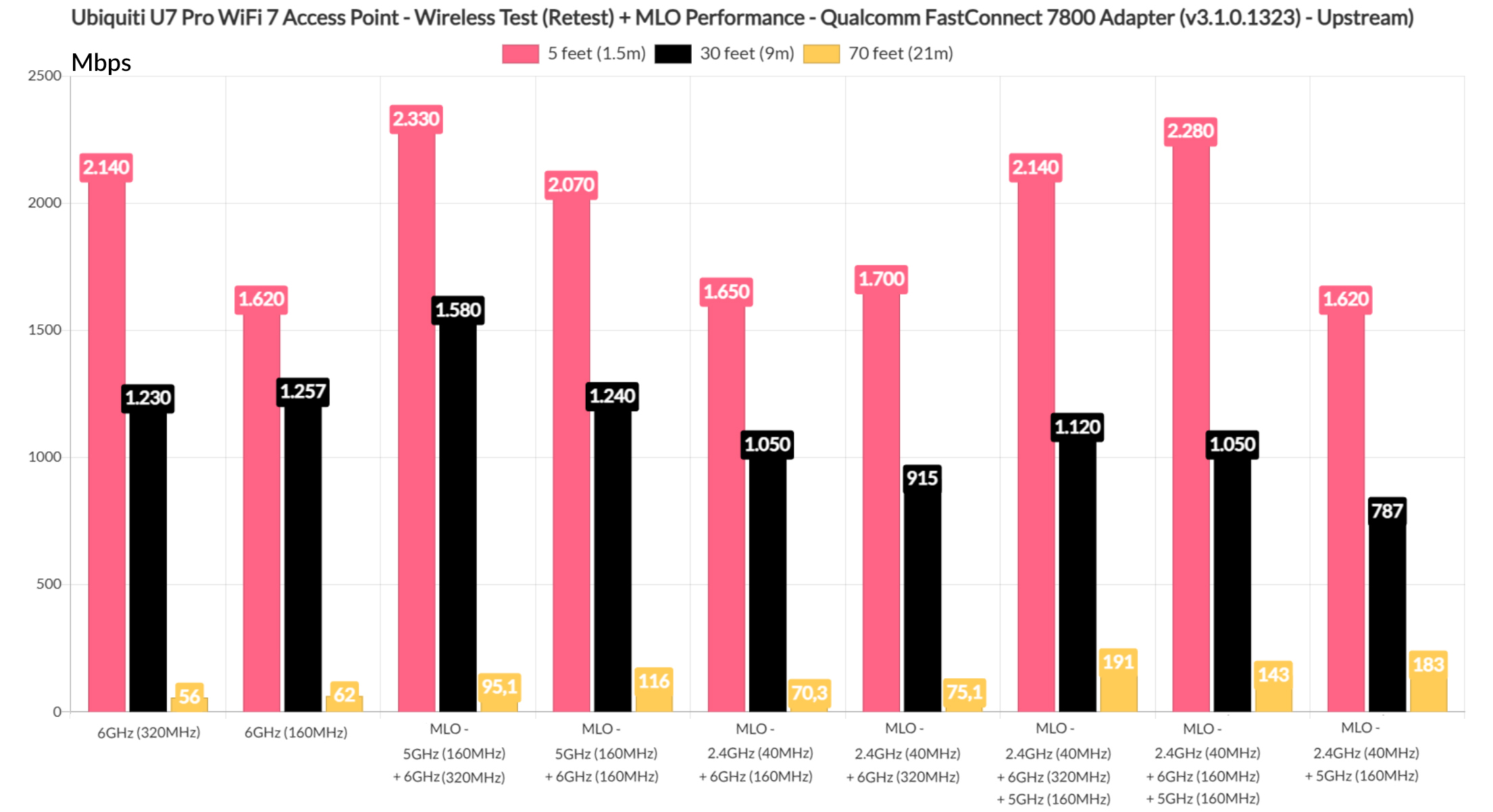
After switching the 6GHz to the 160MHz width, the close-range throughput pictures up and, whereas the sign attenuation has an additional affect on the throughput, it stays spectacular however. Lastly, I aggregated the two.4GHz radio band with the 5GHz one and, whereas it did nicely by way of protection, the close by throughput is missing a bit, particularly when in comparison with the Zyxel NWA130BE. It felt unusual to cease right here, particularly since I often concentrate on latency in just about all my evaluations, so I made a decision to present it a strive right here as nicely.
However I couldn’t run net-hydra on the same old 5 shopper gadgets. First, as a result of not all are WiFi 7 purchasers, second, as a result of it might have taken me no less than per week of testing for about 8 hours a day. I don’t receives a commission for this, so I went with a faster answer. I used the Qualcomm shopper machine and ran Flent which checks for Bufferbloat.
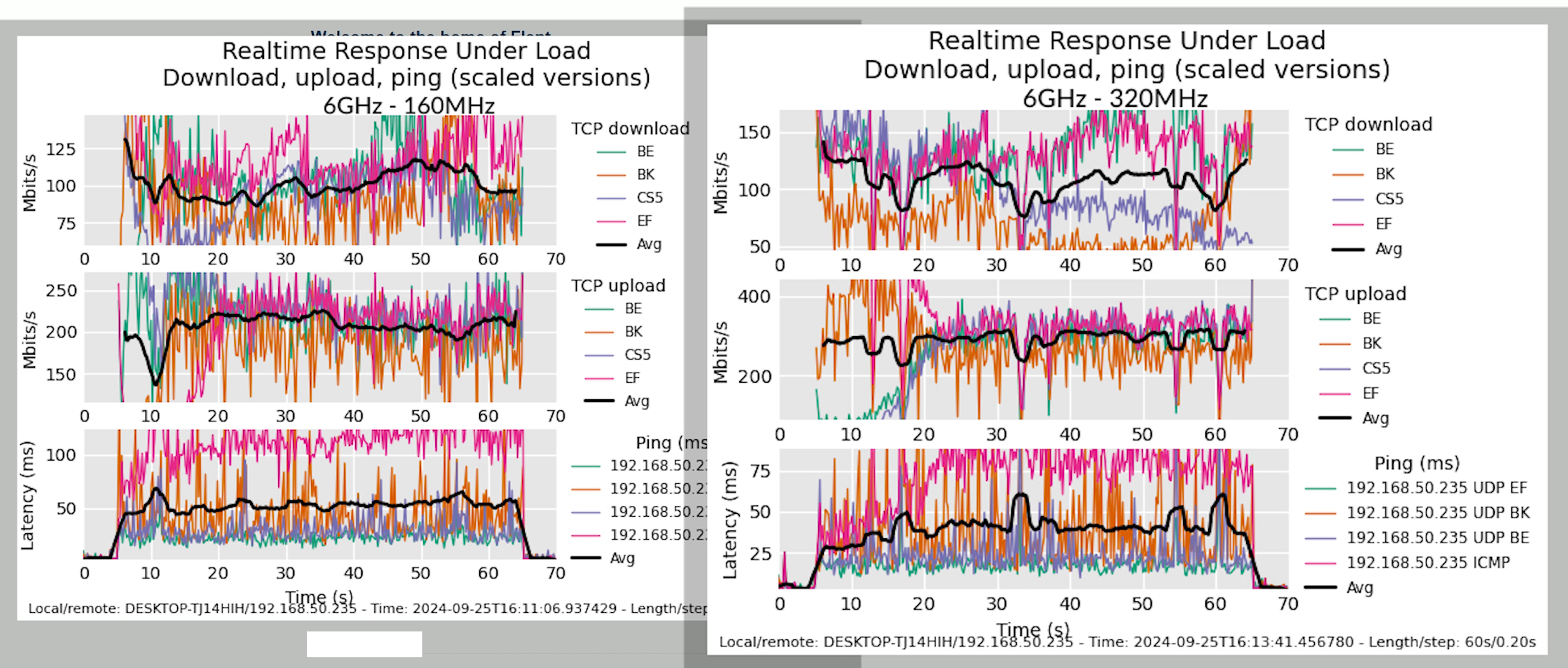
And, as soon as once more, I ran it on the 6GHz radio utilizing the 160MHz and the 320MHz channel bandwidth as a reference for future outcomes. I’m going to concentrate on the typical latency outcomes which appear to be higher than what I expertise utilizing the Zyxel NWA130BE. We see the curve staying under 50ms more often than not utilizing the 320MHz width, whereas the 160MHz reveals a mean of 50ms. Does MLO have an effect when set to make use of the 5GHz alongside the 6GHz radio? Sure and for the higher.
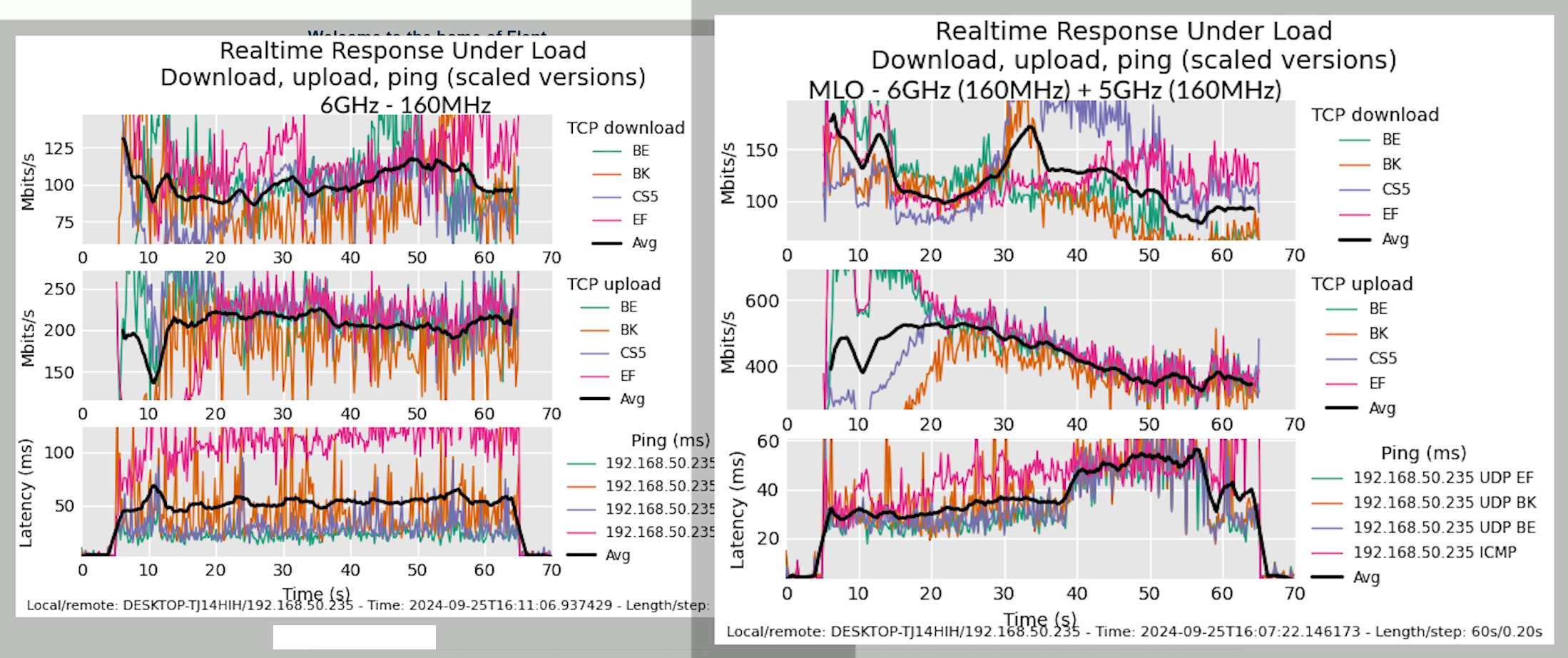
Utilizing the 160MHz channel width, we see that the latency stays at round 30ms for the primary half of the check, then a sudden bump up, adopted by a drop at about 40ms. Utilizing the 320MHz additionally reveals an total enchancment of about 10ms throughout your complete check which shouldn’t be taken flippantly.
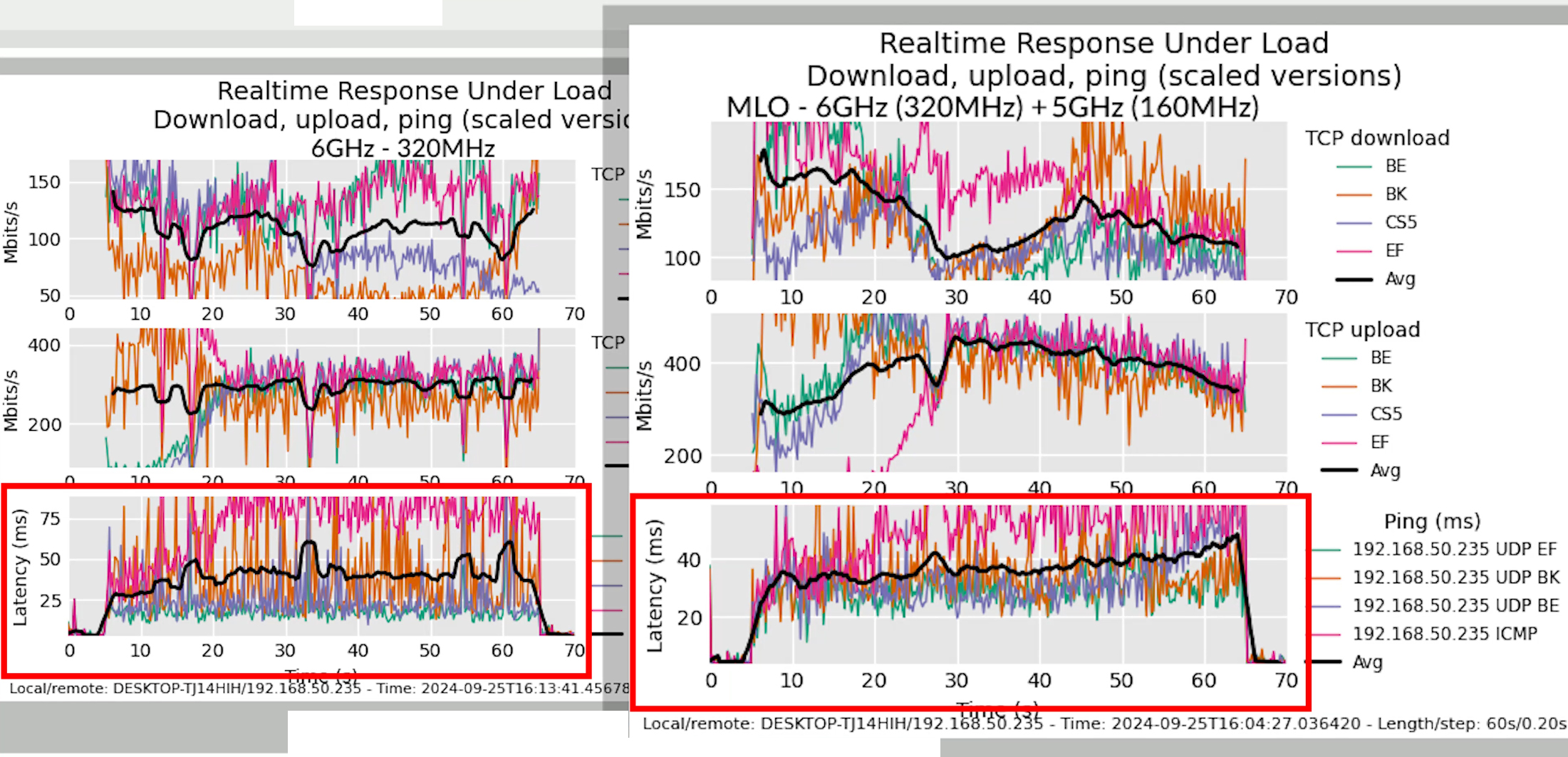
I did see some chaos on the obtain and add graphics, however the latency outcomes are effective. Subsequent, I arrange the MLO to make use of the two.4GHz radio and the 6Ghz radio bands. We will see that there’s a very slight improve in latency when utilizing the 160MHz channel width on the 6GHz radio, and a extra substantial improve when utilizing the 320MHz width, hovering at a mean of 50ms.
6GHz(160MHz) & 2.4GHz(40MHz)
Transferring ahead, I aggregated the three radio bands as soon as once more and ran Flent. Utilizing the 160MHz channel bandwidth on the 6GHz radio, we see a promising begin, however then the latency raises near 75ms and stays there which is much from superb. Utilizing the 320MHz channel width appears to include issues a lot better and the efficiency is extra constant at round 40-45ms.
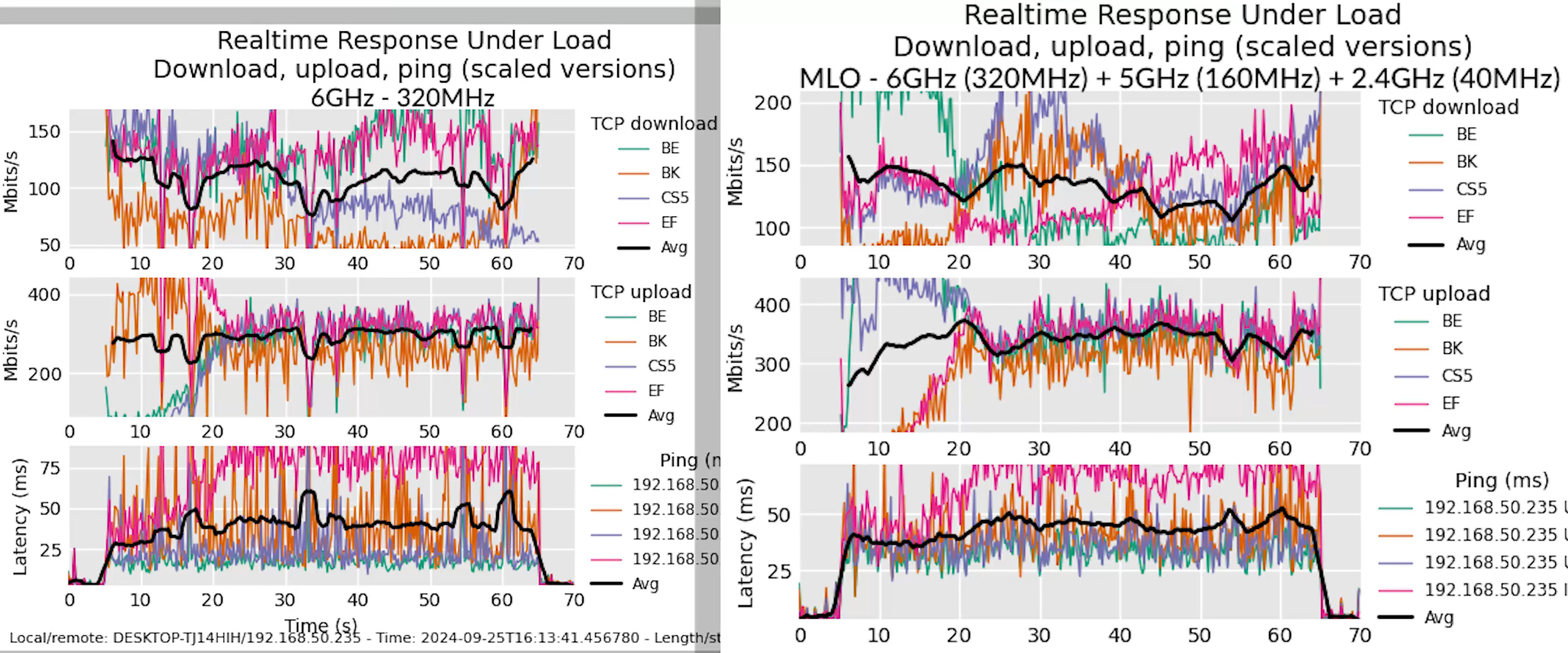
(320MHz) & 2.4GHz (40MHz) & 5GHz(160MHz)
Lastly, I aggregated the two.4GHz and the 5GHz radios, and it’s a reasonably contained efficiency, the latency averaging 50ms for your complete length of the check.
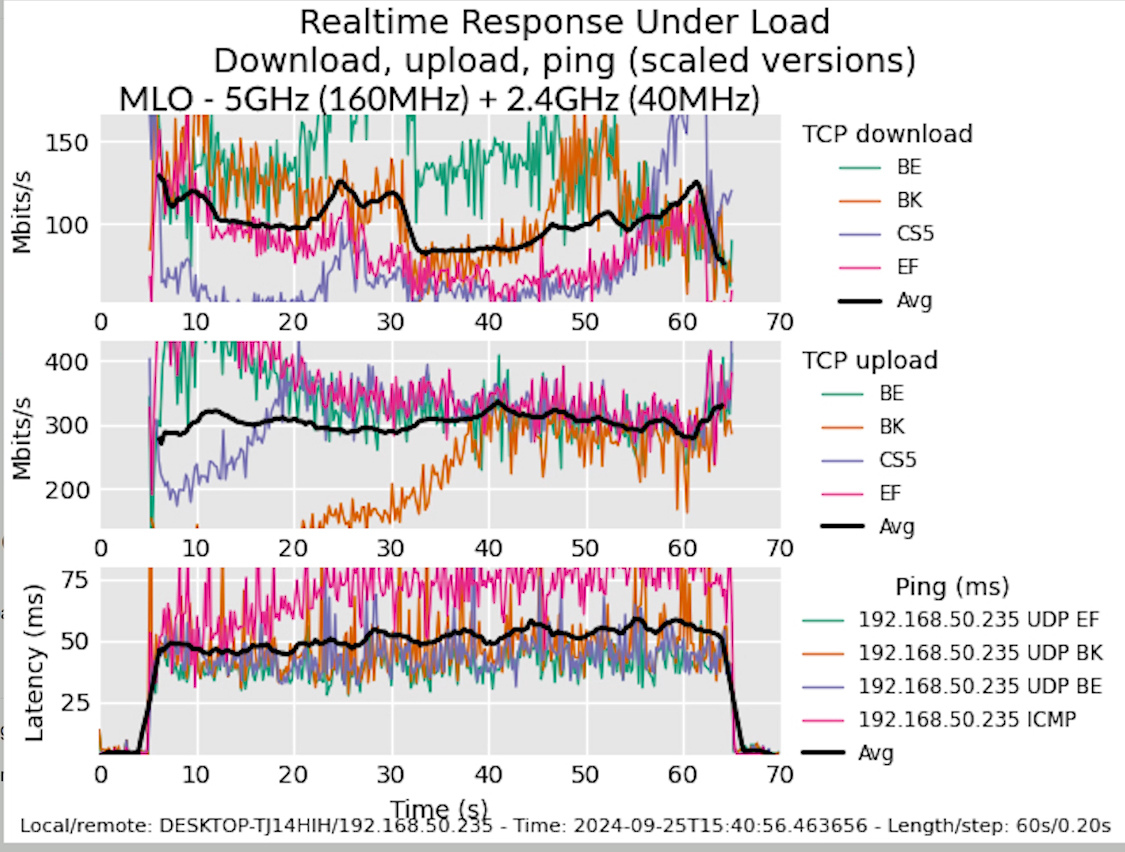
MLO – 5GHz(160MHz) & 2.4GHz(40MHz)
That’s about all for this set of check. Do let me know if you need me to run a particular sort of check. I do have to say that I’m impressed by how a lot Ubiquiti has improved the U7 Professional, and hopefully, the U7 Professional Max as nicely, however we are going to see about that particular mannequin. Throughout my exams, I didn’t expertise any bugs on the entry level stage and there have been no crashed whereas working the exams.
I did expertise some cussed habits from the WiFi 7 adapter aspect to detect the 6GHz radio, but it surely was to be anticipated contemplating that I’m utilizing an unofficial firmware model. Total, issues look good, so, when you’ve got the proper {hardware}, I’d say that the U7 Professional is a much more enticing choice proper now than it was a couple of months in the past. That’s all for now. Thanks for watching and see you subsequent time.

Mark is a graduate in Pc Science, having gathered useful expertise through the years working in IT as a programmer. Mark can also be the primary tech author for MBReviews.com, overlaying not solely his ardour, the networking gadgets, but additionally different cool digital devices that you could be discover helpful on your day by day life.