
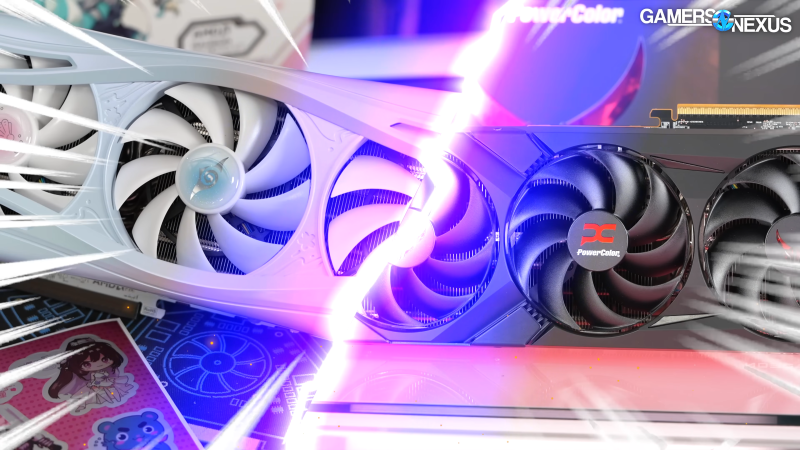
GPU Absurdity: AMD RX 9070 XT Waifu vs. Red Devil Ultimate Showdown Leave a comment
The Yeston RX 9070 XT Sakura Sugar Atlantis OC Version weighs in at $900 and has its own YouTube channel devoted to Sakura, the angel of the ocean, together with energy transfer footage of soaking a video card within the very ocean sands whence it got here.

And when Yeston lastly releases its a lot anticipated Husbando video card, named after the cool and aloof character “GAME ACE,” it’s GAME OVER for PowerColor’s Crimson Satan.
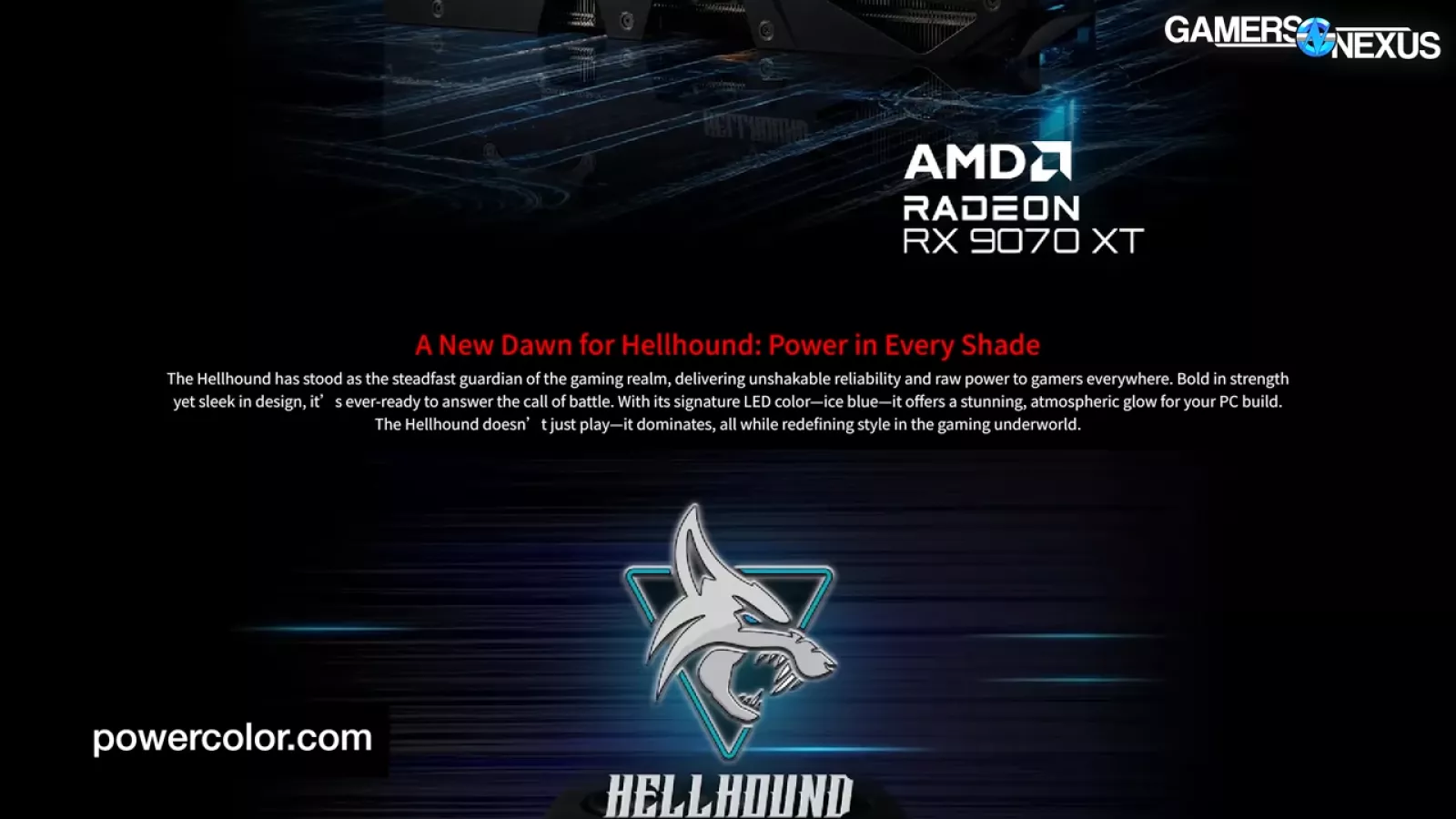
However Yeston isn’t alone on this battle of gamer advertising and marketing: PowerColor’s Hellhound says it has a “New Daybreak” and “Energy in Each Shade,” And… we don’t know what which means.
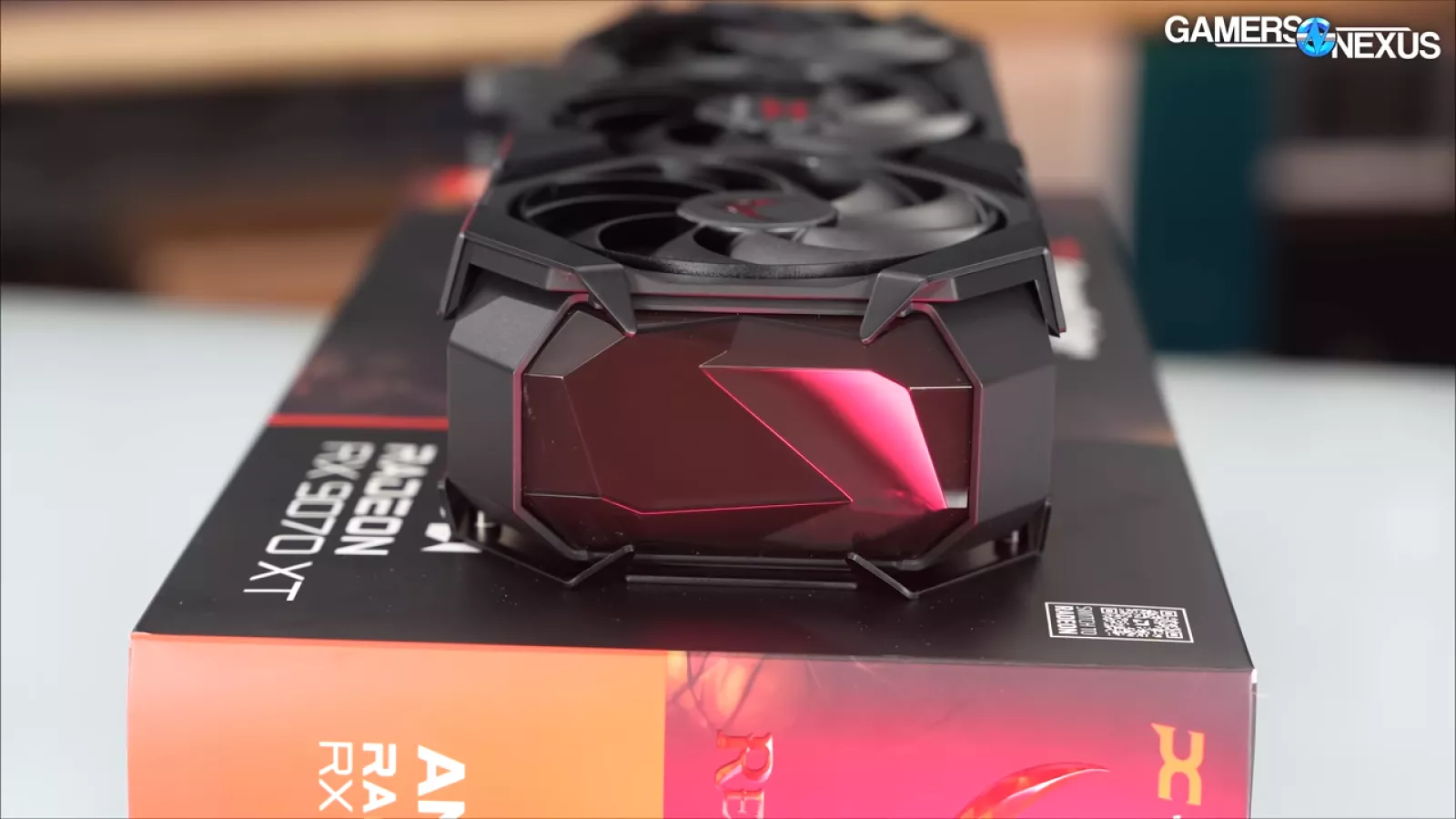
But it surely sounds scary — virtually as scary because the RED DEVIL, the pure counter to the WAIFU. The Crimson Satan says its Hellstone is “born from darkness, radiating energy,” “cast within the fires of the underworld and impressed by the cradle of the rarest gems.” PowerColor “emerges because the unparalleled power in gaming, pushing efficiency to its absolute peak,” and “at its core lies the Hellstone, a wide ranging design aspect the place vibrant RGB pulses with an otherworldly glow, embodying fiery energy and precision.”
Such a stone sounds too highly effective to be within the arms of mere, filthy casuals. The breathtaking design aspect Hellstone is product of hundred-million-year-old supplies dug from the depths of the earth. We’re instructed that it’s product of a uncommon, practically unattainable polymeric matrix composite from hydrocarbon polymers, identified solely to mortal people as… “plastic.”
That is the battle you all have been ready for. It’s the final GPU sh*tpost — second solely to the one which NVIDIA simply made by launching the so-called RTX 5050 (watch our coverage).
And in case you’re questioning if this is only one gigantic meme with precise testing that required dozens of hours of labor and a whole lot of hundreds of {dollars} value of kit all for this one meme, then sure. Sure it’s. But it surely does have an essential conclusion. And we’re going to resolve who is best between the RED DEVIL VS. the WAIFU. Let’s battle.
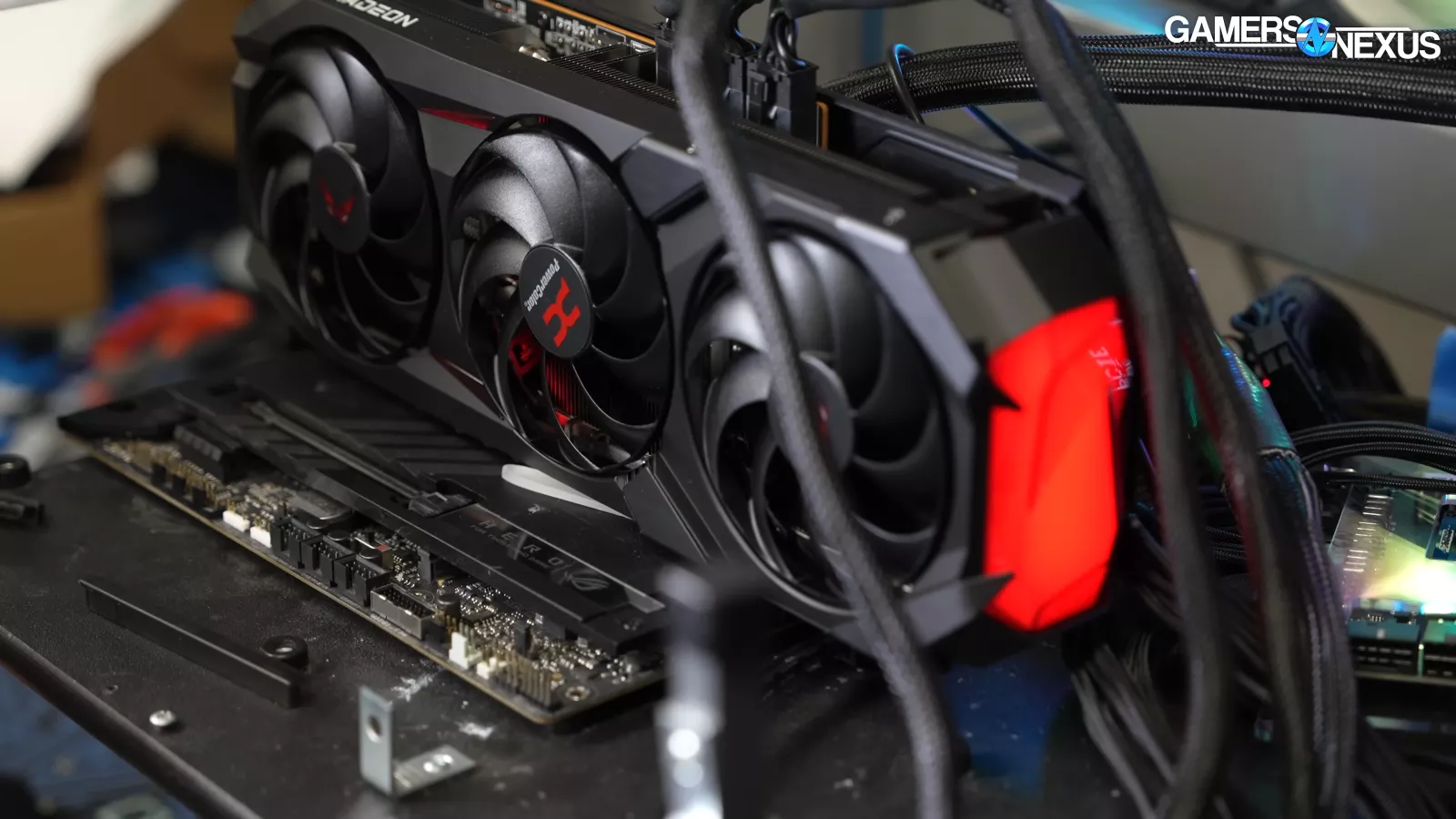
Testing
Regardless of the jokes, we do even have testing in our overview. We’re testing thermals, some energy, acoustics, frequency, and a few video games.
The primary motive we’re taking a look at video games is as a result of the 9070 XT Red Devil is operating at a fairly excessive clock in comparison with different 9070 XTs so we wished to have a look at that to see how a lot it really mattered.
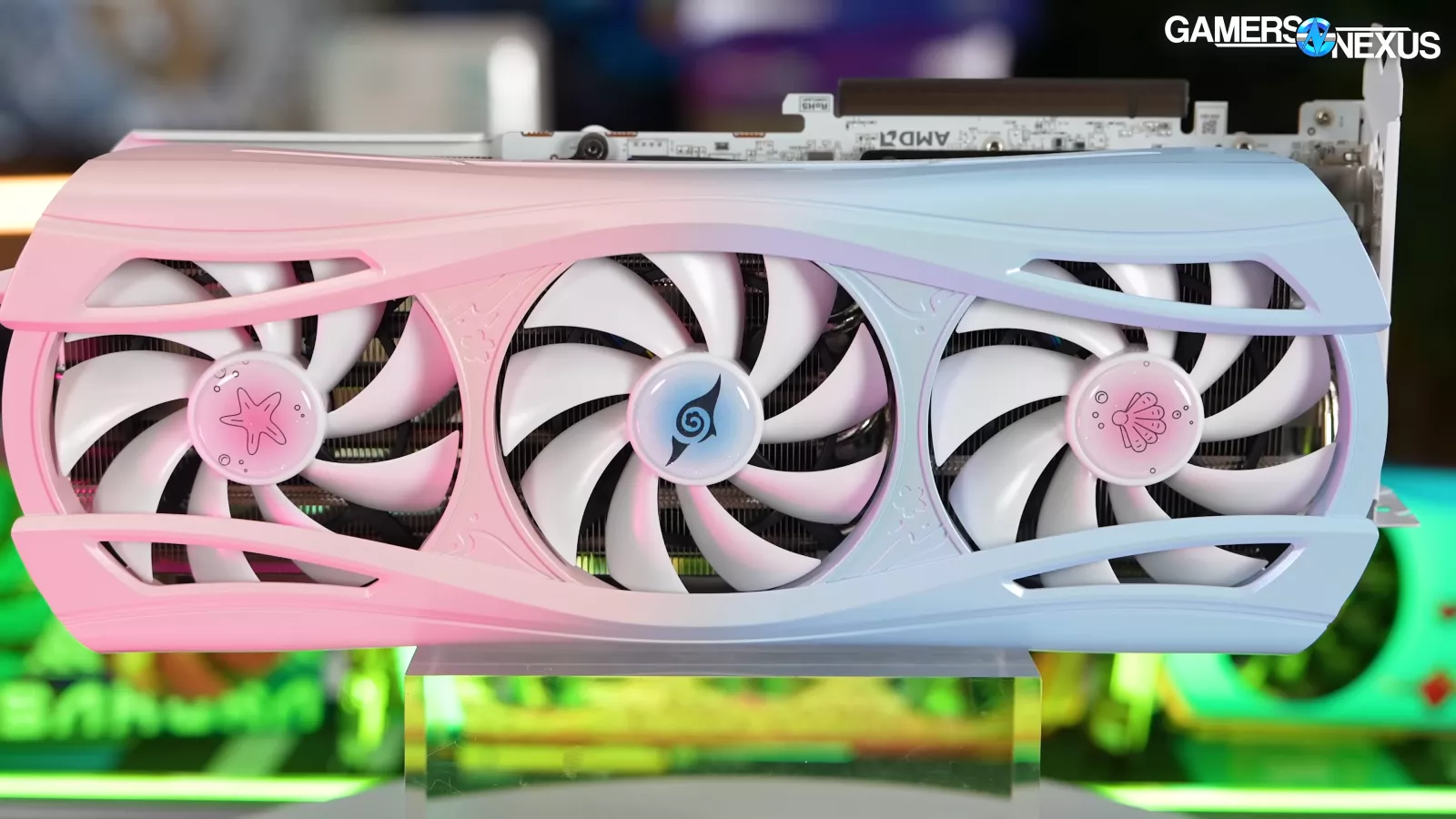
The most important difficulty with each playing cards is that they’re at the moment $900, which is totally insane as a result of MSRP is allegedly $600 for the 9070 XT, although that’s probably not the case. Regardless, $900 continues to be fairly excessive.
Each the playing cards we’re reviewing right here have twin vBIOS and share loads of frequent options. This implies we’re going to focus most on points which are prone to be totally different. This consists of thermals and acoustics.
Thermals
The primary take a look at of prowess for these embattled icons is one in every of thermals: The Hellstone has a transparent drawback right here, principally as a result of it’s, uh, from hell, and the Waifu has a bonus with its affinity for oceans and Atlantis.
For this testing, our methodology concerned testing the auto out-of-box settings along with testing with noise-normalized handbook overrides to make sure a fair battlefield. Waifus and Devils make totally different noises at totally different volumes, in spite of everything, and so it’s solely honest to normalize them.
The normalization required use of our hemi-anechoic chamber that we had custom-built precisely for purchases like this. You would possibly assume that spending $250,000 on a chamber to check the audio high quality of meme video playing cards is insane, and also you’d be proper. That’s why we additionally take a look at non-memes in it and use it each single benchmarking and technical evaluations that we do for coolers and instances. To help our potential to purchase take a look at tools like this and supply correct knowledge, head over to store.gamersnexus.net and seize one in every of our distinctive 3D Coaster Packs, like from our Debug pack. These have fastidiously positioned and examined parts to stabilize drinkware whereas offering a tender, rubberized materials with PC theming. The debug code and energy and reset switches on the red-and-black motherboard is one in every of our favorites, though the unique coaster pack (additionally on the shop) has the fan coaster that works surprisingly properly and can also be the most well-liked. Every pack comes with 4 coasters. Regardless of value will increase through the years, we’ve maintained our unique value. Head over to store.gamersnexus.net to seize these and help our in-depth testing and evaluations — even for memes.
Let’s get into the exams.
Thermals – 3DM 4K Auto VBIOS
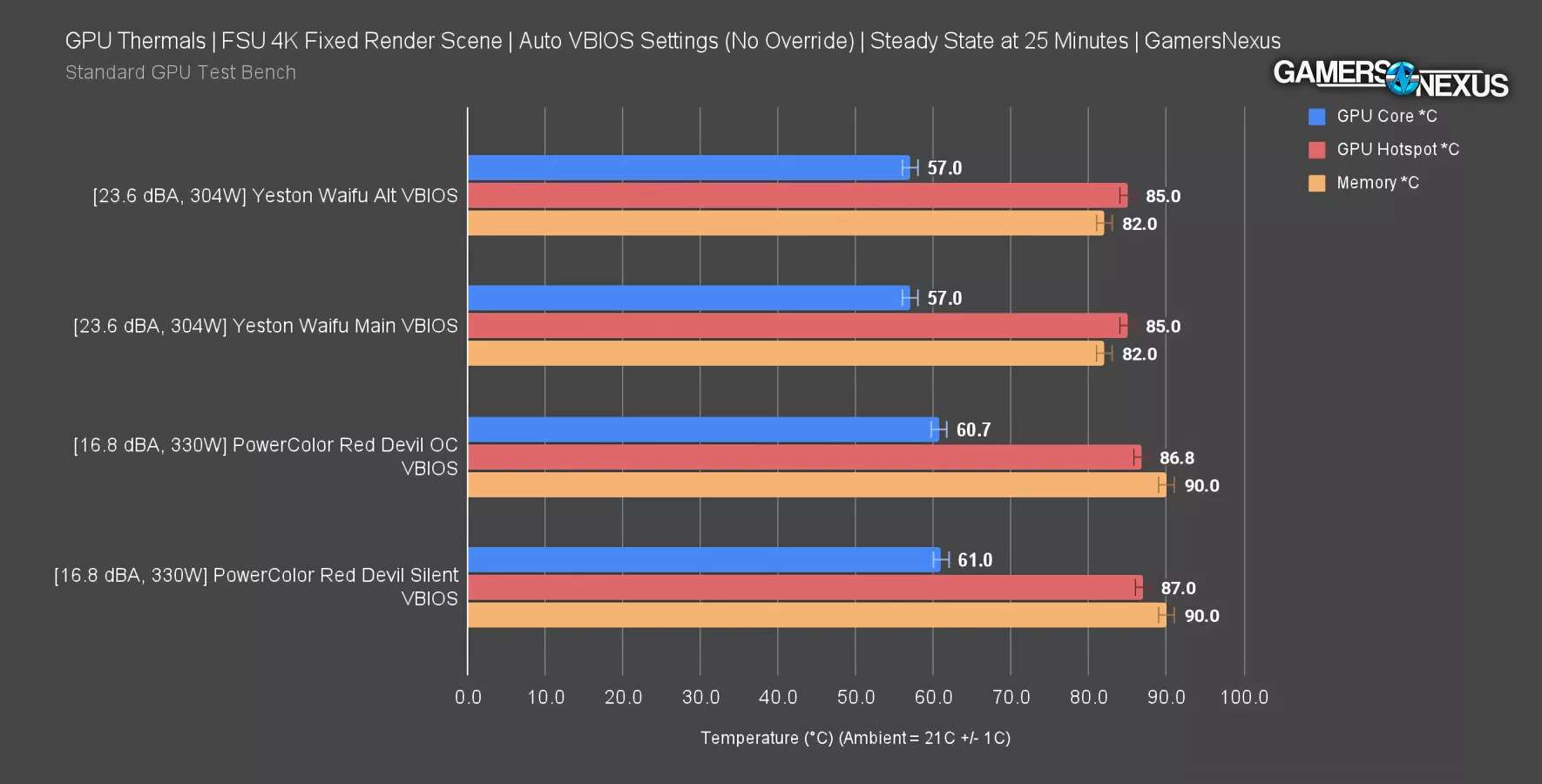
The Waifu begins out with a powerful displaying when set to observe the default VBIOS profile and temperature targets with auto fan controls. The Atlantis-dweller ran at 57 levels Celsius at regular state in a managed ambient setting for GPU core on each the principle and alternate VBIOS; the truth is, as we confirmed in our Yeston Waifu review, the VBIOSes seem to do the identical factor. It’s like they didn’t reprogram one of many fan curves or one thing, which can be a mistake.
However these temperatures are utterly acceptable. They’re maintained at 23.6 dBA and about 304W through GPU-Z board energy monitoring.
The PowerColor Crimson Satan runs hotter: Its default OC VBIOS held a 60.7-degree consequence, with the silent VBIOS additionally seemingly the identical. This has occurred for a number of generations now with each Yeston and PowerColor. Possibly as a result of the load hits regular state, they find yourself settling in the identical place as soon as underneath sustained load. We’re restarting between every VBIOS change and even examine the VBIOS profile title when switching to verify that it does toggle. This course of works to indicate variations in different units, however no less than right here, we’re seeing the identical throughout the profiles. That no less than retains it easy.
The Crimson Satan is operating about 3-4 levels hotter on the GPU and about 1-2 levels hotter on the hotspot, with reminiscence at a considerable climb of 8 levels hotter. There’s a deficiency in reminiscence cooling on the Crimson Satan by comparability, however a bonus within the hotspot-to-core delta, the place Yeston’s delta is bigger.
However there’s one different essential issue: Out of the field, the PowerColor card is pulling 30W extra through GPU-Z logging. This places them at extra equal thermal footing when contemplating the elevated energy consumption. The fan pace is one other big issue. In order that was out of the field thermal efficiency, however we will begin controlling these variables.
Thermals – 3DM 25 dBA
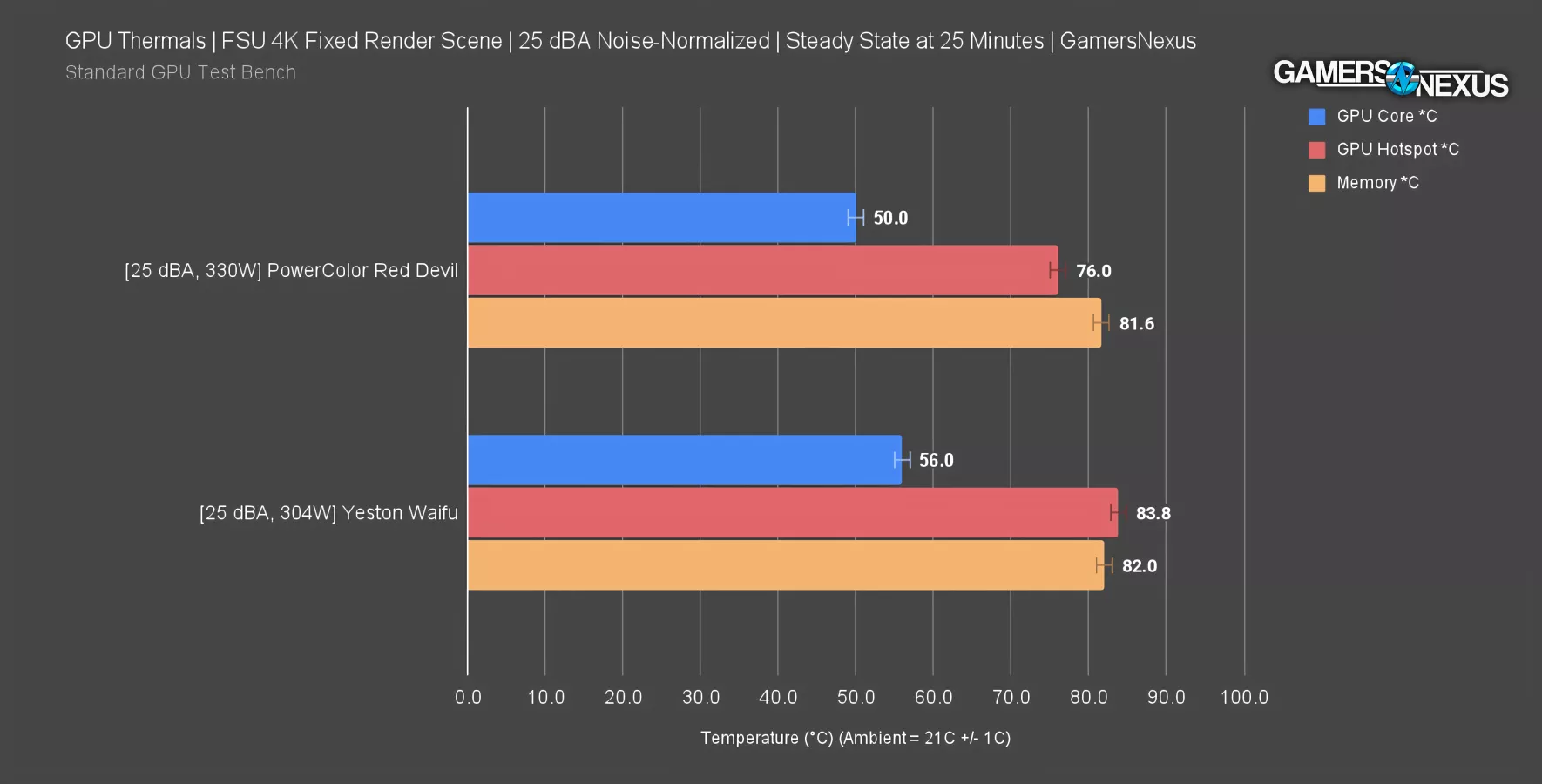
This take a look at normalizes the GPUs for noise ranges. We ran each at 25 dBA at 1-meter for this take a look at.
The regular state 3DMark workload has the Waifu now 6 levels hotter than the Crimson Satan in a searing blow to the Waifu, whose ocean and its scent-imbued plastic is evaporating earlier than our very eyes. Boosting the Crimson Satan’s fan speeds to match the noise ranges of the Waifu’s brings it down considerably, displaying that it’s the higher card in like-for-like acoustic testing. Even with its smoldering Hellstone, the Crimson Satan has a 76-degree hotspot and delta of 26 levels, improved from the Waifu’s 84-degree hotspot delta of 27.8-degree delta. This implies the waifu is hotter right here. Reminiscence thermals are functionally tied between them, displaying that PowerColor’s foremost space to enhance is VRAM thermals. All of those numbers are acceptable, although, with the GPU numbers simply straight-up good for each corporations.
Notably, PowerColor is attaining these outcomes with increased energy draw. It misplaced when auto attributable to poor fan configuration, however pulls forward when manually normalized.
Thermals – FurMark 25 dBA
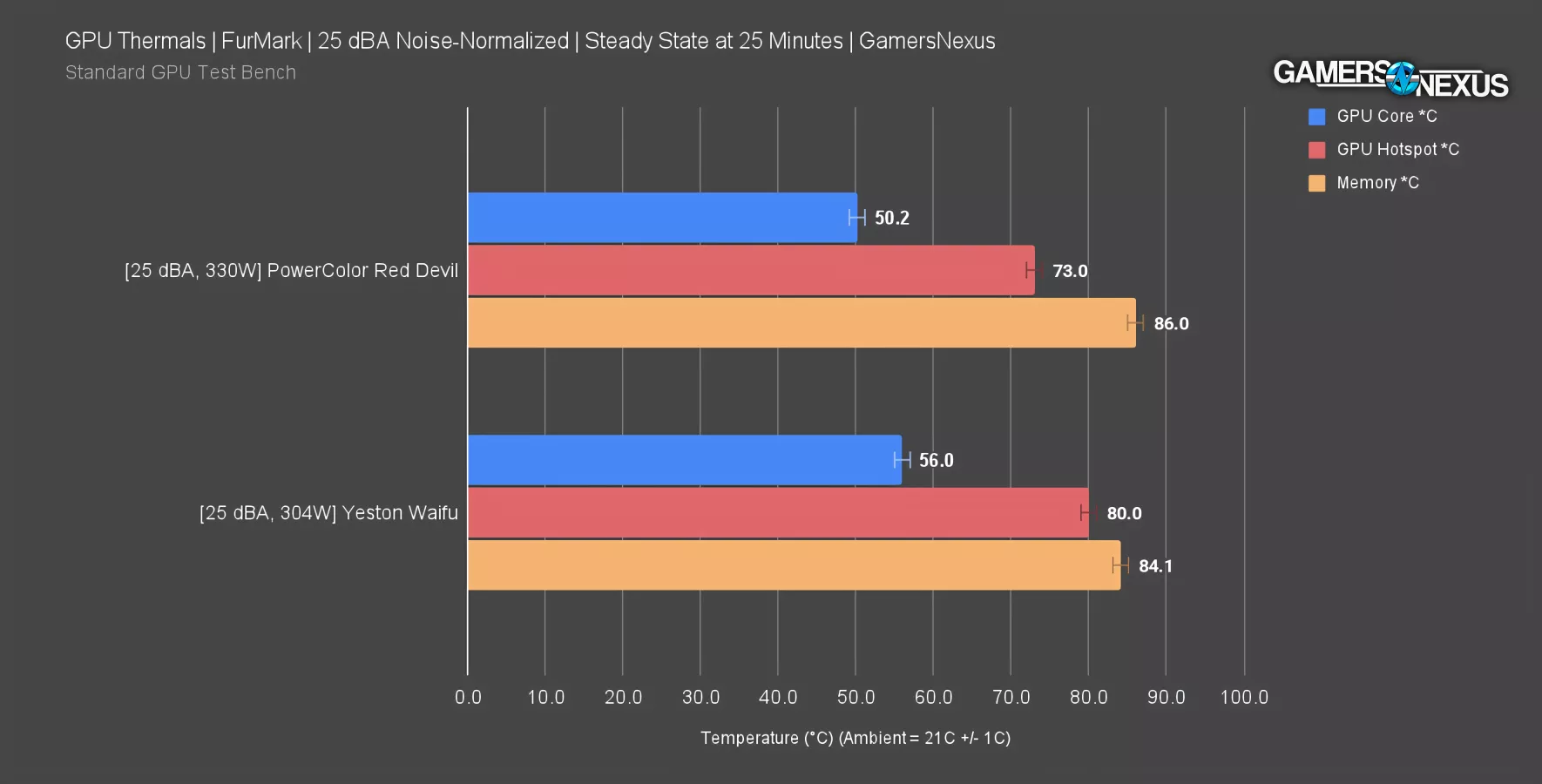
In FurMark at 25 dBA, which masses the GPUs extra closely on the VRM, the GPU temperatures ended up comparable between these with the reminiscence temperatures favoring the Waifu by about 2 levels decreased from the Crimson Satan.
Acoustics
However this doesn’t imply a lot with out acoustics.
Probably the most pure and first take a look at of a Satan towards a Waifu is the noise that they make in battle. For that reason, we threw these two GPUs into our battle area: The hemi-anechoic chamber.
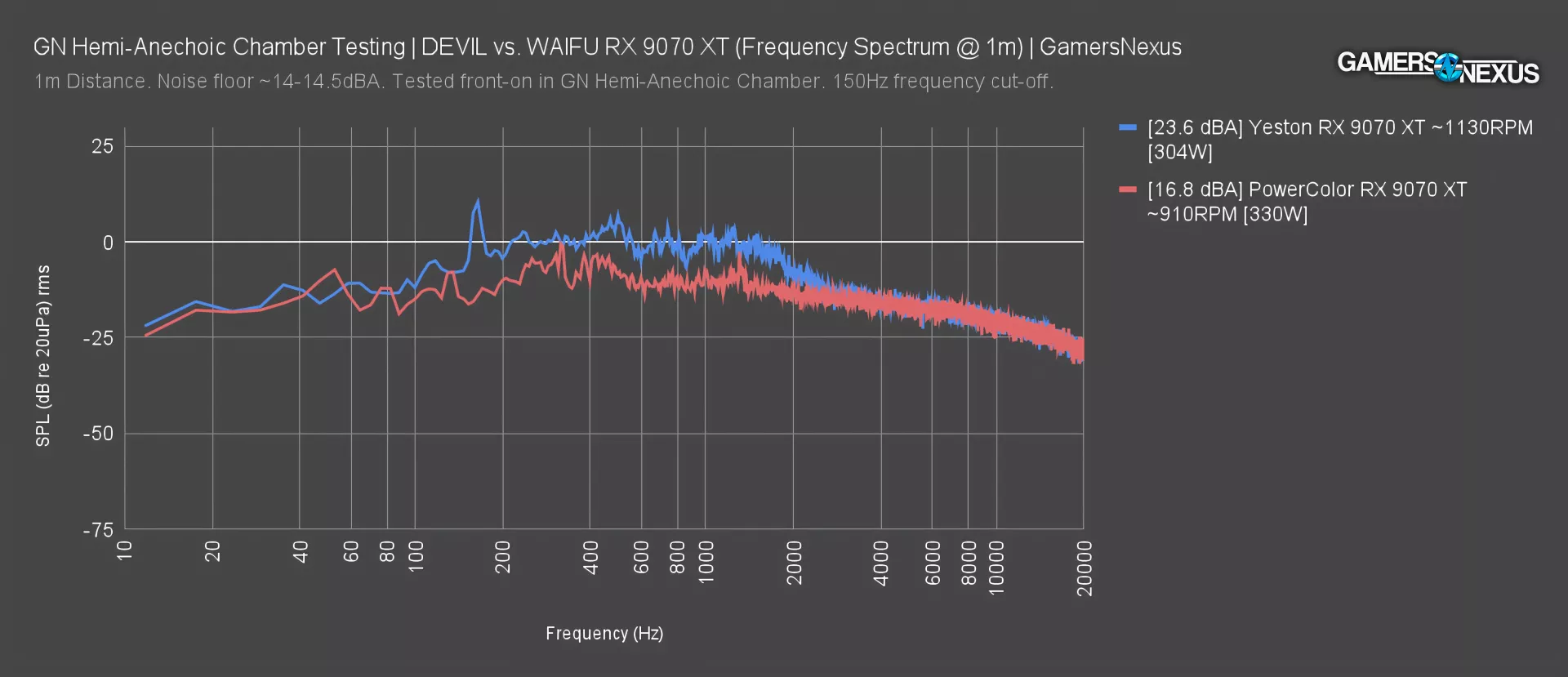
The Yeston RX 9070 XT Waifu version ran at 1,130 RPM when underneath default VBIOS management at 304W within the workload that we ran. The cardboard ran at 23.6 dBA at 1 meter when examined underneath the situations we used for thermal testing. The frequency spectrum evaluation has the very best spike round 164 Hz, with a swell round 500 Hz and a later bump and dip within the vary of 1,000 Hz to 1,400 Hz.
The PowerColor Crimson Satan ran at 16.8 dBA, which is de facto quiet for what we’d think about of hell. It’s too near our flooring to be all that helpful. The Satan is considerably quieter out of field, principally as a result of it simply isn’t using its followers in addition to we expect it ought to be — that’s why it ran hotter within the auto testing. We did some in-depth investigating and realized it’s as a result of the Hellstone converts the Crimson Satan’s offended howlings into the ability wanted to maintain its personal energy consumption, destroying the sound waves within the course of. Followers ran at 910 RPM relatively than 1,130 RPM, which implies it’s quiet, however we expect additionally not correctly utilized. PowerColor might discover extra of a steadiness right here, though perhaps they’re attempting to stay true to the fiery advertising and marketing.
The frequency spectrum has the Satan’s peak at round 320 Hz, with an elevated space round 420 Hz. General, it’s rather a lot quieter than the Waifu, with the high-end of the frequency scale related.
Acoustics – Noise-Normalized
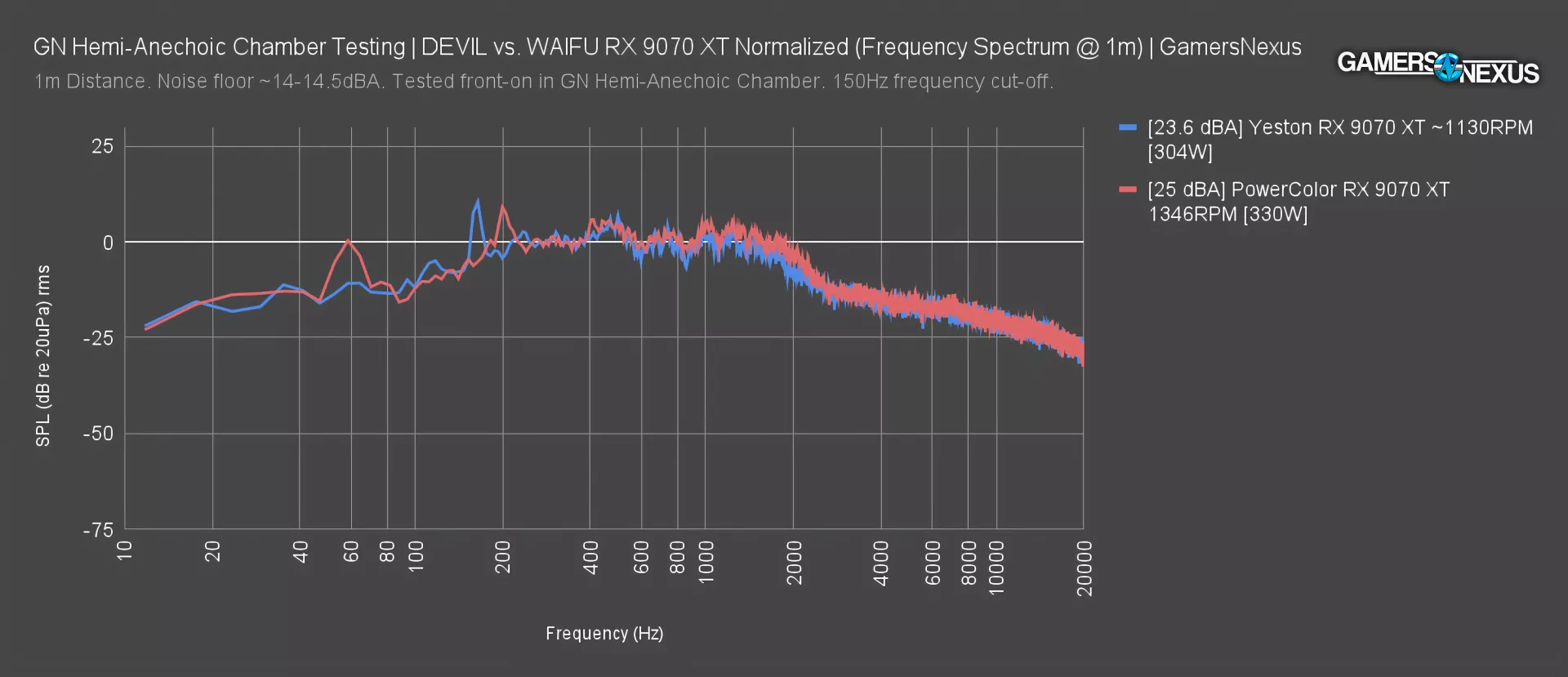
When normalized to roughly the identical noise ranges, leaving the Yeston card on the chart, the Crimson Satan’s new frequency spectrum has the Satan’s peak at about 200 Hz. There’s a slight wave up round 400-500 Hz and one other across the identical place because the Yeston card, at 900 Hz, then a dip, then up once more at round 1,200 Hz.
Frequency
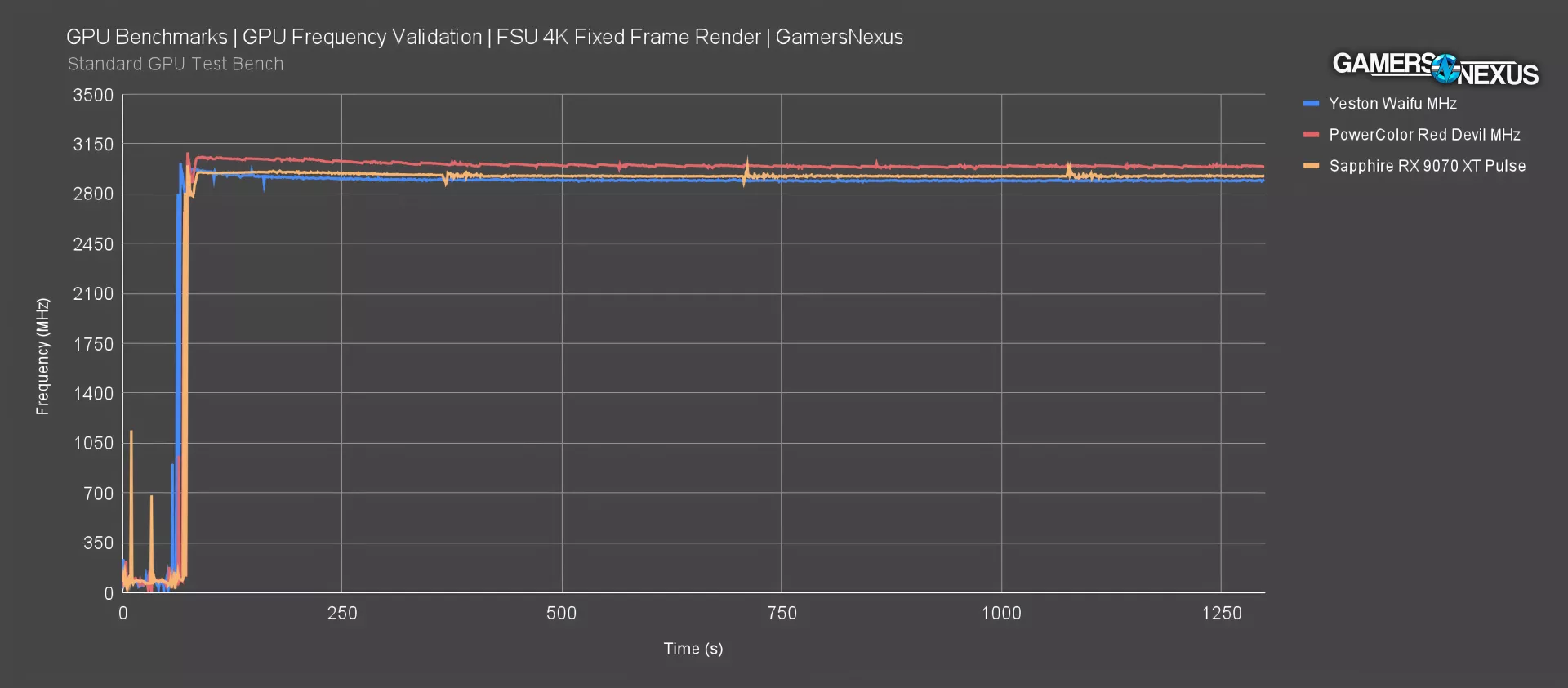
GPU frequency is the following take a look at on this battle of the memes. The Yeston GPU ran at about 2,890-2,910 MHz on this workload when operating a set body render. The Crimson Satan ran notably increased, up at 2,970-3,000 MHz as an alternative. That’s round a 60-100 MHz bump in most cases, so the additional energy goes someplace, and it’s sustaining that frequency.
Plotting the Sapphire Pulse as a body of reference, it holds about 2,900-2,925 MHz at regular state, placing it barely sooner than the Yeston card. The Waifu’s desired frequency simply occurs to be decrease than that of the Pulse and Crimson Satan.
Gaming Efficiency
We’ll do a fast take a look at gaming efficiency to see how a lot that additional frequency does or doesn’t matter. This will likely be a really slimmed-down model of our exams since we solely want a number of head-to-head outcomes. These had been examined on the identical drivers, so for functions of evaluating the 9070 XTs to one another, that’s all we’d like.
FFXIV – 4K
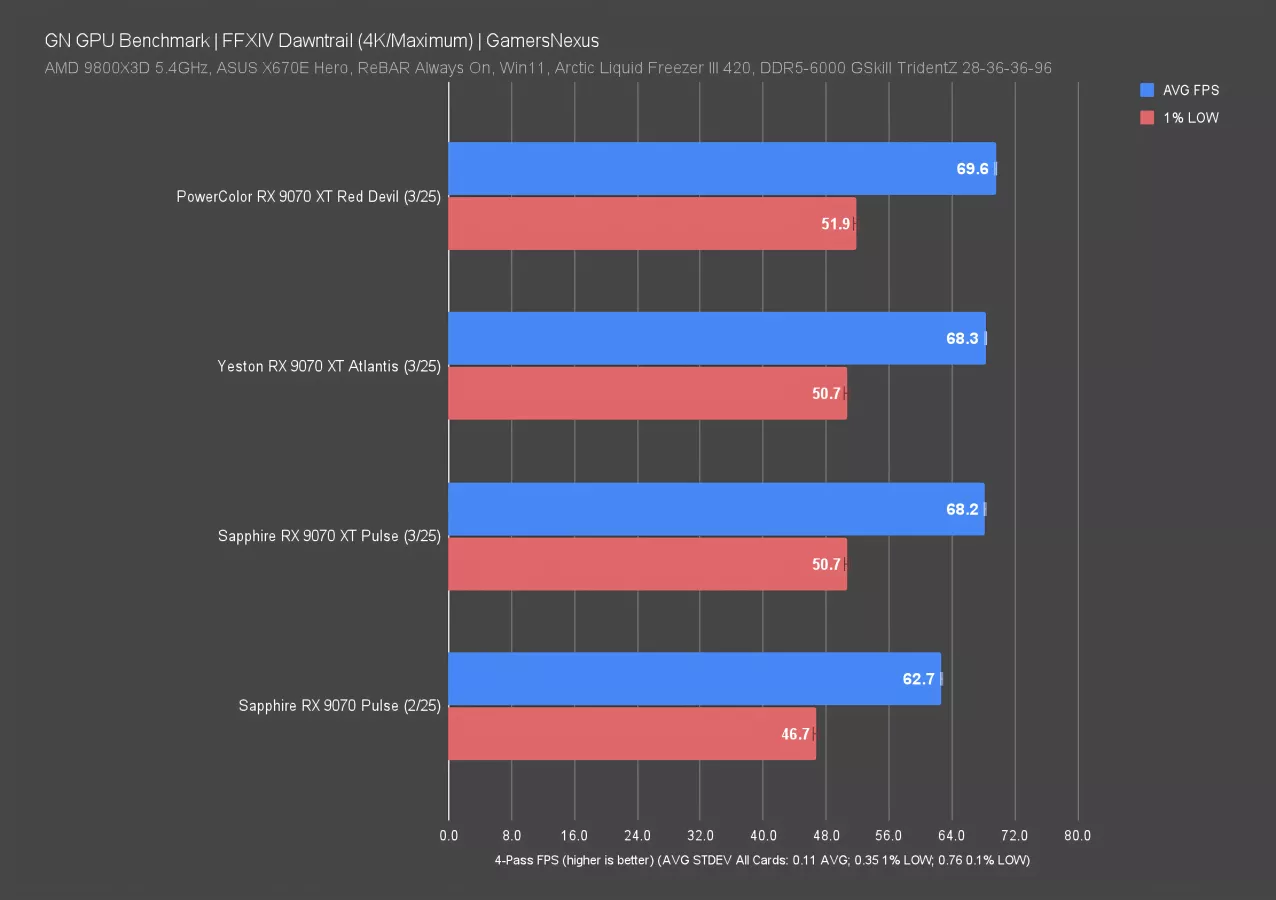
Remaining Fantasy is first. We selected this to start out as a result of the ratio of Waifu-to-non-Waifus in Remaining Fantasy is extraordinarily disproportionate, and so Yeston ought to have a pure benefit.
The Crimson Satan ran at 69.6 FPS AVG in Remaining Fantasy 14 Dawntrail at 4K, main the Yeston Atlantis Waifu card by simply over 1 FPS AVG. You’d by no means discover this, however on a technicality, the Crimson Satan is about 1.9% increased common framerate. The Pulse is about the identical because the Atlantis card.
Resident Evil 4 – 1440p
Naturally, as a result of we biased the Remaining Fantasy take a look at towards the Waifu by nature of the… waifus all around the sport, we needed to bias the following one towards the Crimson Satan. Resident Evil 4 is up now, giving PowerColor a definite and hellish benefit.
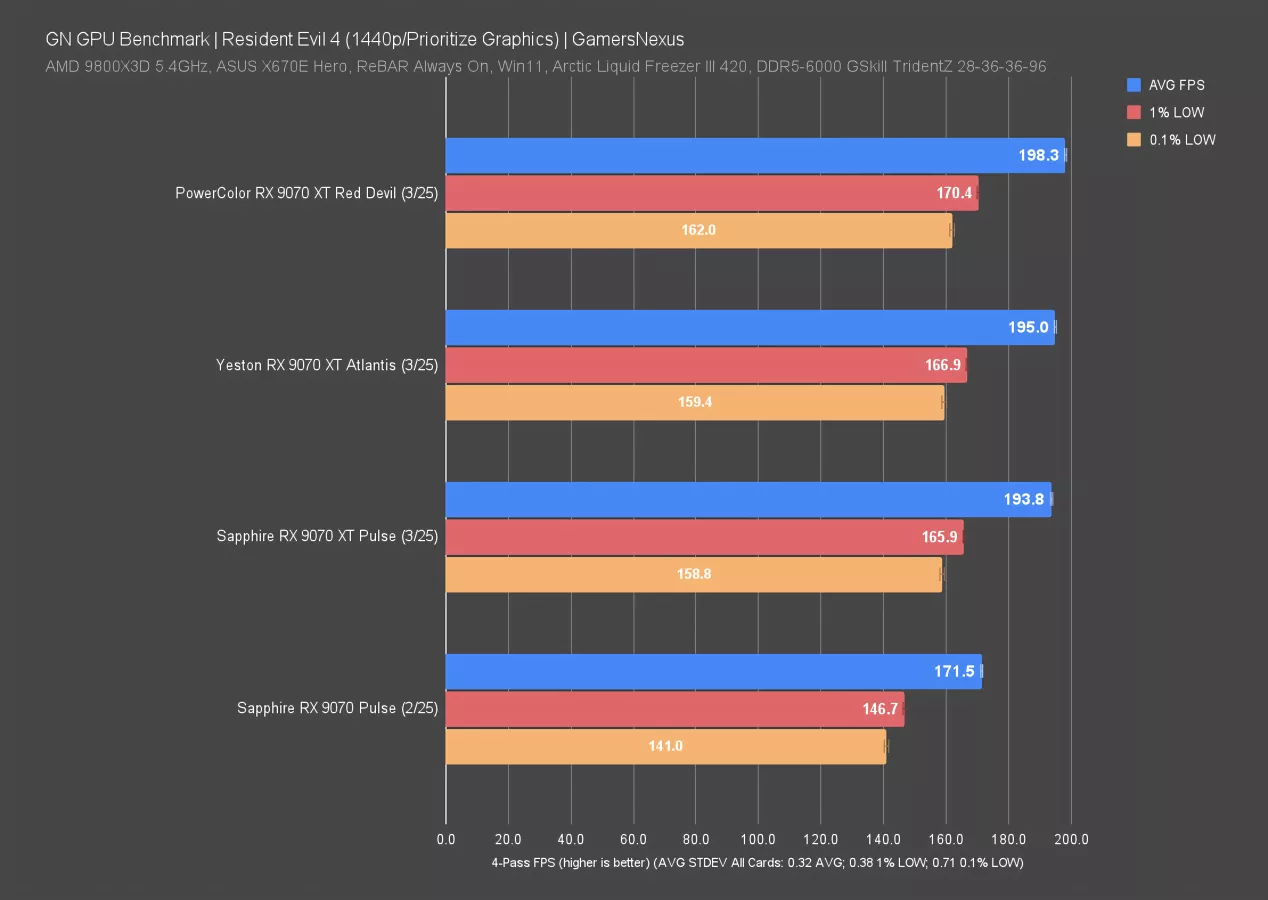
The RX 9070 XT Crimson Satan attracts upon the very evils which it’s rendering with its Hellstone to run at 198 FPS AVG, a few 3 FPS lead over the Waifu. That’s about 1.7% forward. The Waifu outruns the Pulse, although, and also you don’t should be the quickest while you’re operating from zombies — you simply must not be the slowest.
Resident Evil 4 – 4K
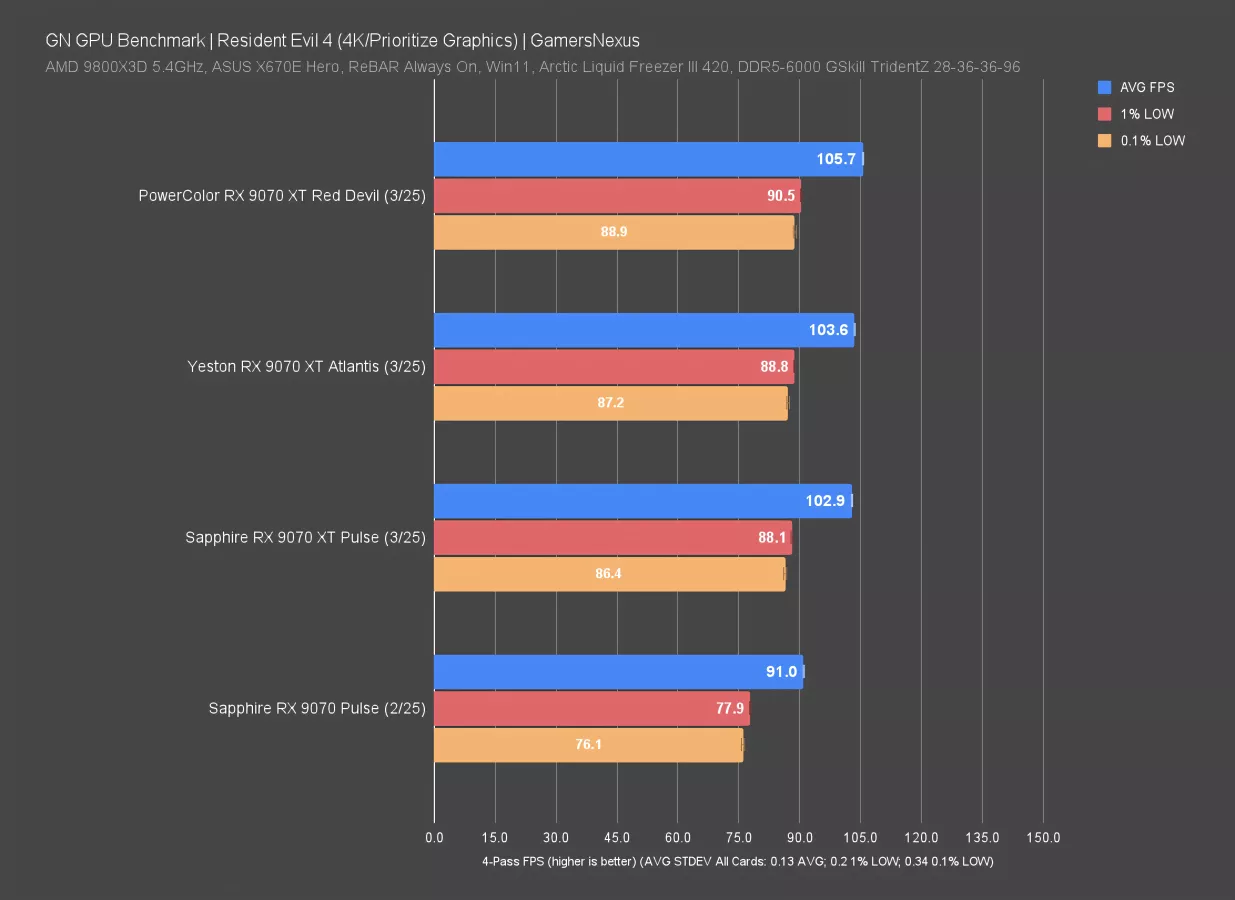
The one factor worse than zombies at 1440p is zombies at 4K, in order that’s what we’re rendering now. In Resident Evil 4 at 4K, the Crimson Satan held a 106 FPS AVG, main the Waifu by about 2 FPS AVG. That’s round 2%.
All of those numbers are anticipated. We did technically run 4 different video games, however all of them present the identical factor: Sometimes, we’re within the vary of 1-3% improved on the PowerColor card out of the field.
Conclusion

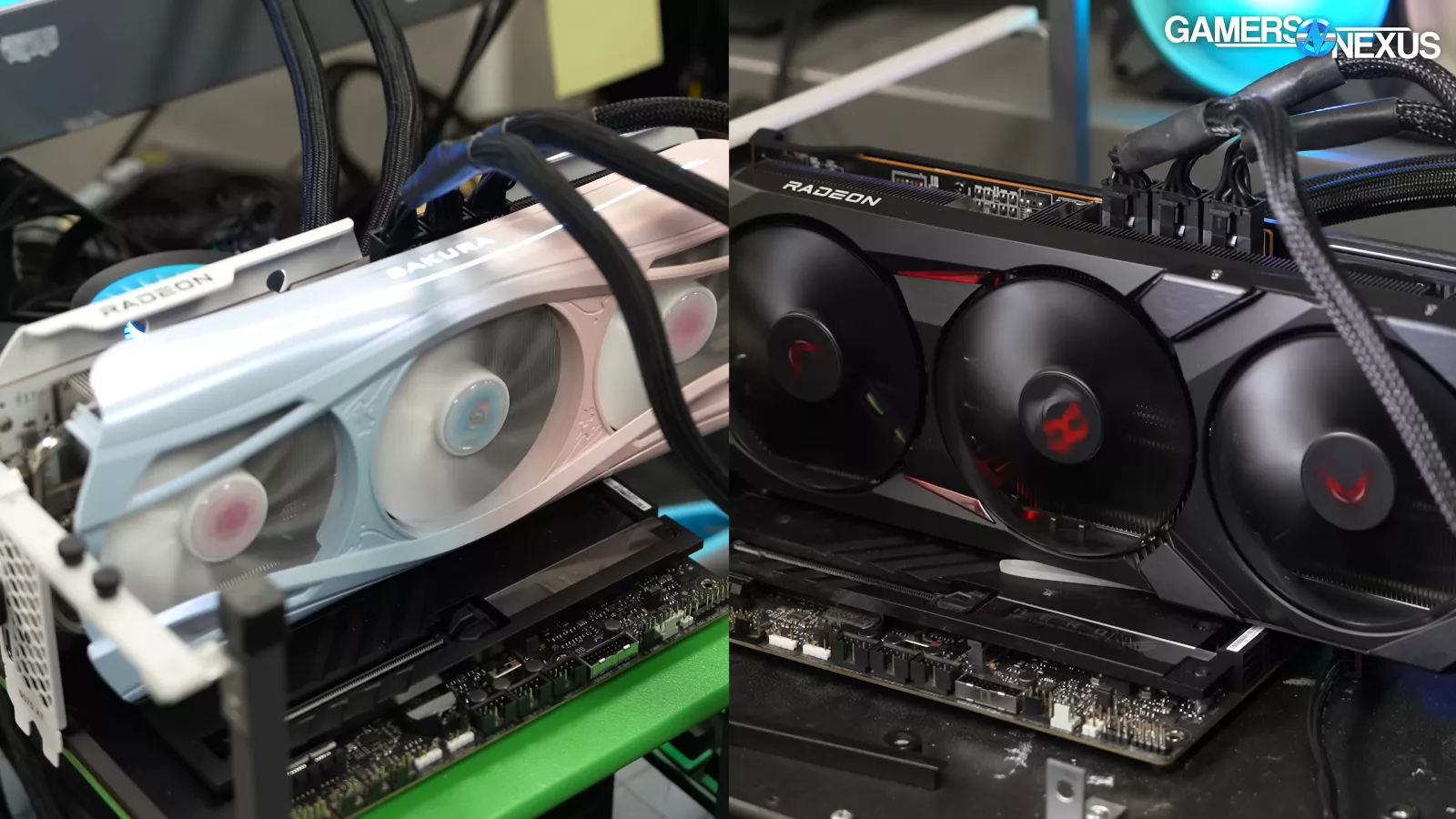
The value for each playing cards is identical, they usually’re each loopy. The excellent news is that as a result of each are $900, they’re simple to match.
We have now to provide each playing cards credit score. Neither are unhealthy. We’ve already reviewed the Yeston RX 9070 XT Sakura Sugar Atlantis OC Edition, through which we additionally tore down the cardboard. We had been pretty constructive on it. There have been issues it might have accomplished higher. For instance, it doesn’t have nearly as good of a thermal answer as we’ve seen on a few of their previous playing cards with this design method, but it surely was nonetheless advantageous in just about each metric.
For the Red Devil, the largest place that card is missing is in underutilizing the flexibility to tune its fan curves extra. That is one thing PowerColor appears to constantly have issues with within the playing cards we take a look at from them. The corporate might put it to use extra to raised steadiness the thermals and acoustics extra fairly.
General, although, each playing cards are fairly shut to one another. The Crimson Satan, in noise-normalized conditions, tends to be the higher cooler, however the Waifu card, out of the field, tends to be the higher cooler. It depends upon the way you’re going to run them. The Crimson Satan additionally has the next clock out of the field and it really runs sooner. Now, in gaming efficiency, this distinction doesn’t actually present itself in a giant approach.
We did mess around with overclocking on each playing cards. We obtained somewhat increased clocks out of the Crimson Satan. That card additionally has the next energy price range.
Each playing cards are too costly, nonetheless. At the very least each playing cards do one thing to try to justify their value.