
Get Ready for More Brain-Scanning Consumer Gadgets Leave a comment
The following gadget you place in your head might scan your mind. Neurable, a Boston-based firm that embeds its noninvasive brain-scanning know-how into {hardware} to watch an individual’s focus ranges, introduced on Tuesday that it’s transitioning to a licensing platform mannequin. By certifying third events, Neurable expects its tech to be in a “flood” of shopper devices this 12 months and subsequent.
Neurable has till now targeted its efforts on a pair of consumer-grade headphones—made in partnership with audio model Master & Dynamic. It additionally has a contract with the US Division of Protection to see how its know-how can monitor blast overpressure and doubtlessly assist diagnose gentle traumatic mind accidents in troopers. With the licensing mannequin, we might see extra of Neurable’s tech in on a regular basis head-based wearables.
The headphones use built-in electroencephalography (EEG) sensors to watch mind waves. That data is shipped to a companion app and lets wearers know once they want a “mind break,” nudging them to take a breather earlier than they really feel burnt out to maximise productiveness. The app additionally lets customers uncover their cognitive readiness for the day, their mind age, and different metrics, equivalent to psychological restoration, cognitive pressure, and nervousness resilience. WIRED workers author Emily Mullin examined the original headphones in 2024, although she discovered it tough to confirm the accuracy of Neurable’s algorithms.
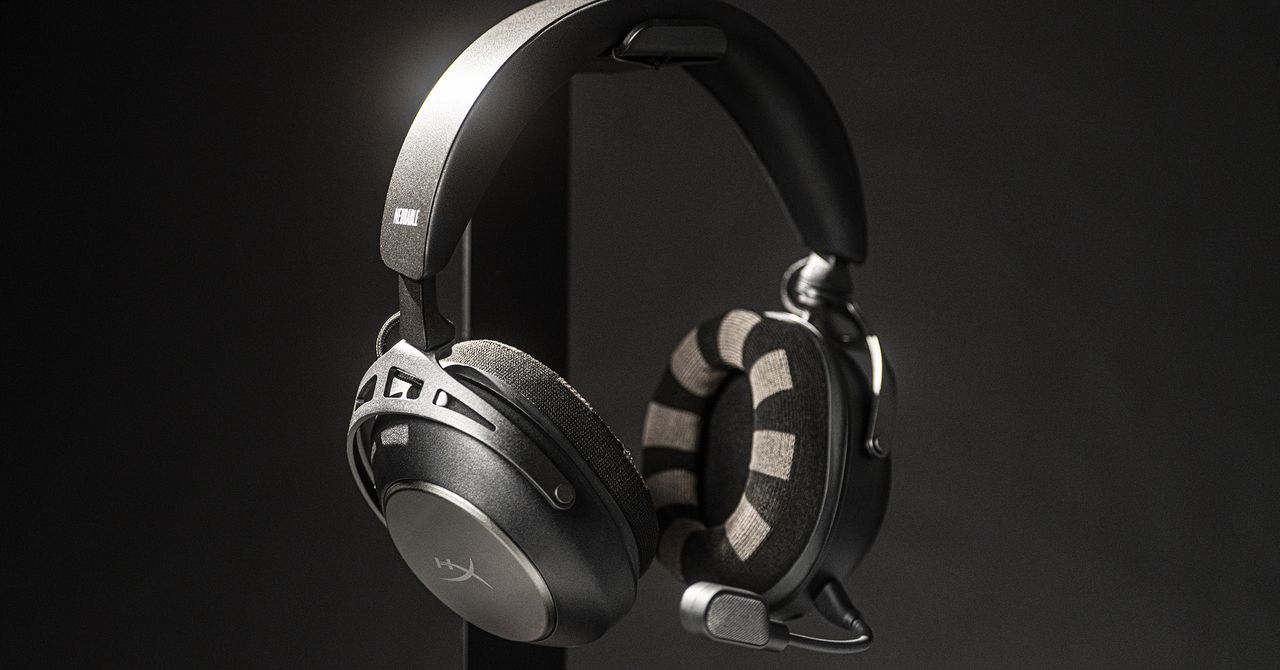
Now, HP-owned gaming model HyperX is releasing a gaming headset with Neurable’s know-how, and it is all about bettering human efficiency whereas esports gaming. The headphones are purported to assist wearers ease into the suitable mind-set for the very best efficiency. Ramses Alcaide, Neurable cofounder and CEO, tells WIRED that the corporate has revealed a white paper displaying improved efficiency amongst avid gamers utilizing Neurable’s tech, with lowered response occasions in first-person shooter video games and a small improve in accuracy.
The enhancements could sound minor, however milliseconds are valuable within the fast-paced world of esports gaming. And Alcaide says it might translate equally to different fields: It might assist a pupil scale back nervousness earlier than an examination, whereas athletes might situation their nerves forward of a race or sport. Neurable is hardware-agnostic; Alcaide says it may be embedded in headphones, good glasses, hats, or helmets. “There’s a complete panorama of know-how that touches your head that is but to be embedded with our platform,” he says.
He likens it to when Fitbit made the thought of a wrist-worn heart-rate tracker widespread. At first, nobody knew how health wearables could be acquired, however now nobody blinks a watch at one on a wrist. Quickly, nobody will suppose twice about brain-scanning tech in headphones—or, at the very least, that is the thought. Neurable’s tech is “invisible” in these kinds of devices.
Corporations licensing Neurable’s tech can combine it into present {hardware}, Alcaide says, and can management your entire expertise from product design to the software program expertise; these merchandise will likely be marketed as “Powered by Neurable AI.” The person information nonetheless flows to Neurable’s servers for processing, however Neurable units the information privateness protections. Person identifiers are separated from the information, and whereas associate firms host the user-facing layer, Neurable says it retains management of the underlying system and information dealing with. Neurable has previously said its enterprise mannequin is to not promote person information.
“Any time there’s a brand new transition to know-how, there’s all the time going to be some nervousness,” Alcaide says. “We’ve been very cautious with regards to that transition. We’re defending the information, being as moral as attainable.”
Neurable is considered one of many brain-computer interface (BCI) companies within the rising class. Elemind makes use of EEGs to enhance sleep high quality, and Sabi wants to turn thoughts into text. Even Apple filed a patent for EEG-sensing AirPods, although they are not but accessible.