
Fractal’s Excellent Era 2 Case: Review, Thermal Benchmarks, Cable Management, & Quality Leave a comment
We made one other 3D airflow animation to assist clarify the configuration that Fractal created the place the facility provide fan is preventing the consumption followers. We’ll discuss this down beneath.
So, it’s mechanically complicated and prices $200. We’ll go over construct high quality and thermal efficiency on this assessment.
Fractal Period 2 Overview and Competitors
Let’s go over the fundamentals and competitors first.
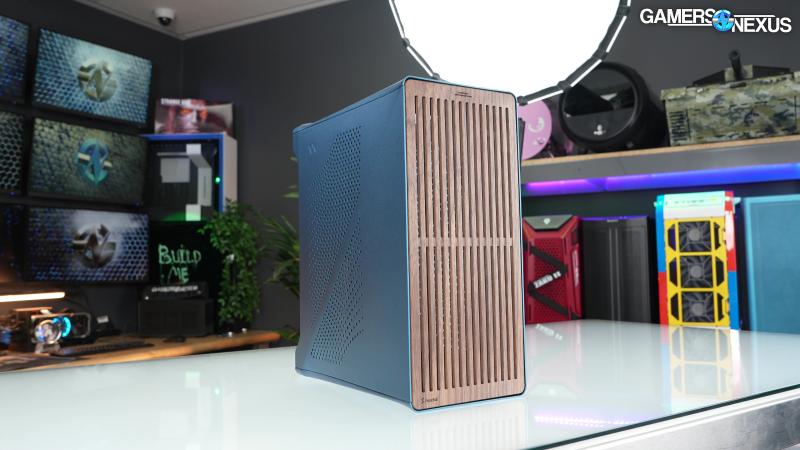
The Era 2 is available in blue, black, or silver and is a sandwich-style ITX case. The case has two pre-installed followers within the backside for consumption, room for a 240mm or 280mm liquid cooler within the prime, and a unbroken development of upper price ITX circumstances. An excellent portion of that price might be tied-up within the stylized aluminum shell and slotted walnut wooden prime panel.
The facet panels have air flow through a gap sample that ranges from sparse to ineffective, mixing an artsy strategy with at the very least attempting to hit the fundamentals of cooling. These holes are a great indicator that Fractal is looks-first on this case. We’ll discuss thermals later within the assessment.
The original Era Il ITX predecessor is a smaller case with an analogous look, but additionally one which Fractal has brazenly informed reviewers it felt it had underperformed on. The corporate is attempting to repair its shortcomings with the Period 2.


Internally, the Period 2 has so much in widespread with the $180 Fractal Terra. The motherboard, GPU, and PSU are in the identical fundamental format on a moveable backbone, however the energy provide is rotated 180 levels within the Period 2. This leads to the cables dealing with up – good for ease of entry – and the PSU exhaust dealing with down, which is awkward from an airflow standpoint.
Apart from its personal Terra, competitors to Fractal’s Period 2 would come with these circumstances:
The $150 Lian Li DAN A4-H2O, which is smaller, extra rectangular, has no additional followers, and nonetheless helps a 240mm liquid cooler. A a lot bigger and cheaper comparability can be the A3-mATX we recently reviewed, however they exist in completely completely different market segments. We did like that case, although. We additionally not too long ago reviewed Fractal’s Mood, however would not recommend the case; its thermal efficiency was general poor and a few of its compatibility selections have been odd. The M1EVO (watch our review) is one other comparatively costly, specialised ITX case you can have a look at.
Fractal Period 2 Dimensions and Fitment

Moving into the size and compatibility: The Period 2 is 365mm lengthy, 165mm large, and 315mm tall, which calculates to a 19L quantity and is almost spot-on with Fractal’s personal measurements.
When you’re maintaining monitor of our ITX critiques at residence, add another to the tally for “not mendacity on the spec sheet.” That’s not as widespread a tally accurately.

The movable backbone has a significant impression on inside fitment and could be set to 3 predetermined, stepped positions. It is a huge distinction from the stepless nature of the Terra’s backbone adjustment.


Place 1 provides probably the most CPU-side clearance and suits as much as 70mm tall coolers whereas lowering GPU-side clearance to 48mm (or simply 2.4 slots) of accessible thickness. Place 3 adjustments these values to 55mm for the CPU facet and 63mm (3.1 slots) for the GPU.

Most GPU peak is 137mm no matter backbone place, however you’ll need to concentrate on the cable bend additionally. Fractal recommends a max GPU backplate thickness of 4mm. Keep in mind that bigger GPUs will limit air motion inside that facet of the case and energy cable administration can turn into problematic with bigger playing cards. As at all times, simply because it suits doesn’t imply it’s a good match.
As one other level of reference, the RTX 4080 FE suits, however may have its flow-through cooler closely restricted as a consequence of having solely 11mm of clearance behind the cardboard in backbone place 3. So we’re again to “it type of suits” however isn’t essentially a sensible choice.

For cooling: The highest bracket can maintain 280mm radiator and fan combos as much as 52mm thick. 240mm liquid coolers could be barely thicker relying on actual placement, however will rapidly encroach on energy cables and their very own tubes.

Each SFX and SFX-L PSUs are supported. House for cables is drastically hampered by SFX-L, so we’d favor normal SFX.

Inner drive assist is fairly good for the scale. There are 4x 2.5” mounts in whole – two within the rail-mount drive cage (blocking a big portion of the consumption fan beneath it) and two on the backbone behind the PSU, although are solely usable with the backbone in positions 1 and a pair of, and can be detrimental to flow-through GPUs. 3.5” drives usually are not natively supported within the case.
The Construct – Positives
Time to run by way of positives and negatives. We’ll begin with positives.


There are numerous issues the Period 2 does proper, and the construct course of was comparatively easy for ITX requirements. The highest radiator mount was a significant assist, as was the PSU orientation with the interior terminals dealing with up. Accessibility general is superb, which is a significant component in ITX circumstances.
The GPU facet of the case is actually large open, and a cutout on the entrance helps with set up of the longest supported GPUs. You’re capable of angle the far finish of the cardboard into the outlet first, then transfer the PCIe slot facet into place.

Cable administration can also be glorious general and is without doubt one of the most troublesome issues for an ITX case to accommodate efficiently. There are tie-down factors and small channels for cables all over the place – like round and in between the underside followers. Even in probably the most GPU-biased backbone place (3), you find yourself with simply sufficient house across the fringe of the motherboard to get the job executed tidily for cable administration. The guide can also be well-made and presents truly useful cable administration ideas.
Fractal’s consideration to element within the design of the Period 2 is general nice, because it was capable of make an objectively complicated case stay simple to make use of by way of considerate engineering.
There’s numerous different small options that we thought have been effectively executed. To rapidly undergo them:
- Tapered plastic rails on the entrance and rear be certain that sliding the shell on/off is clean
- A slight inward angle alongside the underside inside edges to assist preserve cables tucked in
- Flared main edges on the rail interface for the drive cage and PSU bracket are effectively executed
- The opening on the entrance of the interior chassis to help with lengthy GPU set up is rounded over to be utterly clean
- A small strip of cloth glued to the highest fringe of the entrance I/O to maintain the aluminum from rubbing
- The mud filter doubles because the lock mechanism, inflicting two spring-loaded plastic lugs on the entrance to pivot into place
- A bowed-down filter on the backside to match the bowing of the underside of the case, which Fractal claims provides higher entry to air
The Construct – Negatives
Shifting on to the negatives, one of many solely troublesome facets concerning the construct was entry to the motherboard’s prime edge. Because it’s inverted within the Period 2, it finally ends up down on the backside. You could wish to pre-connect cables there earlier than set up or get snug with utilizing a plastic spudger to poke them on after the actual fact.

The wooden prime panel on our pattern is cracked in a single place between the sting and the inside slats. We don’t know at what stage the wooden cracked — probably on the manufacturing facility or possibly in storage and delivery because it crossed climates, humidity, and temperature gradients. Both manner, wooden is a comparatively delicate materials, and this makes us involved concerning the sturdiness of the half, regardless of the steps Fractal took to bolster it. Fractal emphasised in its early conferences that it was reinforcing this panel with steel to stop cracking in a manner that appeared like pictures taken at competitors, however now we marvel if it was truly due to their very own experiences. Utilizing two separate items of wooden may need prevented this, regardless of making a seam. This isn’t extraordinarily noticeable, however it’s disappointing.

By urgent the edges collectively, we see the crack match completely again into place. This makes us assume that Fractal could also be higher off with 2 crossbars moderately than one, because it looks as if the wooden curing and getting old might have pulled aside horizontally. One other crossbar to carry the edges uniform to one another may assist.

Additionally within the realm of construct high quality, one of many facet panels on our pattern is Tesla-like, in that it doesn’t line up completely with the panels round it, leading to a visual bounce from one to the opposite. These are each QC points on the core, and are issues Fractal ought to undoubtedly look out for on a $200 case.


A closing minor annoyance is the truth that the shell has a crossbar on the backside of the rear I/O space, that means that you must take away all the cables earlier than you may slide the shell on or off. Fractal might have constructed this in a manner the place it’d be simpler to get into the case for upkeep with out that bar, although this can be a sacrifice for rigidity.
Fractal Period 2 Airflow
For the potential airflow draw back, we flip to our animation.
As we talked about earlier than, the PSU’s exhaust facet faces the consumption fan. The case orients the facility provide for the simplest cable administration at the price of potential airflow battle between the PSU’s exhaust and the underside consumption. Most fashionable energy provides cease spinning the followers when load isn’t adequate, so at idle, this could truly work fairly effectively. It’ll pressure air “backwards” into the facility provide, permitting it to move previous the PSU’s passive fan and out the standard “backside” of the facility provide. That air will then exit by way of the perforations within the facet of the chassis. That a lot is nice. When the facility provide fan turns into lively, it’ll abruptly instantly combat the force-fed air from backside consumption, and it’s probably that backside consumption will overpower the facility provide fan. There’s sufficient of a niche the place it gained’t trigger main issues, versus a instantly connected opposing fan, however this might nonetheless be sub-optimal for some energy provides. It’s going to be extremely PSU-dependent. It’s not one thing we predict is a crucial challenge, however it’s one which was a bit odd.
Fractal Period 2 Thermals

Now we’ll check out the thermal efficiency of the Period 2. As a reminder for anybody new to our ITX critiques, our present ITX testing methodology prohibits aggressive comparisons between circumstances, however permits us to be rather more versatile relating to testing a single case towards itself in a number of configurations.
For the Period 2, all testing was carried out with locked frequency and energy on the 13600K, locked fan velocity on the 4070 FE, and 100% fan and pump speeds on the 240mm CLC and case followers. We handled backbone place 1 because the default, because it’s the meant setup for this measurement GPU.
CPU Thermals

Beginning with CPU thermals, all the examined configurations resulted in a slender band of solely 2.1C. The inventory end result has a slight lead with the P-cores at regular state common at roughly 45C over ambient.
Eradicating the highest panel didn’t end in any significant thermal change, exhibiting us that regardless of appearances, it isn’t truly restrictive to move, at the very least not on this configuration.

Setting the backbone to place 3 hurts CPU thermals barely, however not considerably. We have been curious if the holes on the facet panels truly did something, so we lined them with tape. The reply for CPU thermals is “no,” because it’s tied with the place 3 end result.

The most important impression was from populating and putting in the decrease drive cage, leading to 46.8 levels over ambient on the P-cores. You probably have only a single SATA SSD, we suggest mounting it to the forward-most backbone mount behind the PSU to keep away from this blockage.
Typically talking, the 2 units of followers at full velocity are considerably brute-forcing the scenario, however the noise ranges aren’t truly that top or disagreeable as a result of followers’ middling 2000RPM most.
GPU Thermals

GPU thermals are subsequent and submit a wider vary. Outcomes are additionally constant right here and effectively inside regular working ranges. The inventory outcomes have the GPU die at 50C over ambient at regular state, with roughly 68C hotspot and 43C on the VRAM. Eradicating the highest once more has no considerable impact.
The backbone place 3 end result isn’t meaningfully exterior of variance, however means that maintaining the GPU’s consumption followers nearer to the facet panel is useful.
Putting in the drive cage raises core temperature of the core by about 2C, however may very well be additional exaggerated by bigger GPUs that want all of the airflow assist they will get.
Blocking the facet air flow and shifting the backbone to place 3 to permit the GPU greatest entry to inside air exhibits us that the holes do truly assist, because the temperature did climb.
VRM + RAM Thermals

For VRM and RAM temperatures, we see precise scaling between configurations. The whole lot is saved in verify by the fan blasting air instantly on the prime fringe of the motherboard.
The inventory place 1 result’s one of the best at simply 20C over ambient, and shifting the backbone to place 3 provides the worst end result. This is smart contemplating the proportion of consumption air is lowered on the CPU facet of the case when shifting from 1 to three. Apparently, blocking the facet panel truly lowered VRM temperature by a few levels. We suspect it is because taking away these exit routes forces the consumption air in that area to move solely over the motherboard.
Fractal Period 2 Conclusion
The Fractal Era 2 has an important mixture of options, ease of use, and efficiency. The one largest draw back is the value. $200+ isn’t unusual for high-end, boutique ITX, however it’s fairly steep for the mass market. A number of that cash might be within the materials selections of walnut and reasonably thick aluminum, however it’s additionally simply the ITX world.
ATX circumstances at this worth could be actually spectacular too, inherently have extra flexibility, and so they price extra to ship. As at all times, ITX is all about wanting the shape issue.

When it comes to development, we predict the Era 2 shows a mastery of stamped metal as a medium. There are quite a few options and nice element touches all around the stamped components that point out use of complicated, multi-step tooling, and nothing is left sharp. Fractal is reaching a powerful degree of tooling engineering maturity.
The outside aluminum shell and walnut prime panel come off because the weakest components on this regard, with our pattern having each a crack within the wooden and a misaligned facet panel. This exhibits potential execution points regardless of sturdy fundamentals.
Talking of the shell, Fractal might use this as a possibility to make visually and functionally distinct variations of the case by simply making new exteriors. That opens up the avenue to do extra colorways or seasonal colours going ahead.
We have been most impressed by the mechanical options and good implementation of them:
- The highest radiator mount is executed effectively
- The locking motion on the mud filter is intelligent
- The rail system with a single screw for PSU and SSD brackets additionally labored effectively
- And the movable backbone to fine-tune half fitment is bettering with iterations
Thermals are good throughout, regardless of unusual PSU orientation.
The Period 2 sits on the reverse finish of the spectrum from how tedious and clunky the NCASE M1EVO is. The one factor going for the M1EVO on this comparability is its excessive versatility and talent to suit even the most important of GPUs, making it nonetheless a extra versatile and customizable answer, however one which we predict is much less refined. The flexibility has advantages, however they’re for a distinct type of construct.

For the cash, we predict the Period 2 makes the $180 Terra (learn our review) look much less interesting on paper, because the $20 will get you two followers and far expanded functionality in cooling and drive mounts. That stated, the Terra is smaller and has a singular look and its personal mechanical complexities that may simply be extra to some individuals’s liking. They’re completely different sufficient, particularly in measurement, that anybody who needs a Terra particularly might discover the Period 2 non-viable. However in the event you assume both might work and also you’re on the fence, we’d favor the Period 2, at this level.
Those that need related functionality for much less cash ought to have a look at the A4-H2O, however must be conscious that it’s tougher to construct in as a consequence of its lowered measurement.
The A3-mATX can also be a superb case (learn our review) for comparatively low-cost (by fashionable requirements). It’s a completely completely different fashion and never instantly comparable, however you need to be conscious of it in the event you’re OK with a bigger measurement and less complicated case.
Total, we predict the Period 2 is well-executed.