
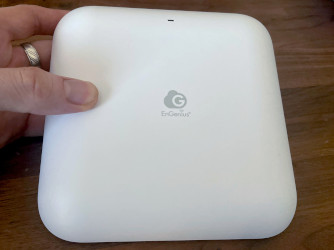
EnGenius ECW520 Cloud7 2x2x2 Test and Review – MBReviews Leave a comment
The EnGenius ECW520 is without doubt one of the most inexpensive WiFi 7 entry factors that the corporate at present provides and its purpose was to supply enterprise-level options, whereas holding the worth tag beneath $200. And that’s completely positive, however we do have the 2x2x2 ECW526 out there as effectively and not too long ago, EnGenius has additionally launched the affordable Cloud Lite ECW516L, so the place does the ECW520 place available in the market?
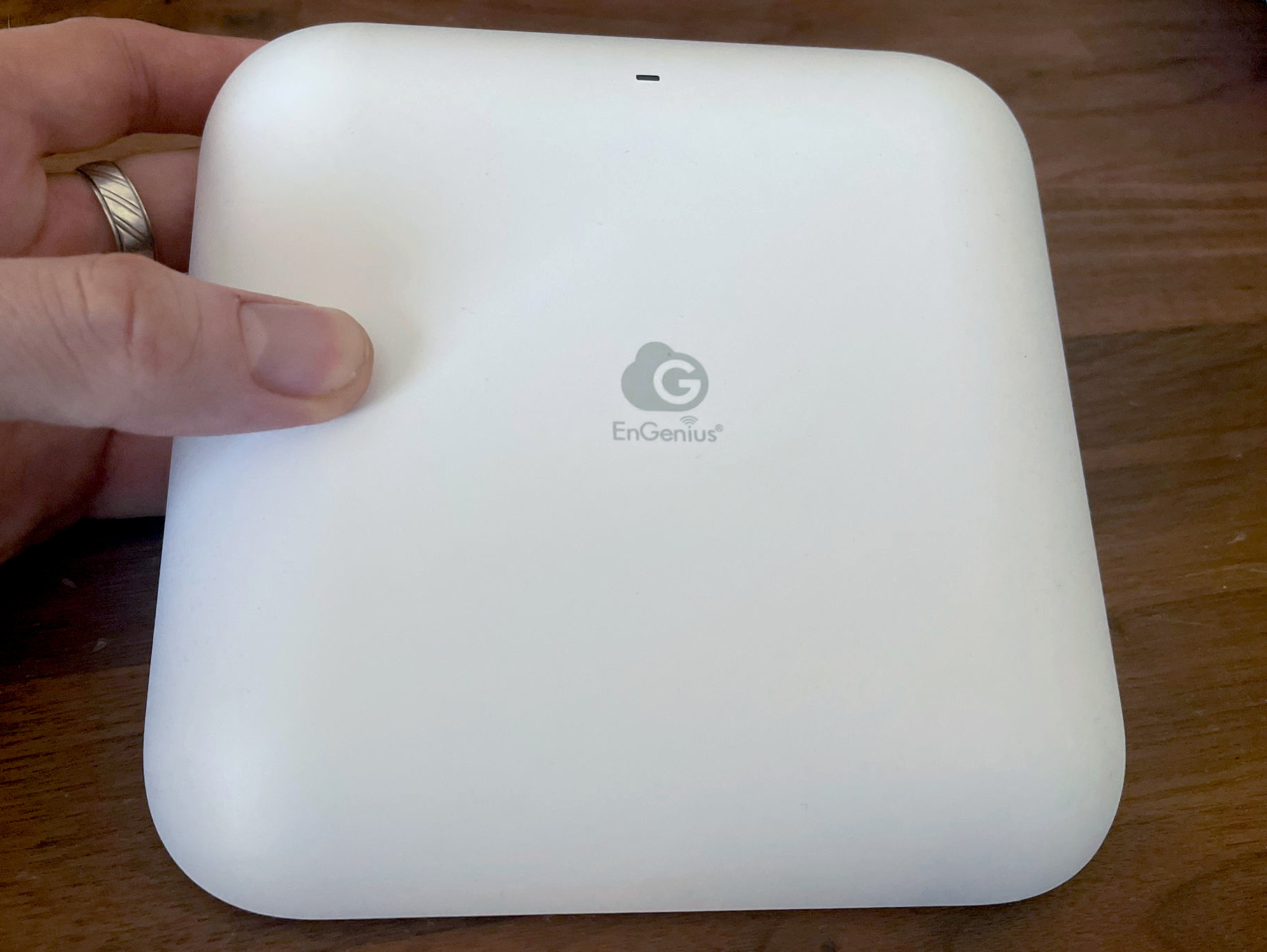
The Cloud Lite entry factors are clearly extra restricted each in {hardware} talents and by way of software program help, however the ECW520 and the ECW526 are extremely related. Each depend on the Qualcomm platform, the antenna acquire is comparable, with the previous truly being a bit higher on the two.4GHz radio, however there’s a main distinction by way of port. The ECW526 comes with a 10GbE PoE+ port, whereas the newer ECW520 is supplied with a 2.5GbE PoE+ port.
The three radios (together with the 6GHz) are provided on each entry factors and so are a lot of the newer WiFi7 options, so there’s fairly a little bit of overlapping between these two gadgets. Then once more, there could also be extra elementary variations which might be lower than skin-deep, so let’s take a better take a look at the ECW520 and see the way it carry out in relation to its primary opponents.
The Design and Construct High quality
By way of design, the EnGenius ECW520 is nearer to the ECW130, than the newer, slimmer fashions. Certain, it’s a bit thick, however it’s additionally far smaller, standing at 15.8 x 15.8 x 3.5cm.
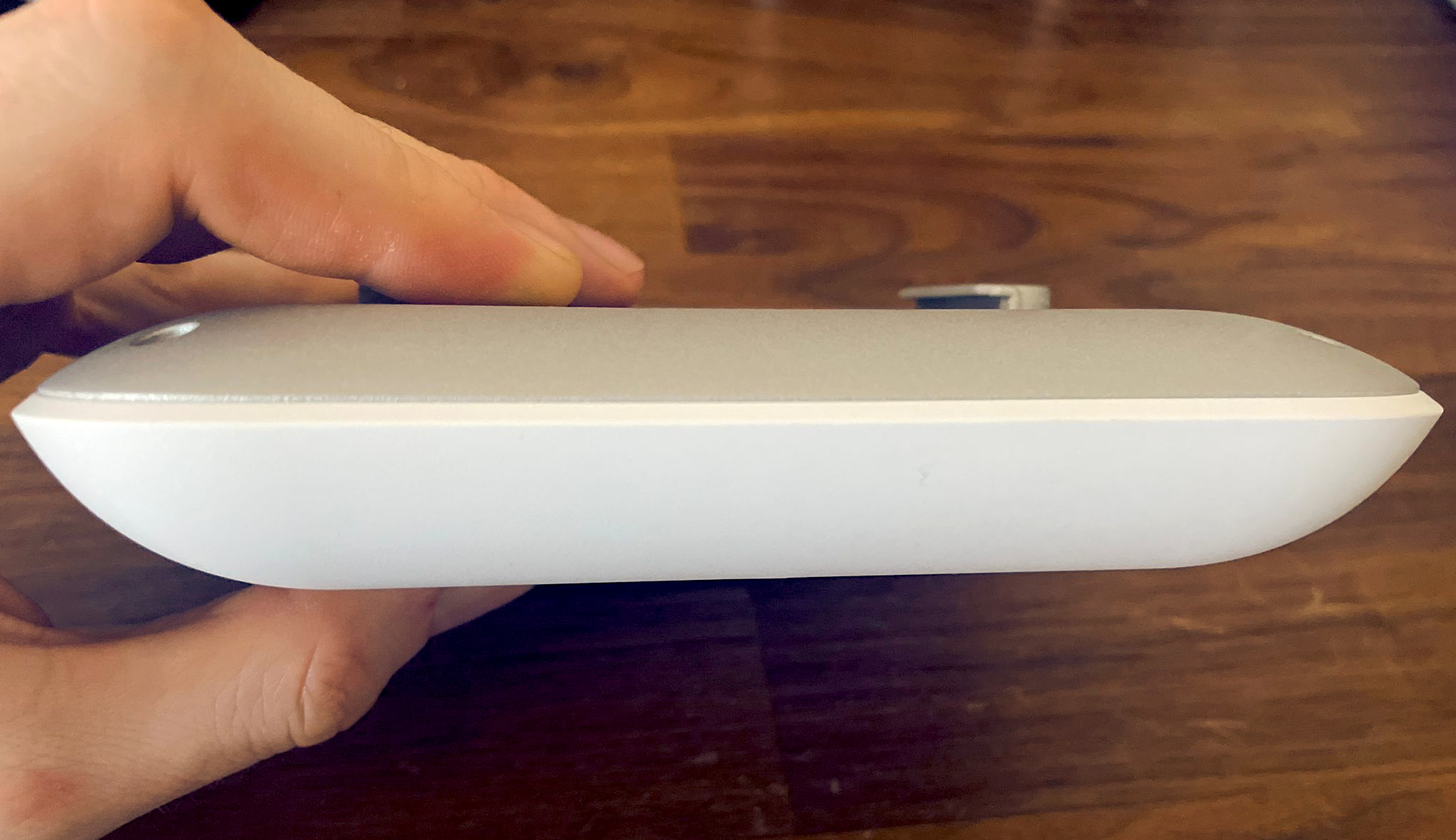
The entry level does include a bracket, so it’s straightforward to mount it on the ceiling, however there are additionally a few holes throughout the metallic alloy backside, so it’s doable to wall-mount the machine as effectively. Additionally, equally to the opposite EnGenius entry factors, the highest is plastic, so the metallic backside takes the function of dissipating the warmth away from the parts. To this point, it has confirmed to be a dependable system. As for LEDs, there’s a single one which is much from being intuitive. It’s a mix between inexperienced and blue to let the standing of the AP..
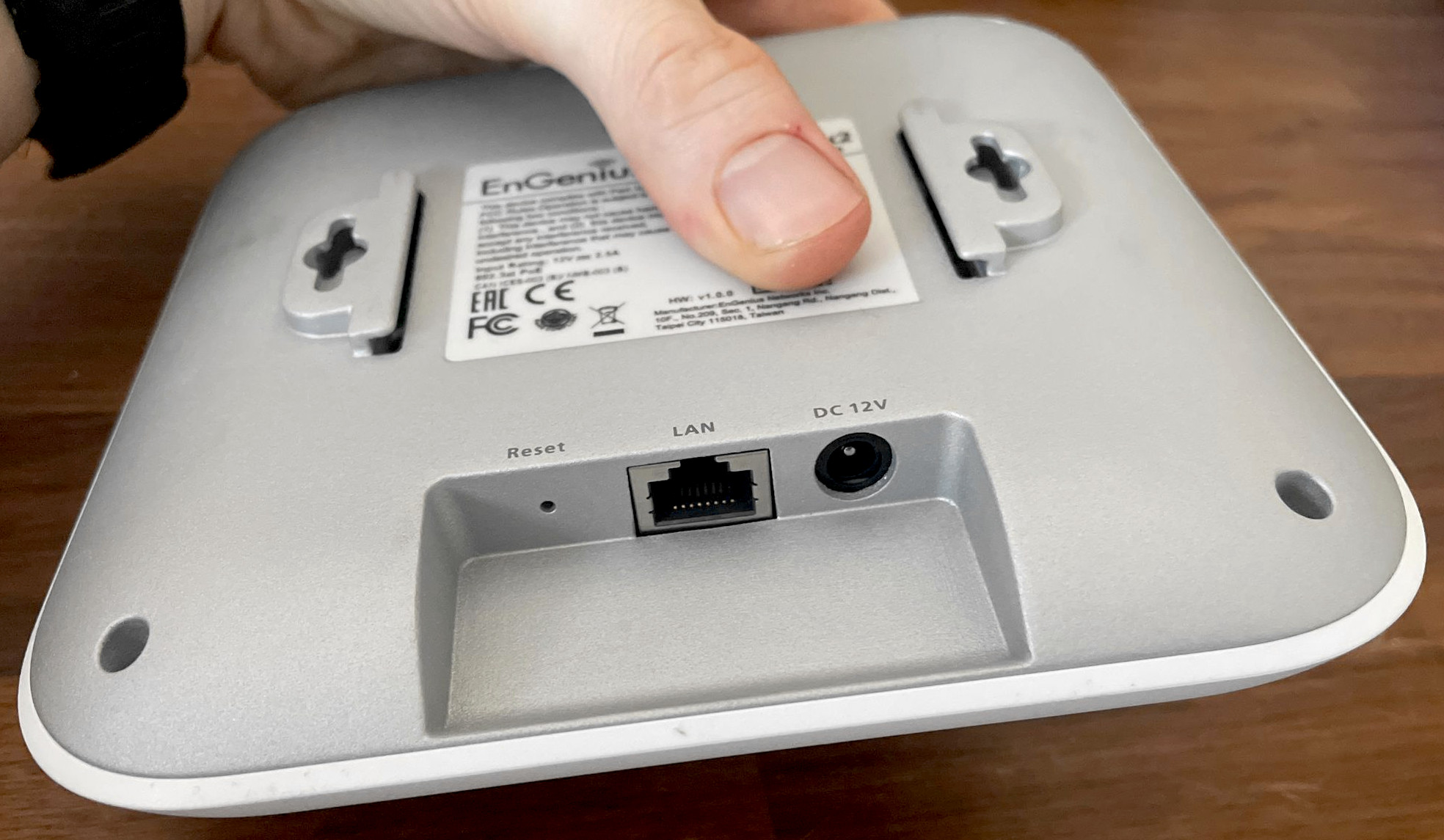
Anyway, on the rear facet, we get to see the ports space the place’s we are able to discover the recessed Reset button, a 12V DC port and a single 2.5GbE PoE+ port.
The Thermal Administration
Now let’s discuss in regards to the warmth administration of the entry level. I did open up the machine and, whereas compact, EnGenius appeared to have made the ECW520 pretty environment friendly. However this must be confirmed by a thermal digicam.
And, after operating a number of exams to simulate a resource-heavy surroundings, the entry level does get fairly sizzling going above 52C (125F), so we may even see some kind of throttling if there’s quite a lot of fixed stress placed on the community.
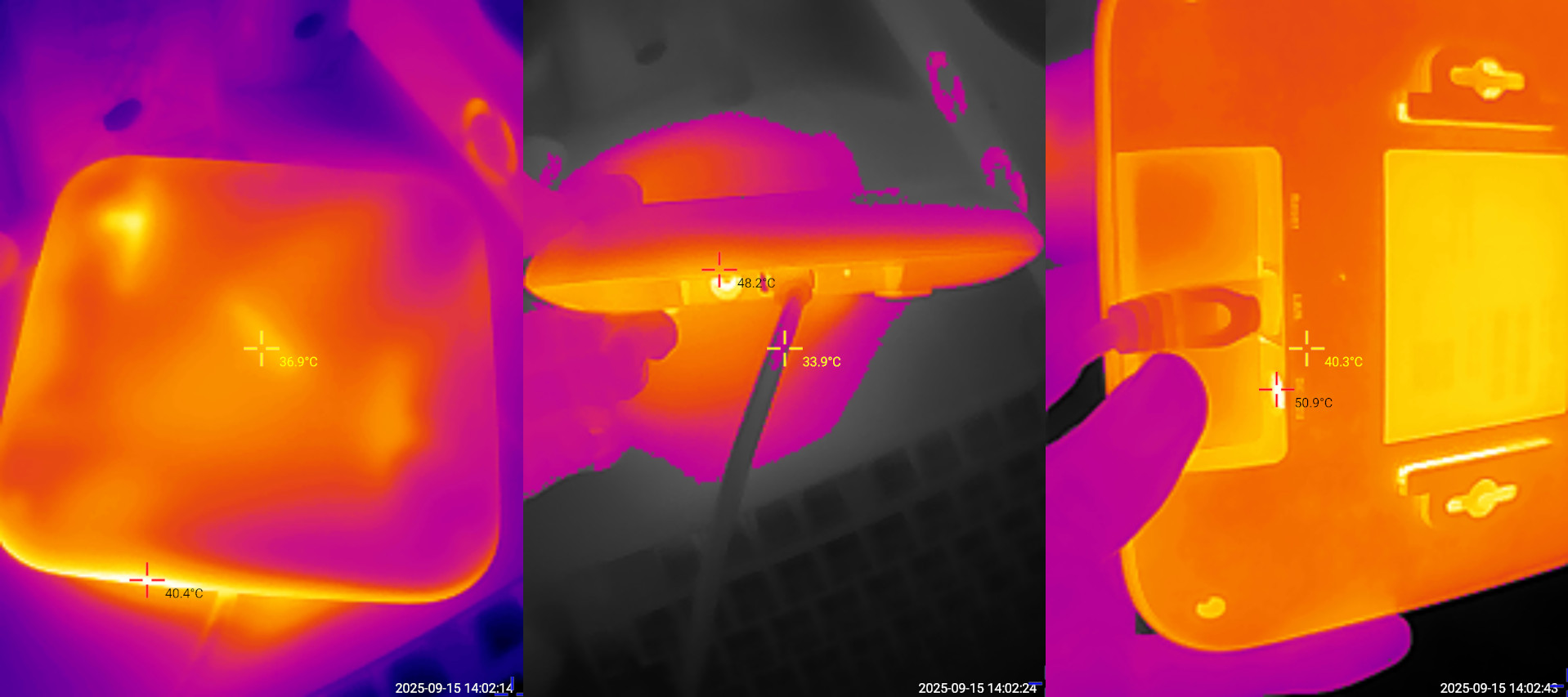
EnGenius ECW520 Teardown
As standard, it’s quite simple to open an EnGenius entry level, so in case you must take away mud or restore the machine, the producer made the method easy. All I needed to do was take away the 4 screws from the underside of the machine and the highest half will pop off simply. Then, we are able to see the antenna array and, after taking out the screws, we are able to detach this half as effectively, however not earlier than the six antennas are eliminated as effectively.
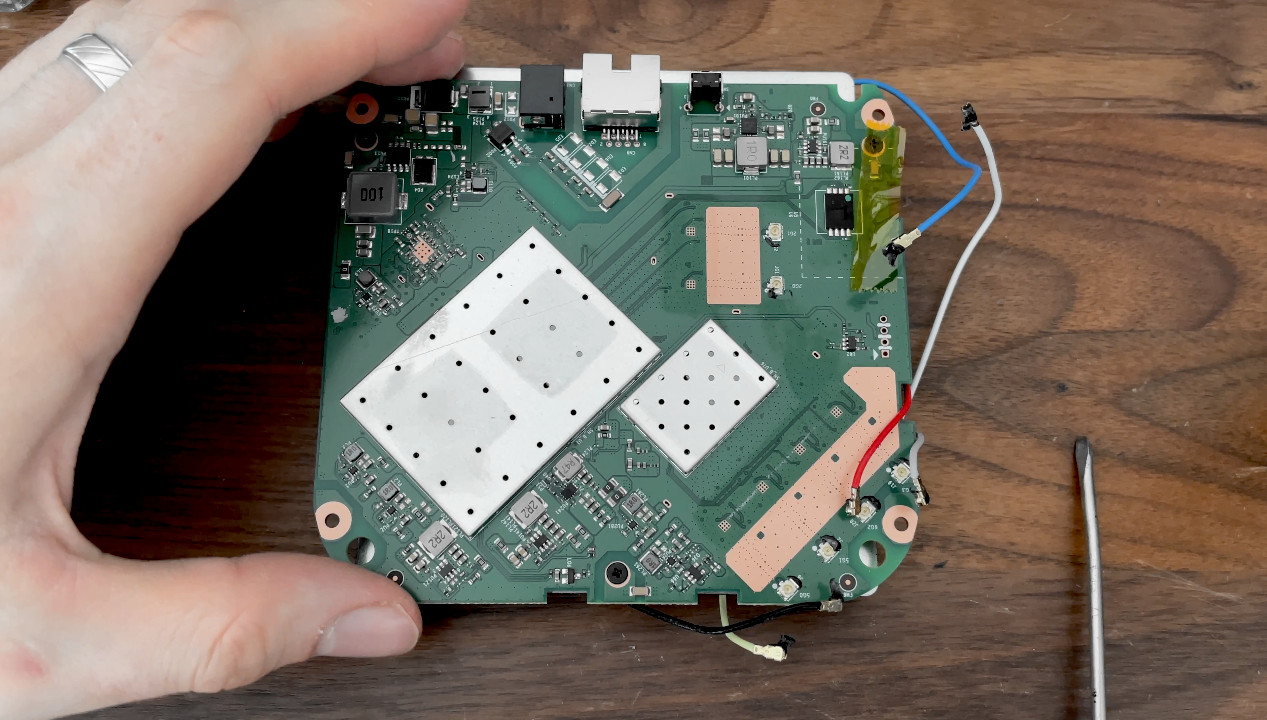
And it’s not as straightforward as I anticipated it to be. That’s as a result of the antenna connectors are glued to the board for some cause. It’s not straightforward to detach them, so I don’t actually see the purpose, however the engineers thought in any other case. In any case, we are able to see the storage chipset on the underside of the PCB, whereas the remainder of the primary parts might be discovered on the highest facet, beneath the aluminum covers. As a facet observe, the EnGenius ECW520 has related {hardware} to the Xiaomi BE6500 Professional.
{Hardware} Comparability
| EnGenius ECW520 | EnGenius ECW516L | Zyxel NWA130BE | Zyxel NWA110BE | |
| CPU | quad-core 1.5GHz Qualcomm IPQ5322 | tri-core 1.8GHz Mediatek MT988DV (A73) | quad-core 1.5GHz Qualcomm IPQ5322 (Cortex-A53) | quad-core 1.5GHz Qualcomm IPQ5322 (Cortex-A53) |
| RAM | 1GB DDR4 Nanya NT5AD512M16C4-JR | 1GB DDR4 SDRAM Nanya NT5AD512M16C4-JR 222801NOEF | 1GB Micron 3UR77 D8BPK (DDR4) | 1GB Micron (41R77 D8BPK) DDR4 |
| Storage | 256MB NAND Winbond (25N02KWZEIR2434) | 256MB NAND MXIC X241952 MX35LF2GE4AD-Z43/ 128MB serial NOR Winbond 25Q128JVSQ 2251 | 512MB (MXIC X233662 MX35UF46E4AD-241)/ 16MB NOR flash (MXIC MX25U12832F) | 256MB NAND Winbond 25N02KWZEIR |
| Swap | Qualcomm QCA8081 PHY | Mediatek MT7995AV | Qualcomm QCA8385 Ethernet PHY | Qualcomm QCA8385 Ethernet PHY |
| 6GHz Radio | Qualcomm QCN6274 802.11be + 2x 50083714 + 2x 42674013 modules | Mediatek MT7976QN2415-BWELBPTA4836 3×3 | Qualcomm QCN6274 802.11be 2×2:2 | Qualcomm QCN6274 802.11be /td> |
| 5GHz Radio | Qualcomm IPQ5322 802.11a/b/g/n/ac/ax 3×3 | Mediatek MT7976QN2415-BWELBPTA4836 4×4:4 | Qualcomm QCN6274 802.11be 2×2:2 | Qualcomm QCN6274 802.11be |
| 2.4GHz Radio | Qualcomm IPQ5322 802.11b/g/n/ax 2×2 | Mediatek MT7977IAN 802.11b/g/n/ax 2×2:2 | Qualcomm IPQ5322 802.11b/g/n/ax 2×2:2 | Qualcomm IPQ5322 802.11b/g/n/ax 2×2:2 |
Single Consumer Checks (6GHz & 5GHz)
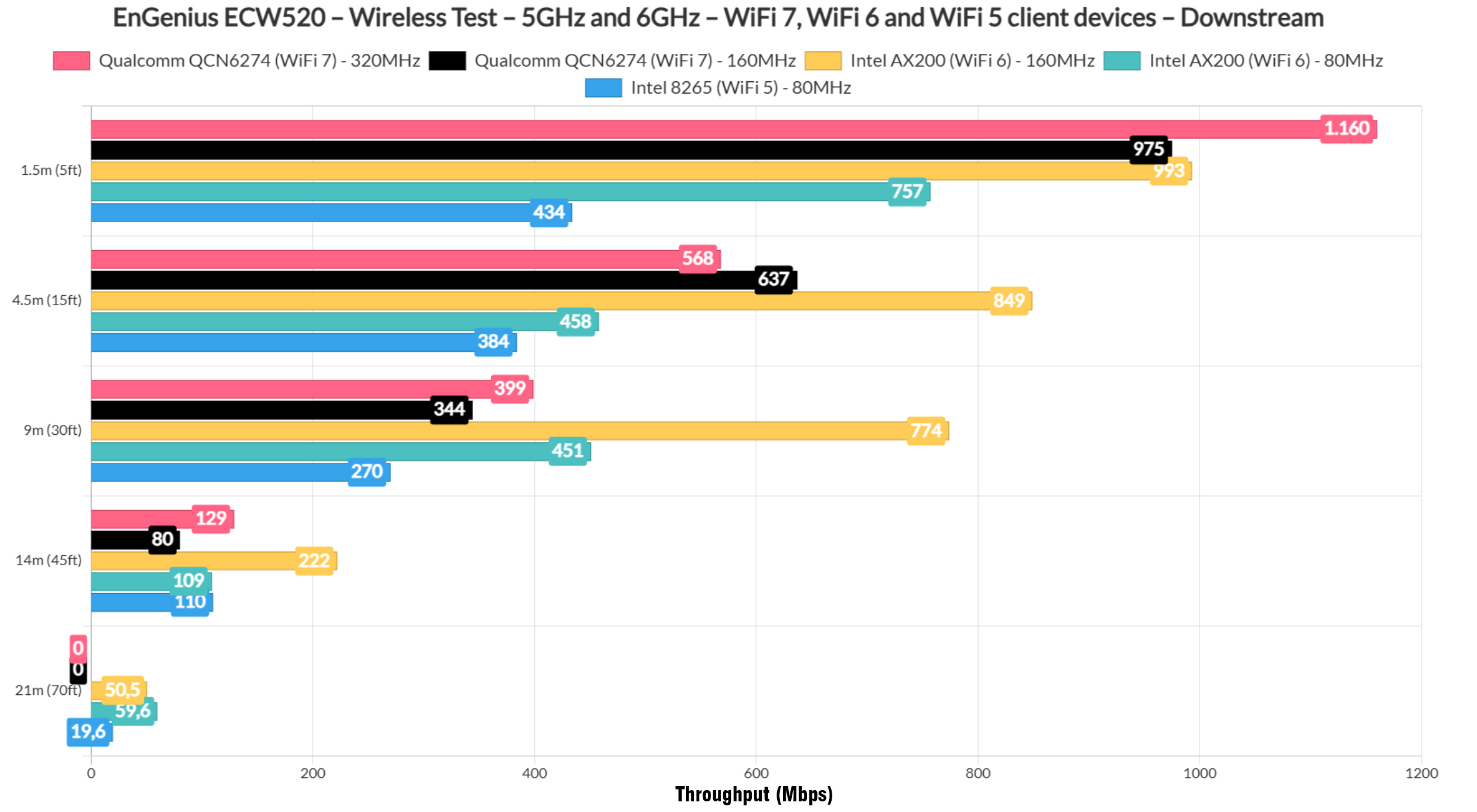
I couldn’t assist however examine the throughput I managed to report testing the EnGenius ECW520 with the Cloud Lite ECW516L. And that’s as a result of each these entry factors include related value tags.
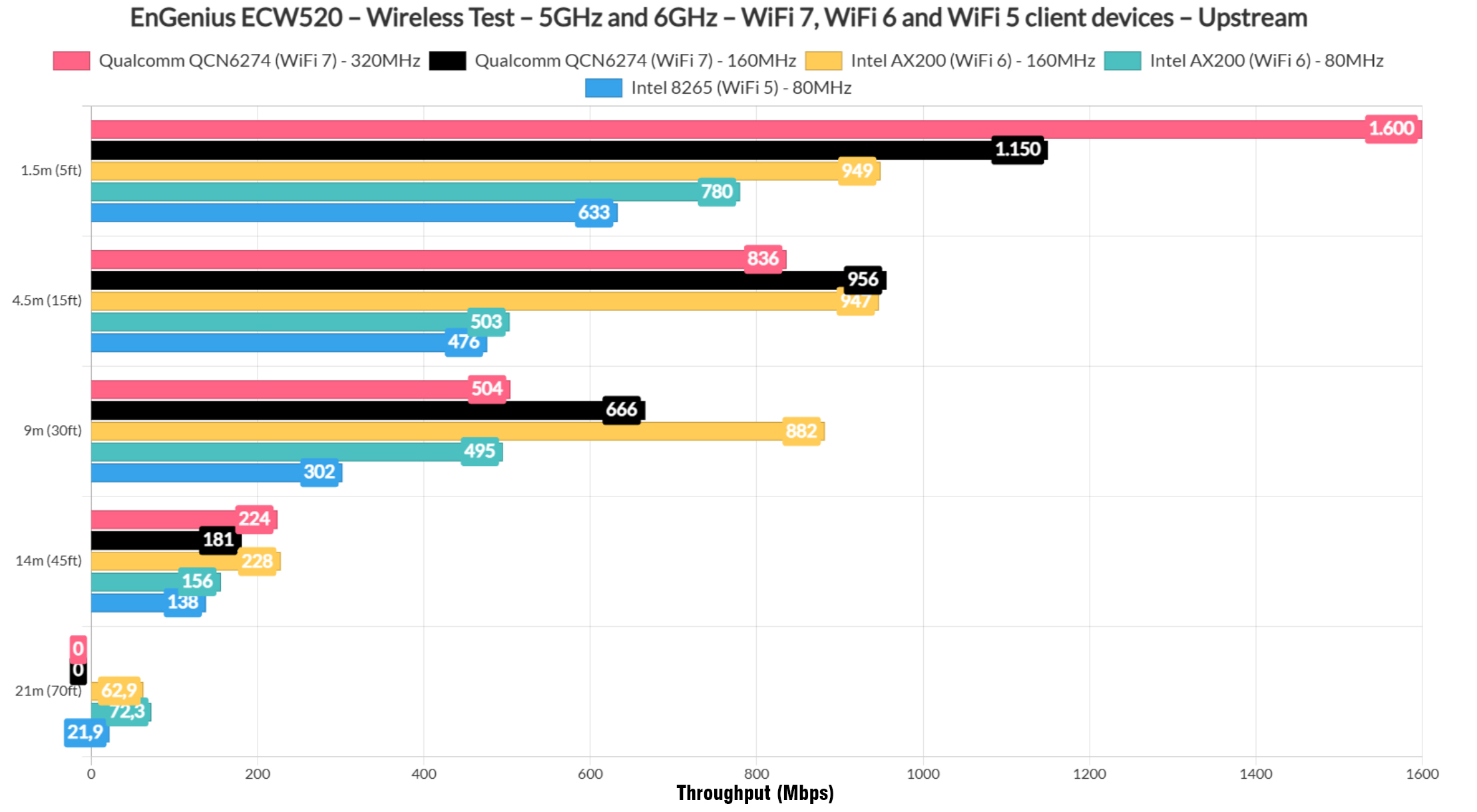
From the seems of it, the ECW520 provides a greater throughput close to the shopper, however after going a bit farther away, even at 5 meters away, the efficiency is kind of related.
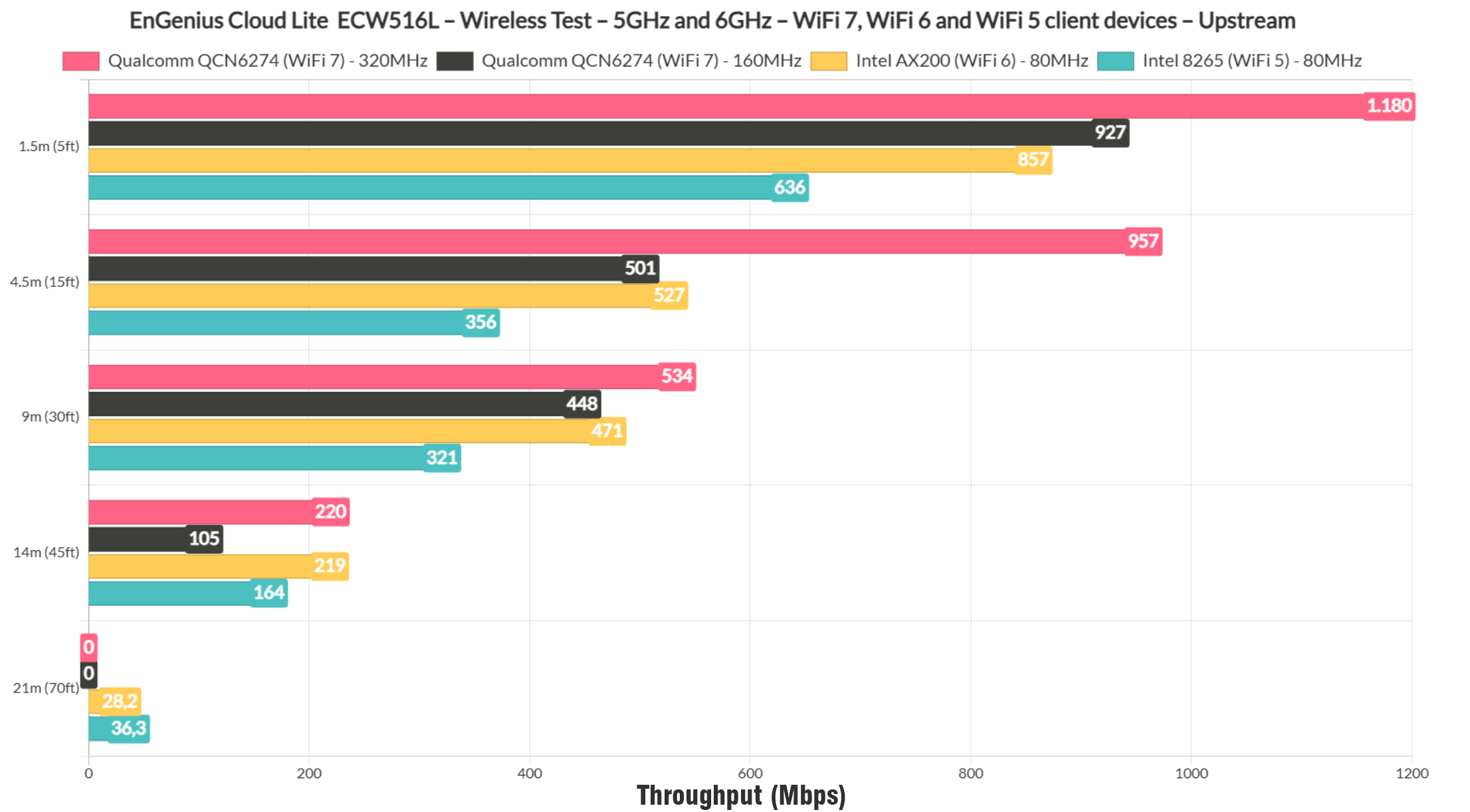
And that’s true each upstream and downstream. Discover how these two entry factors failed to take care of a connection father than 20 meters (or about 70 toes).
Issues do change barely after checking the sign attenuation graph.
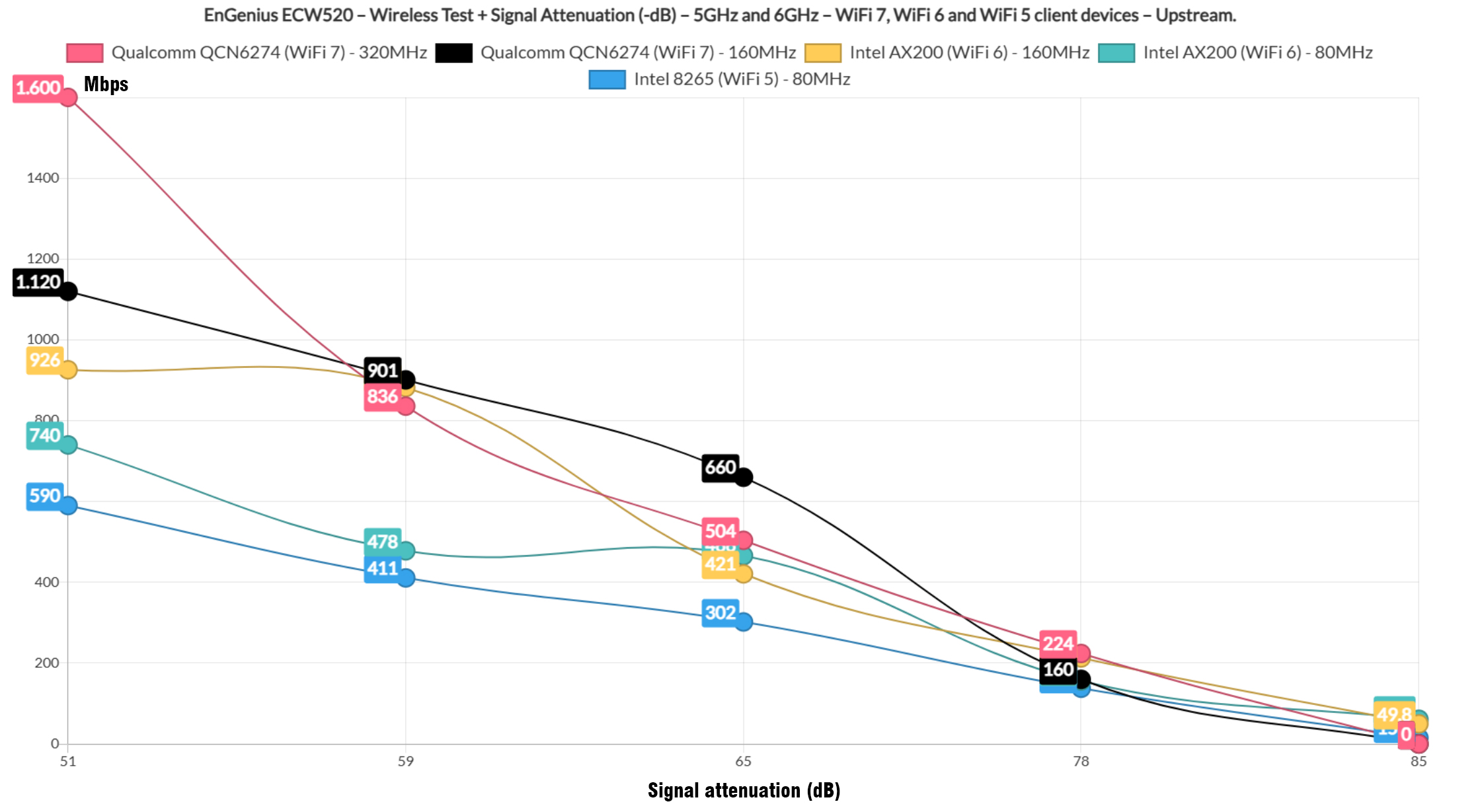
The WiFi 7 shopper is the winner when close to the entry level and the loser on the higher-range exams. The opposite purchasers did pretty effectively and it was fascinating to see how reducing the channel bandwidth on the 6GHz radio displayed a greater throughput only a bit farther from the shopper.
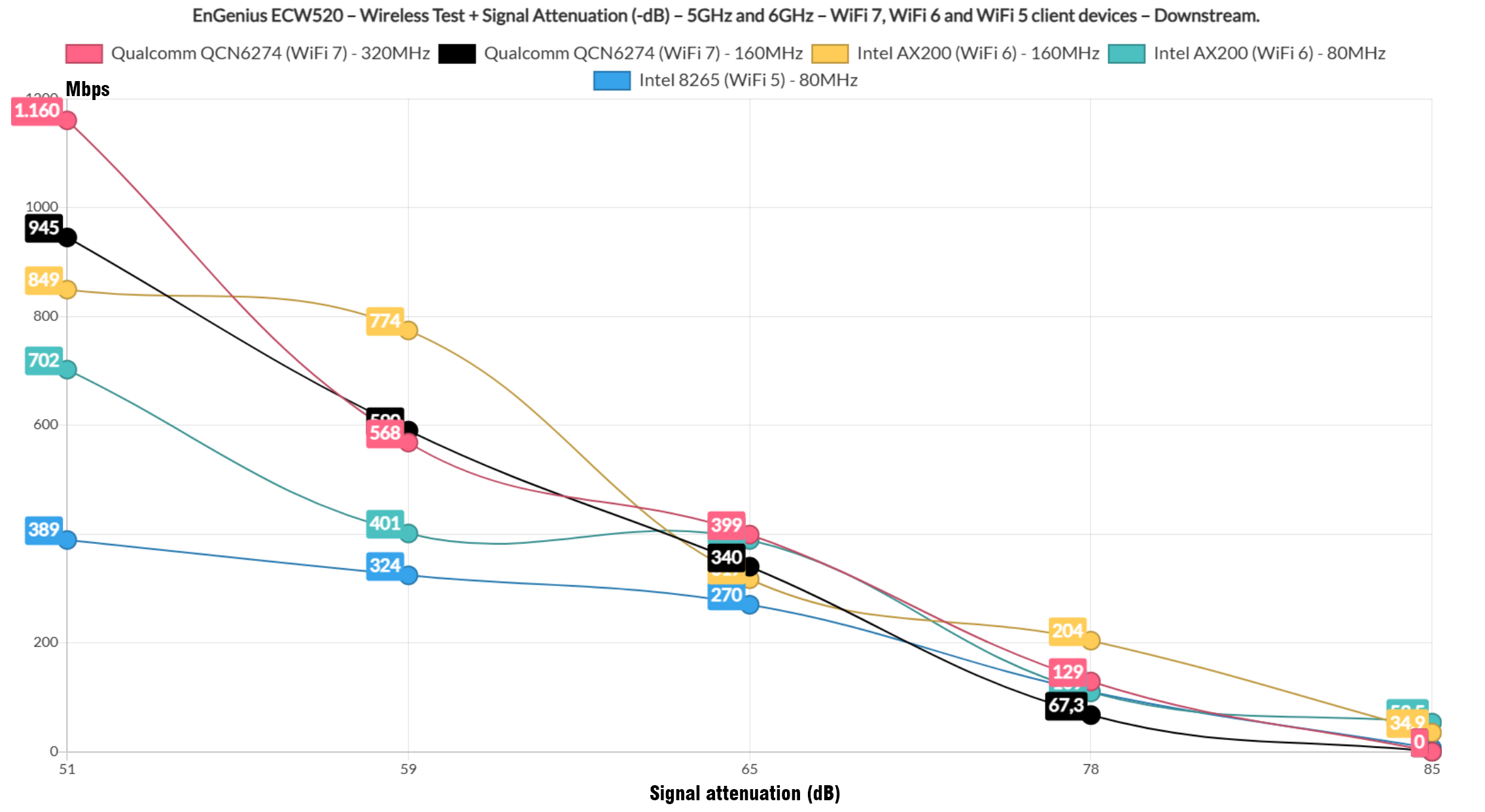
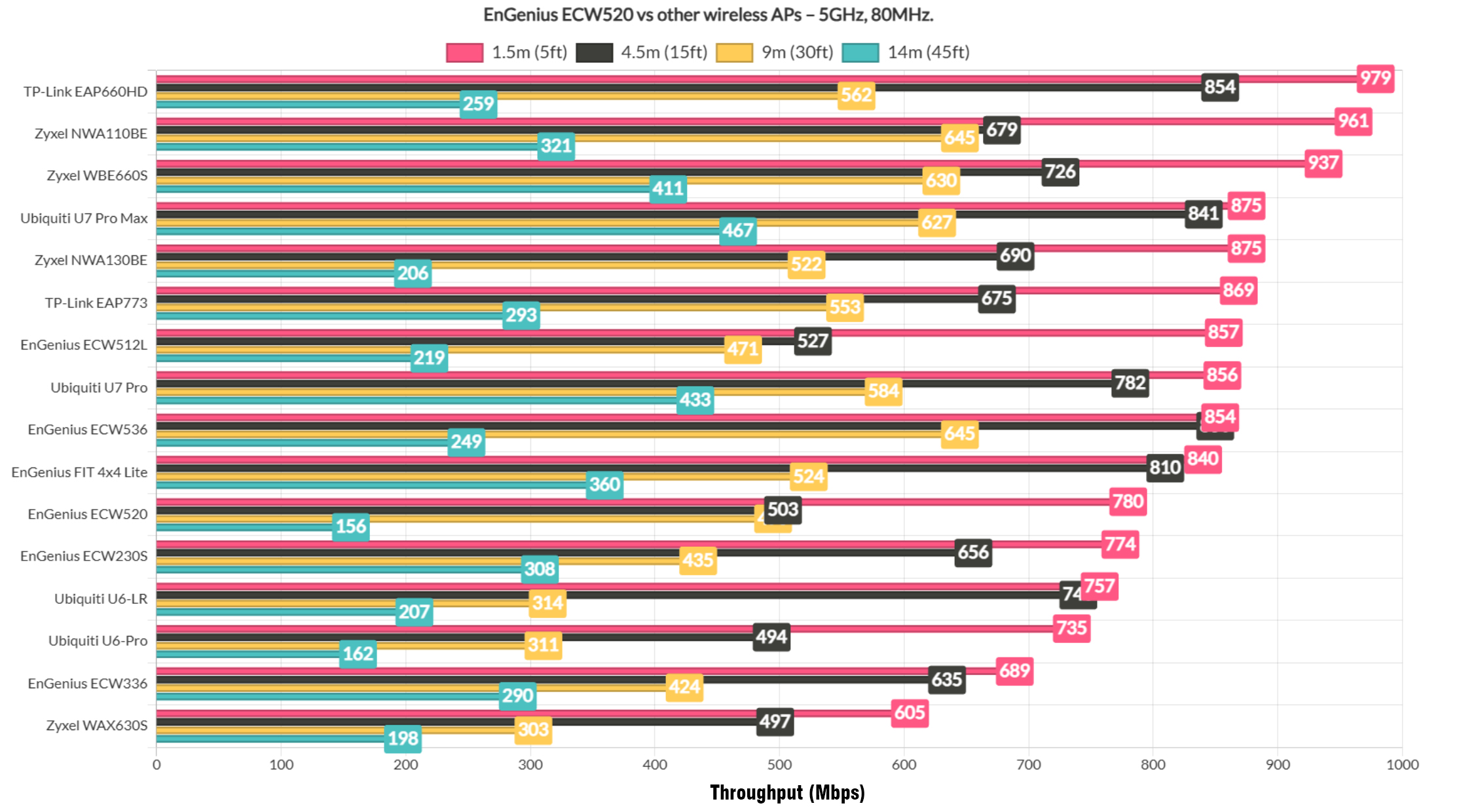
Once more, this stays true each upstream and downstream. When in comparison with different wi-fi entry factors, the ECW520 sits between the ECW230S and the FIT 4×4 Lite, so long as the 5GHz radio is used set at 80MHz.
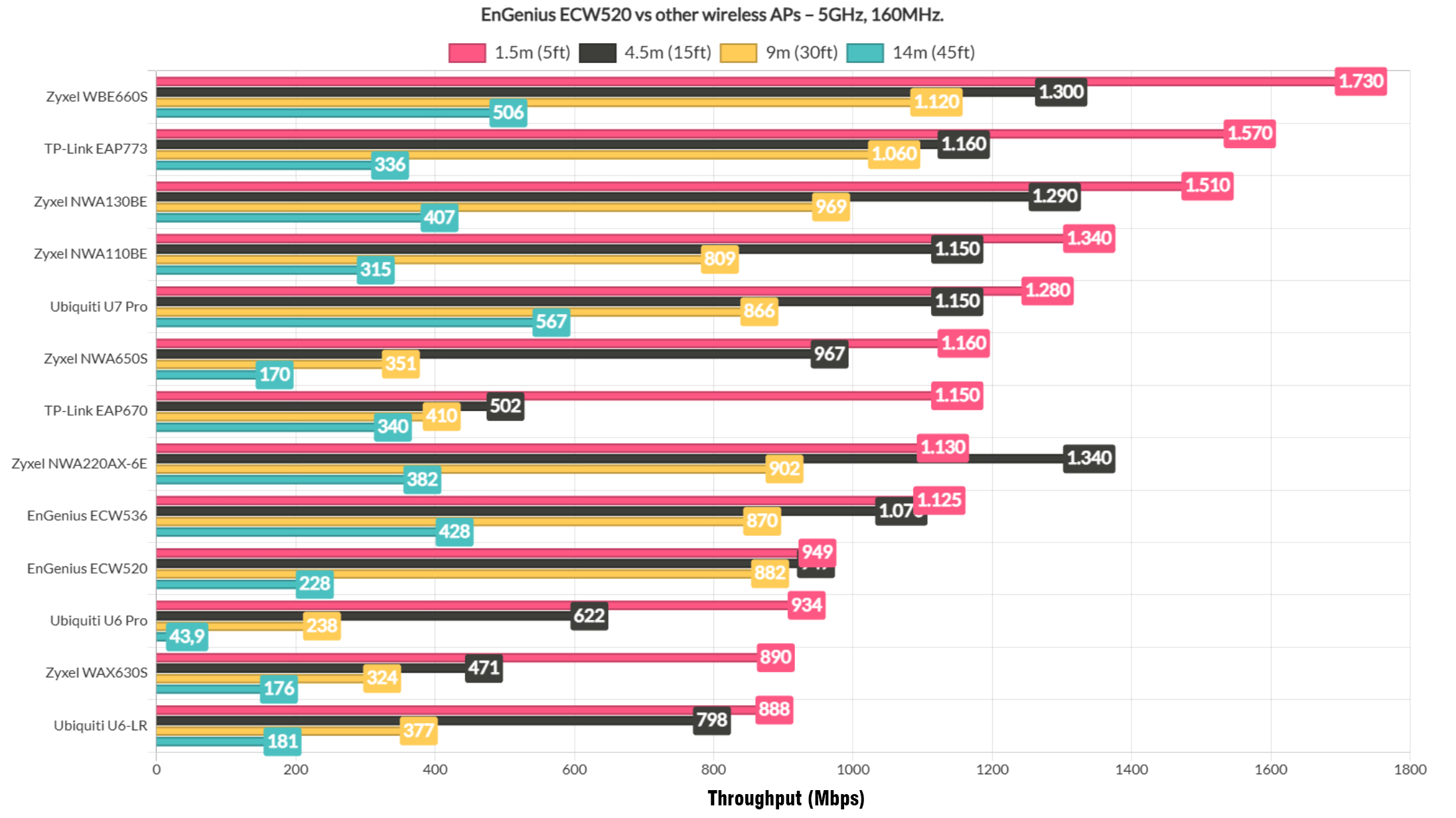
After switching to the 160MHz width, the ECW520 sits between the ECW536 from the identical household of entry factors and the U6 Professional.
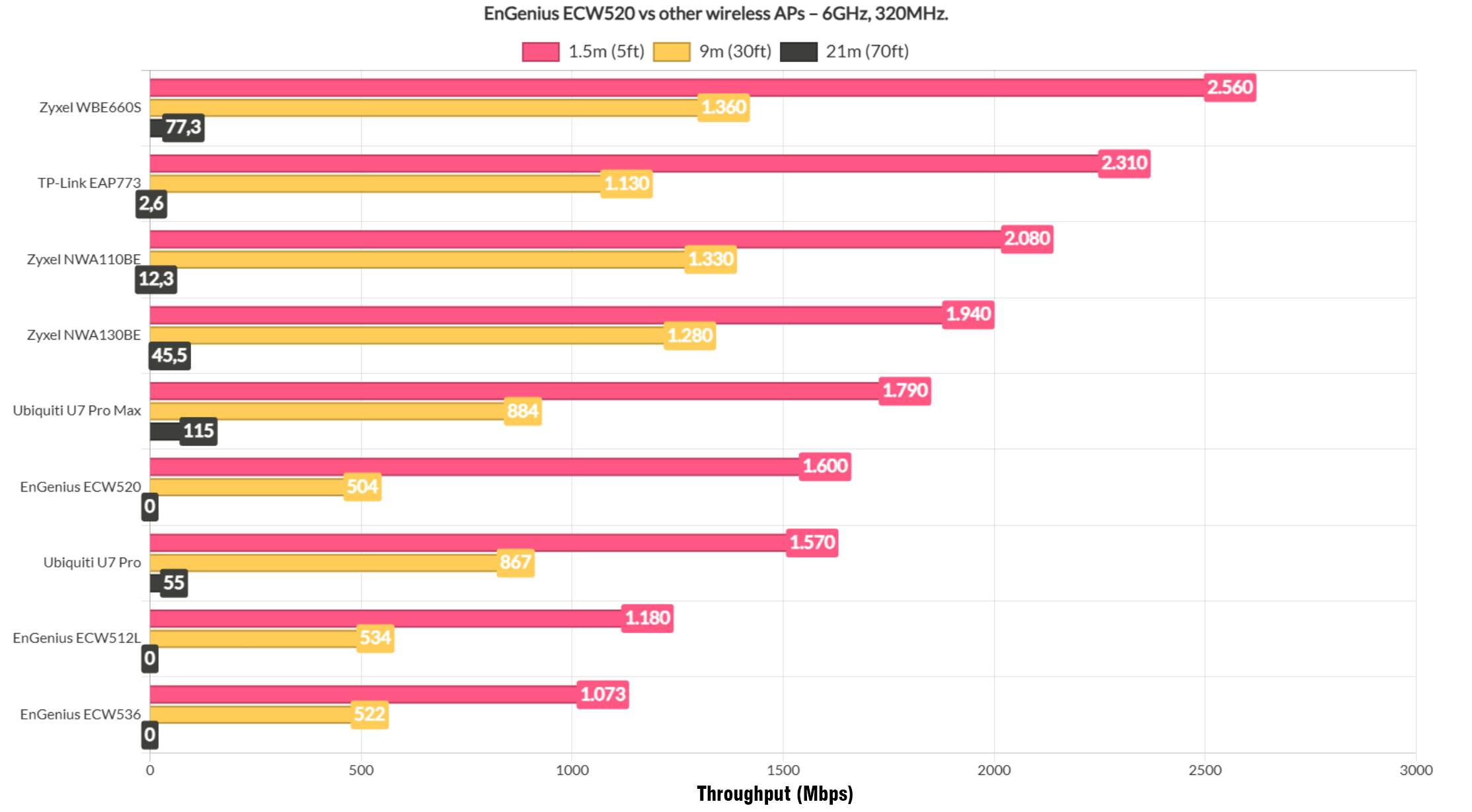
When utilizing the 6GHz radio and the 320MHz channel width, the entry factors sits between the U7 Professional Max and the U7 Professional.
Lastly, I made a decision to incorporate a longer-term efficiency graphic the place we are able to see some curious fluctuations, particularly when utilizing the 5GHz hi fi to the 160MHz.
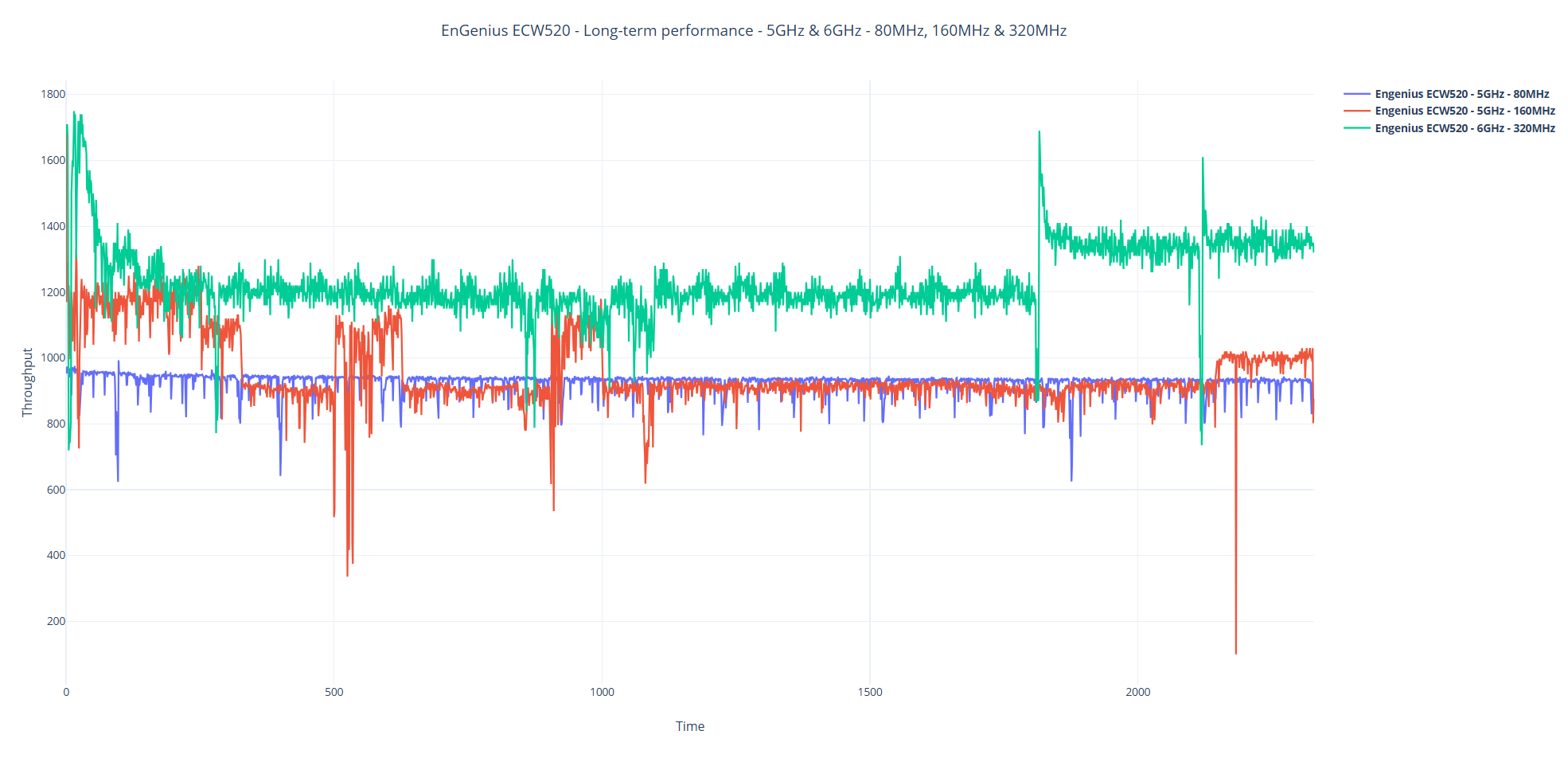
May they be heat-related? Undecided, however the entry level positively runs hotter than different gadgets from EnGenius.
Single Consumer Checks (2.4GHz)
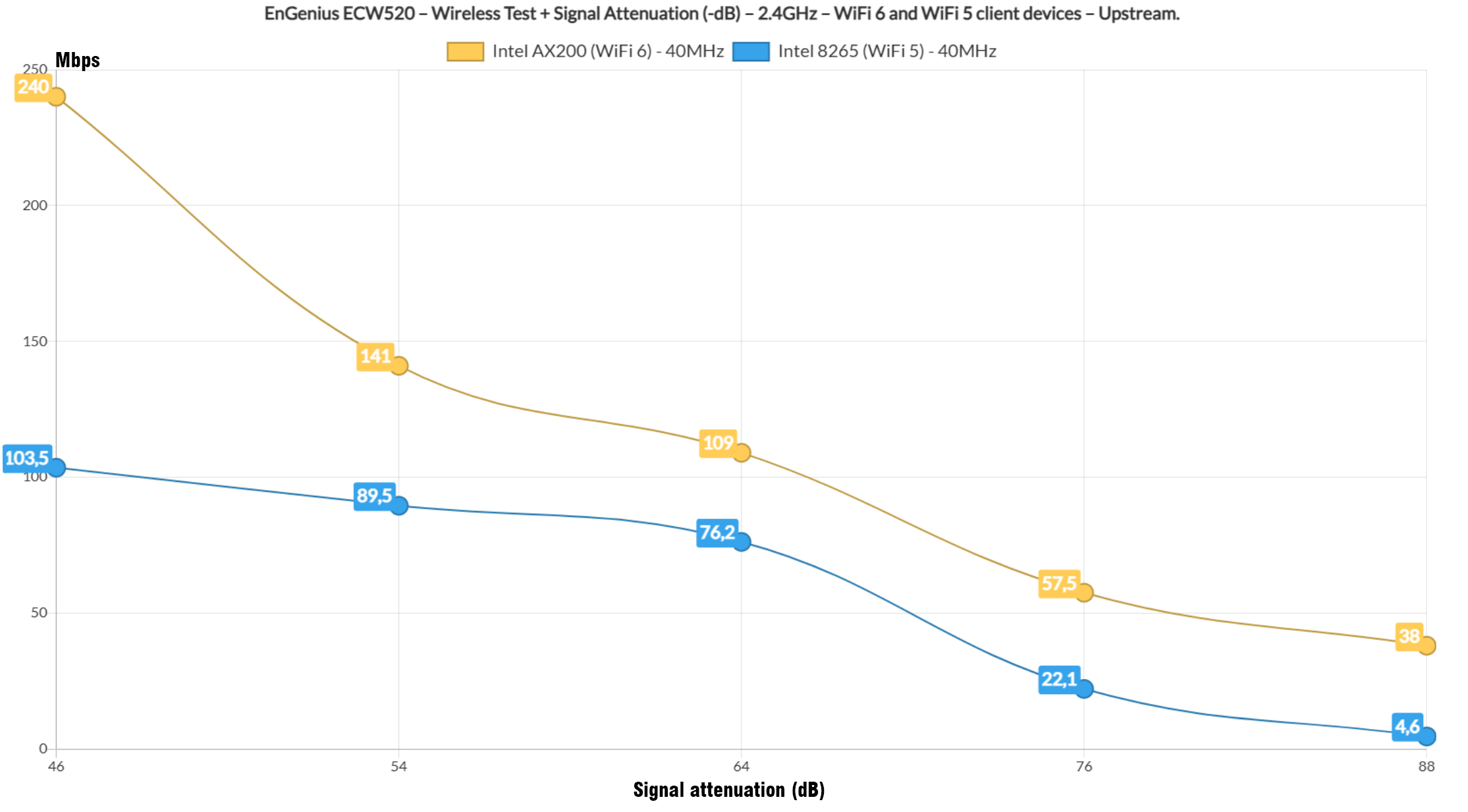
Now let’s change to the two.4GHz radio efficiency. We will see that it’s an honest throughput utilizing both a WiFi 6 or a WiFi 5 shopper machine and we do get usable throughput even when the space is above 20m from the entry level.
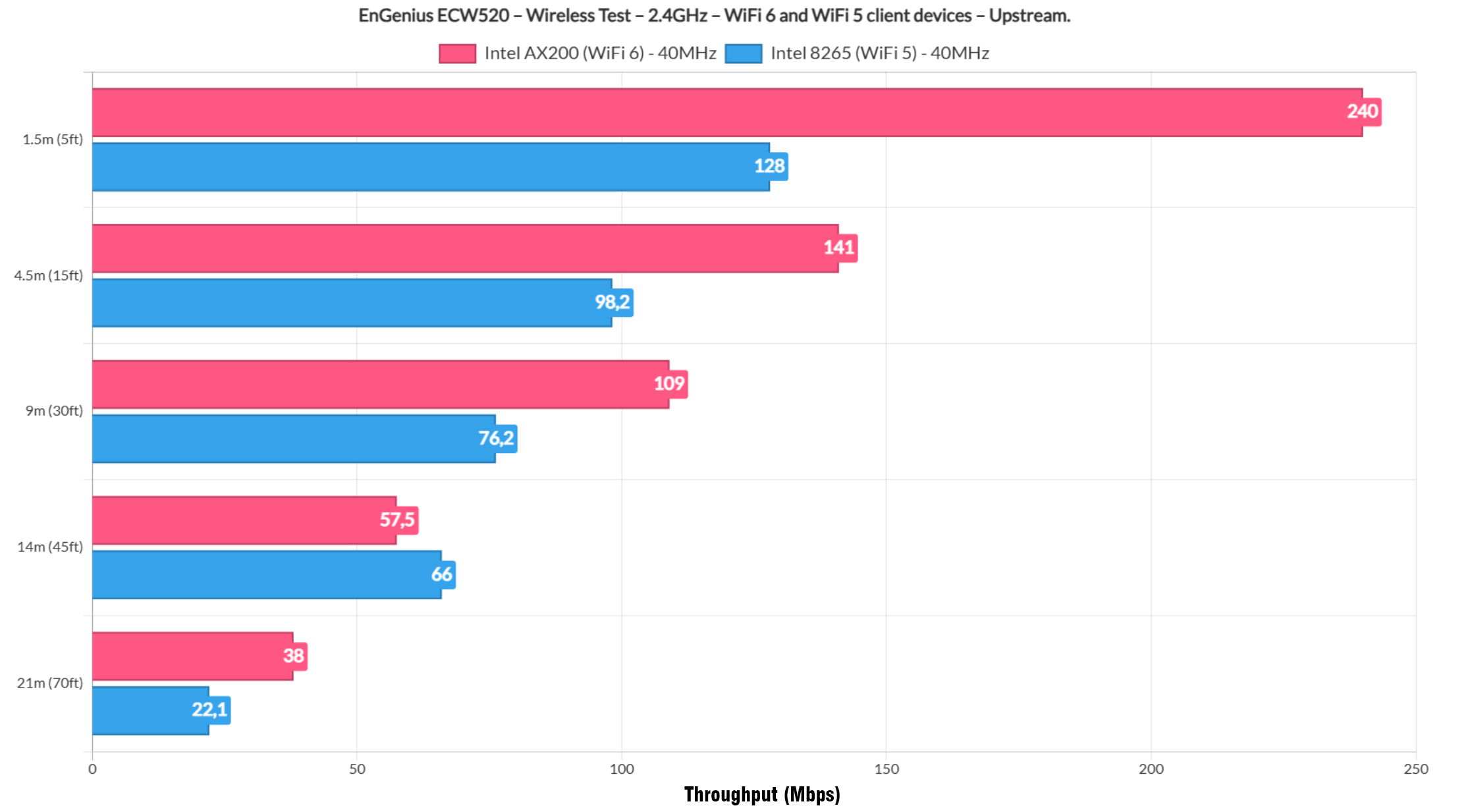
The sign attenuation graph merely enforces the earlier outcomes as we see near 40Mbps even when the attenuation is -88dB.
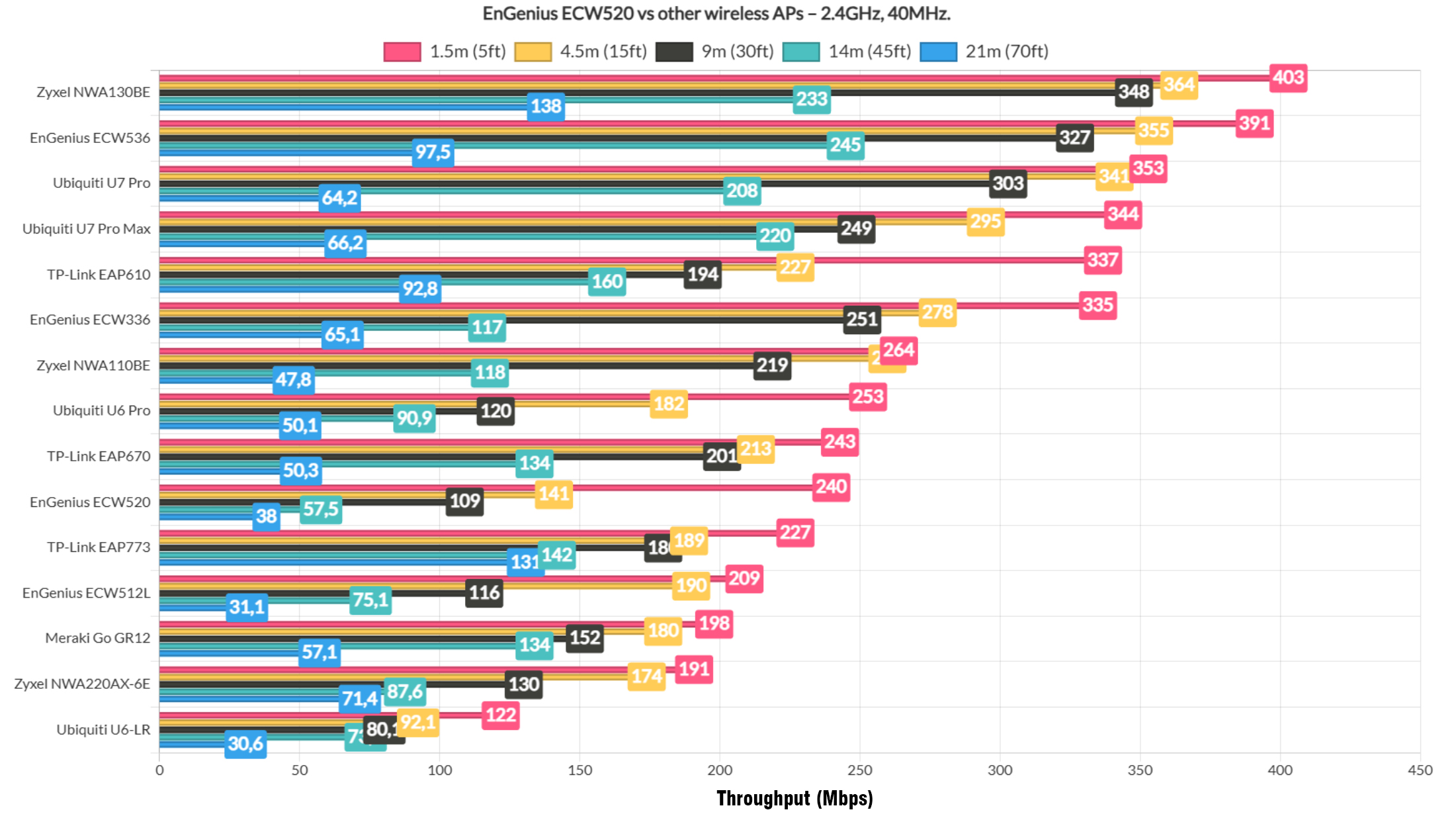
When in comparison with different entry factors, the EnGenius ECW520 sits between the TP-Hyperlink EAP773 and the EAP670 which is a good efficiency, particularly because it’s higher than what I noticed with the ECW512L.
The Multi-Consumer Checks
I don’t check networking {hardware} that usually anymore, however I nonetheless most popular to go pretty in depth when testing the EnGenius ECW520, so I as soon as once more relied on net-hydra, a set of instruments developed by Mr Jim Salter and which can be found for anybody on GitHub. The preliminary check includes simulating 1080p streaming on 5 shopper gadgets.
And sure, solely a few them are an identical, the WiFi 6 laptops, however I suppose a various solid could present a extra life like efficiency that may be anticipated in most households.
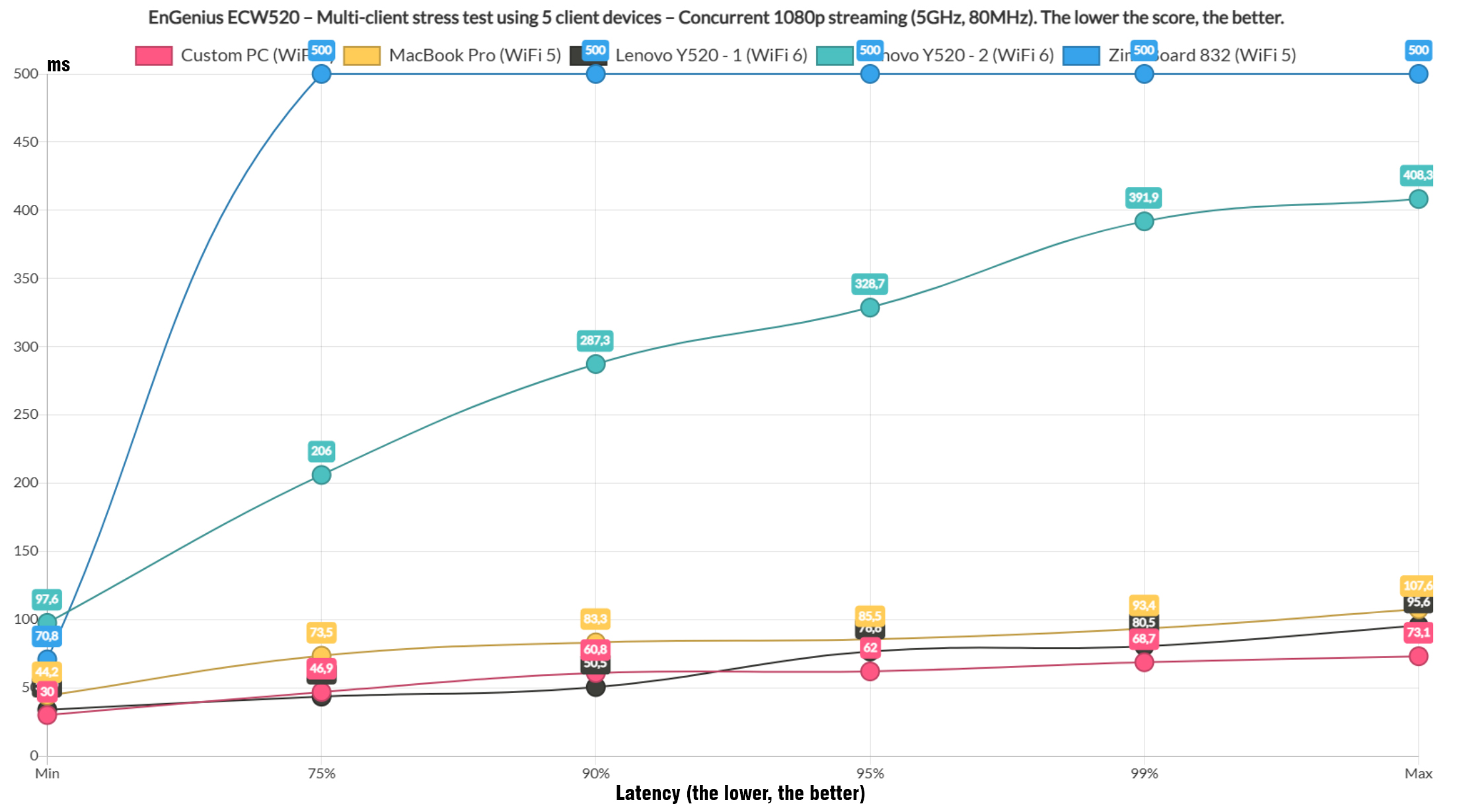
The outcomes present that one WiFi 6 shopper and the WiFi 5 ZimaBoard 832 carried out the worst, whereas the MacBook Professional did a bit higher, the final two purchasers doing decently effectively. Not excellent, however usable.
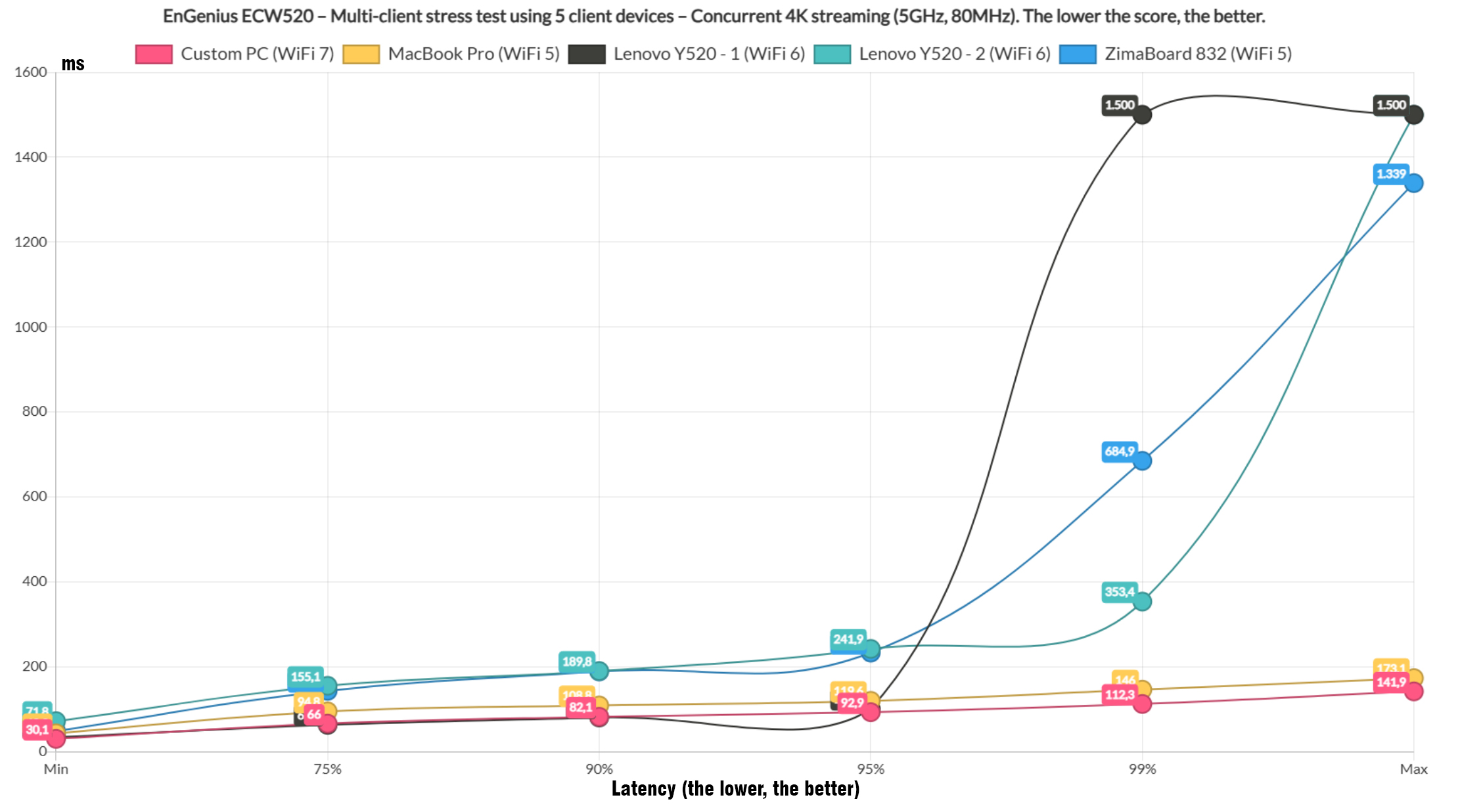
Switching to the 4K streaming graphic, we are able to see an identical efficiency throughout the identical purchasers, with two purchasers doing effectively, whereas the others displaying unusable latency.
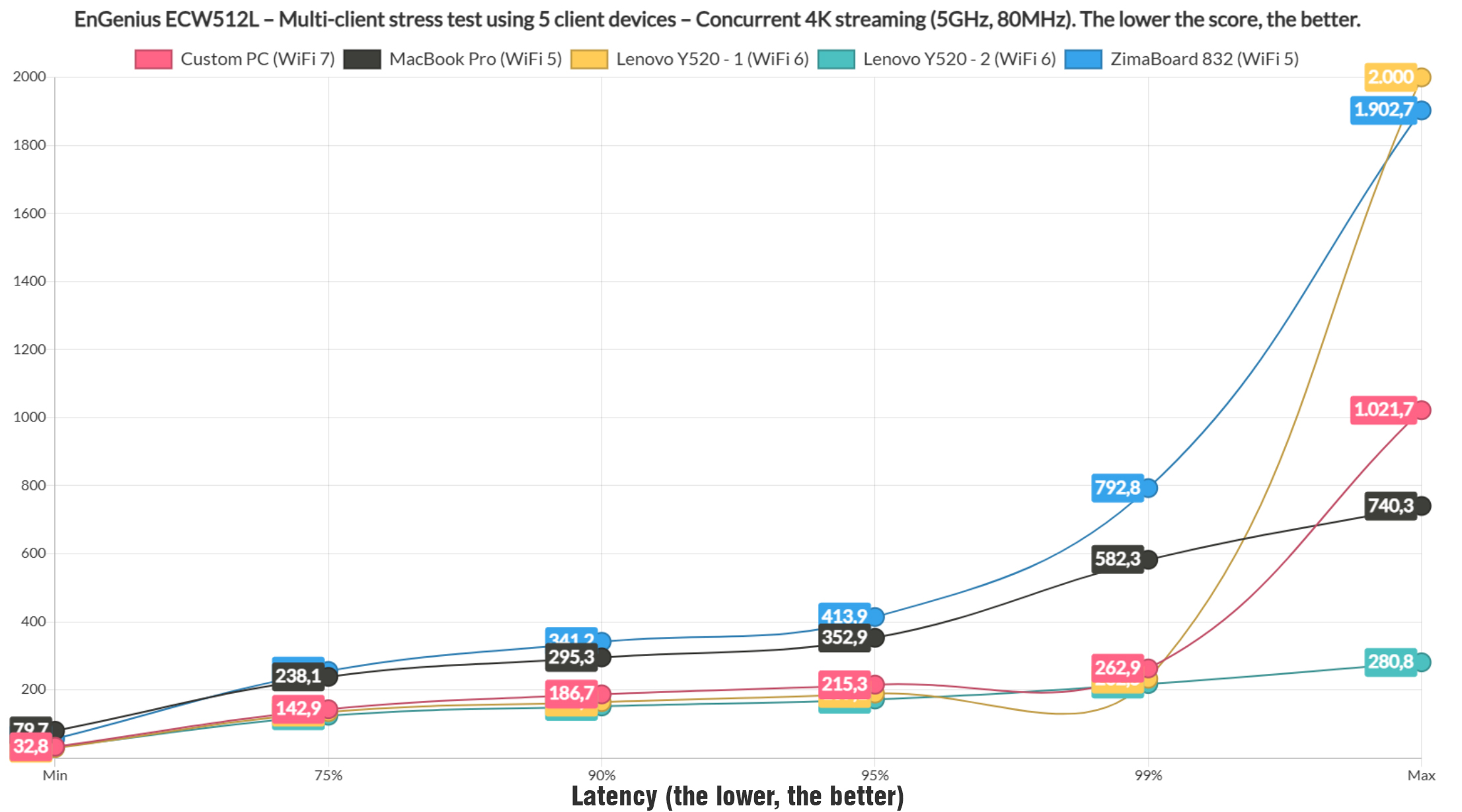
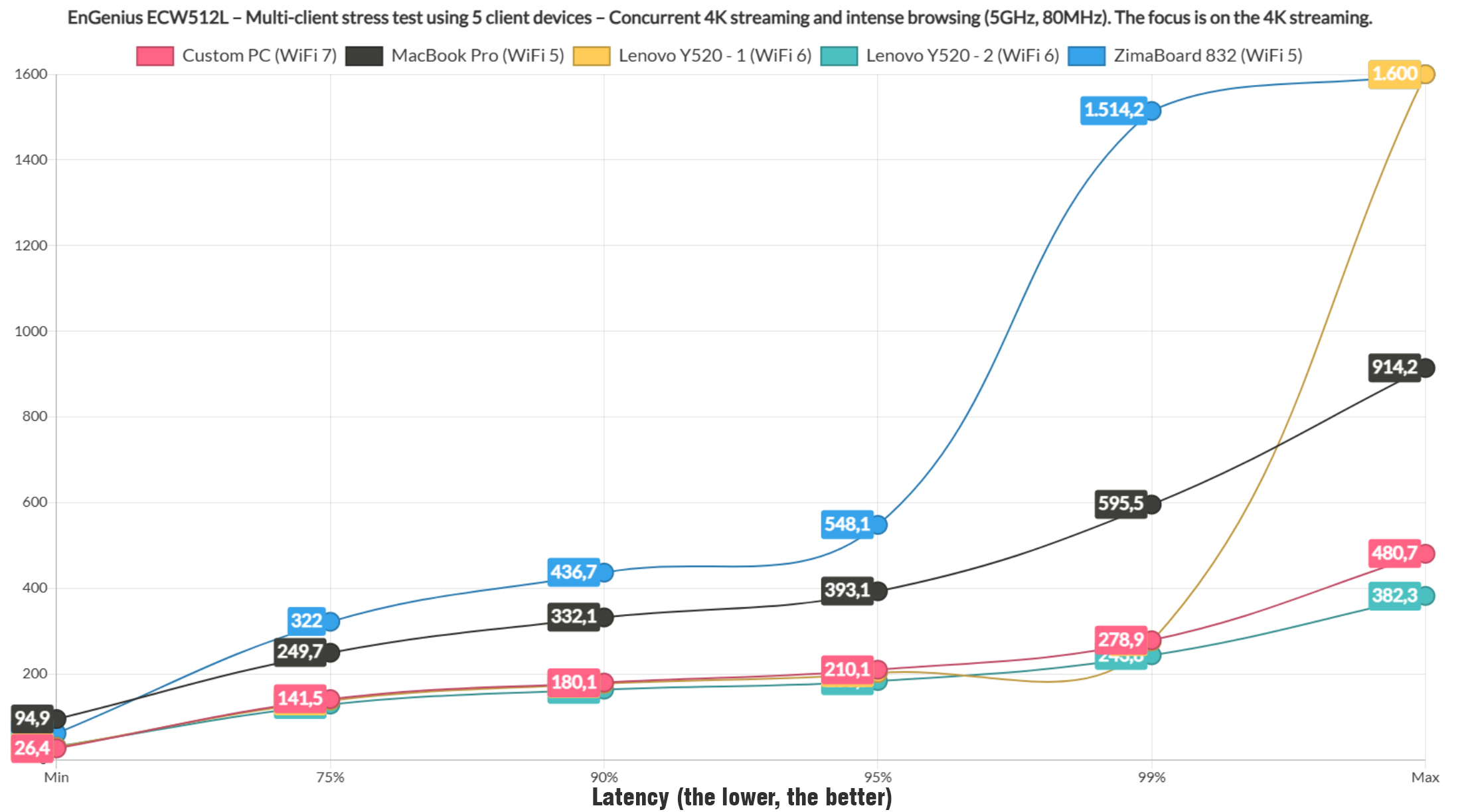
If I had been to check it to the ECW512L, it’s nonetheless effectively higher contemplating that every one shopper gadgets went above 100ms just about from the start. Now, I made a decision to incorporate intense searching and run it alongside the preliminary 1080p streaming.
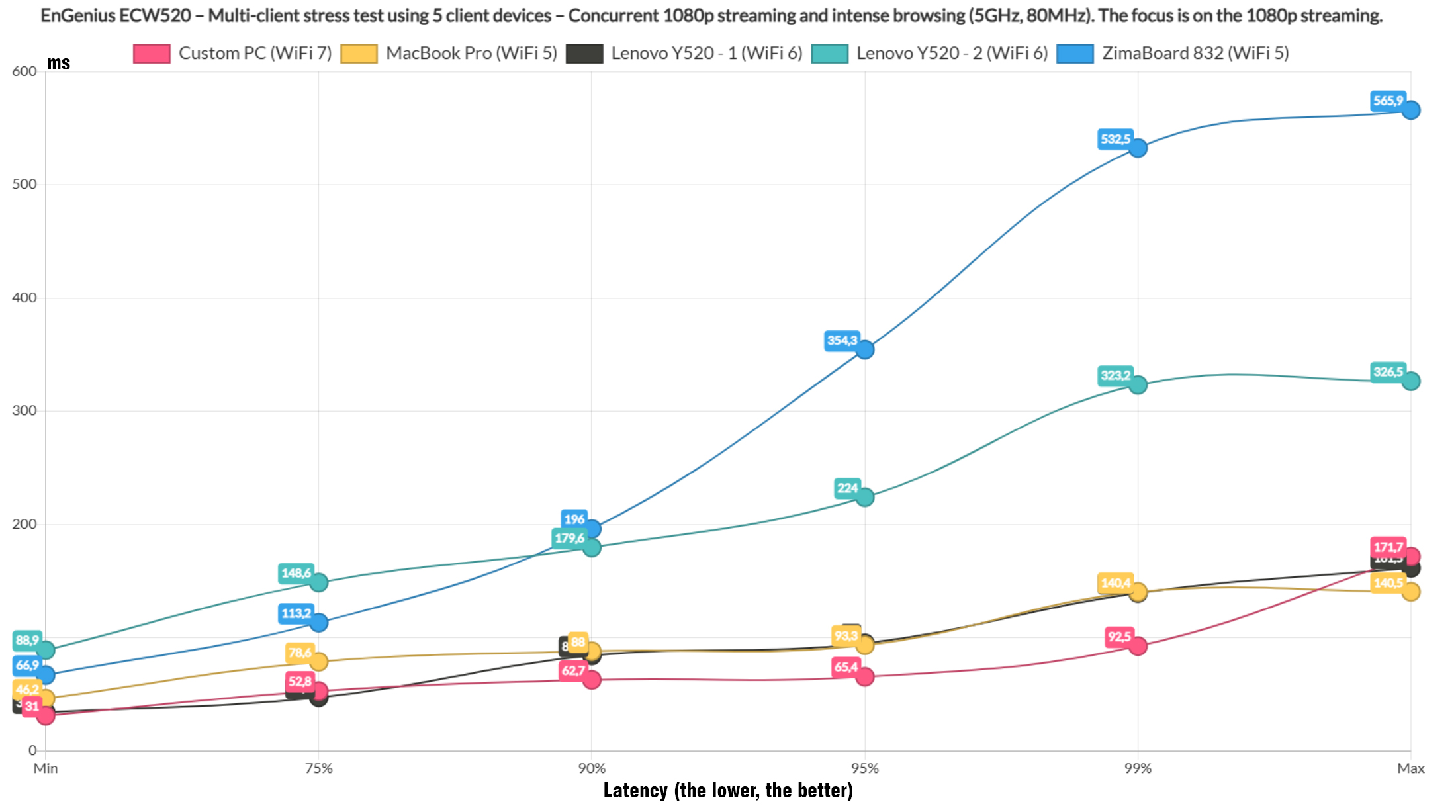
It’s clearly higher to restrict the variety of purchasers if that is one thing that usually occurs in your community, however it’s nonetheless good to know that we do get sub-100ms latency on three purchasers for about 95% of the time. Not preferrred, however usable to a sure extent.
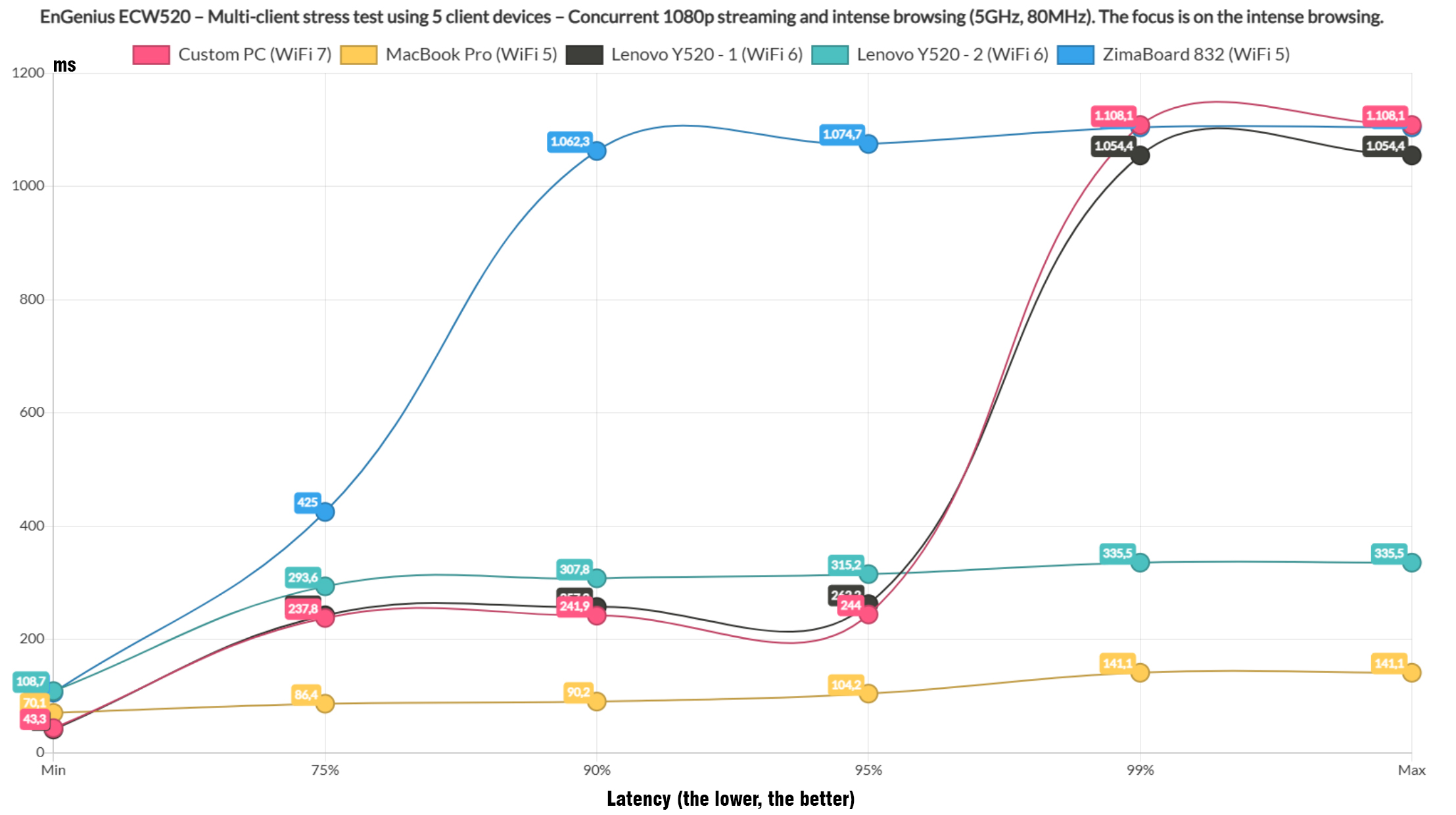
The extreme searching graphic reveals that one shopper is pushed near the restrict, however the remainder behave properly. Transferring ahead, I ran the extreme searching visitors alongside 4K streaming and I bought the next outcomes.
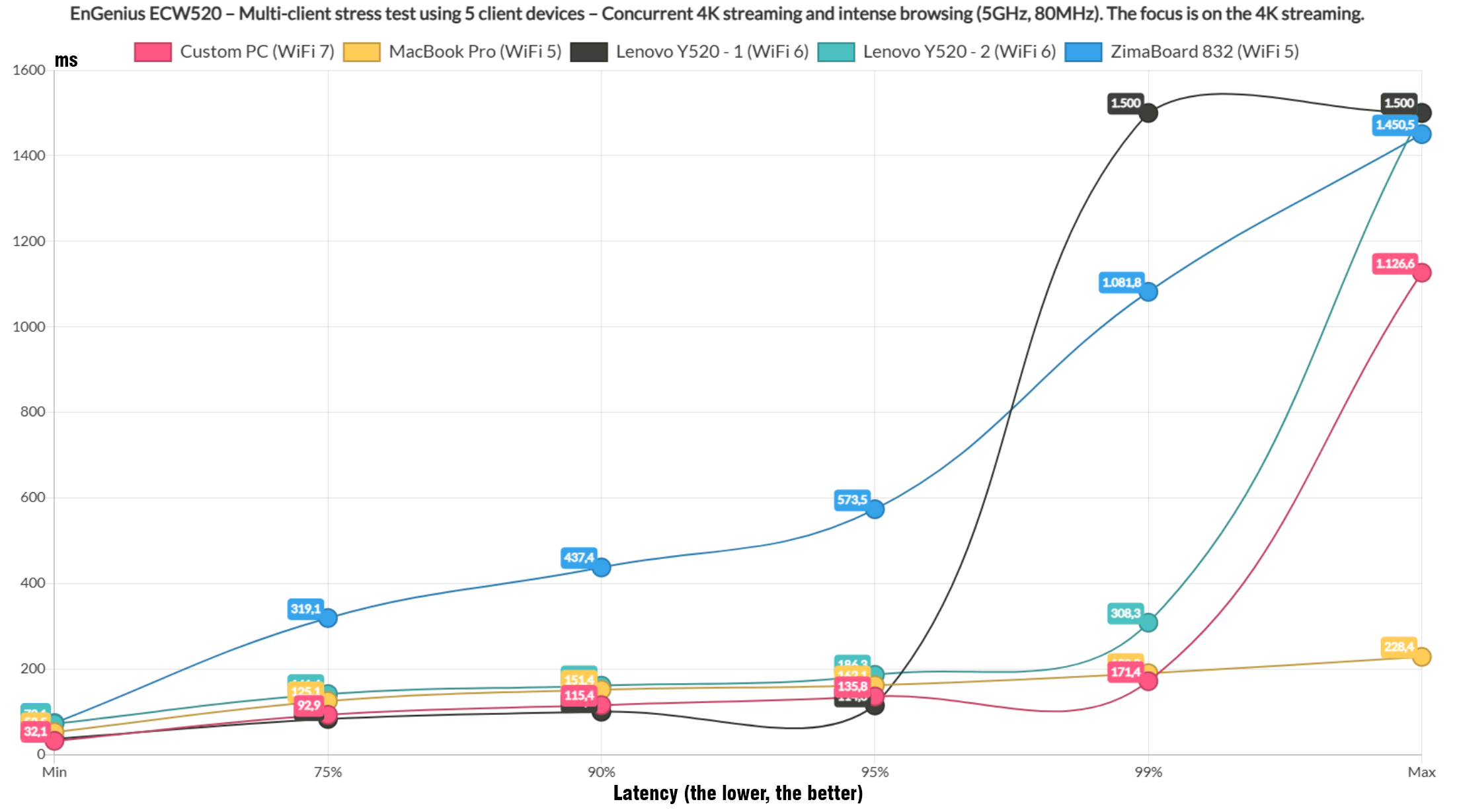
The 4K streaming graphic reveals that it’s not likely a good suggestion. Certain, we get to see a latency close to 150ms for the 4 purchasers which might be close to the entry level, however it’s not likely usable. Nonetheless, as soon as once more, it is a higher efficiency than what I noticed with the ECW512L.
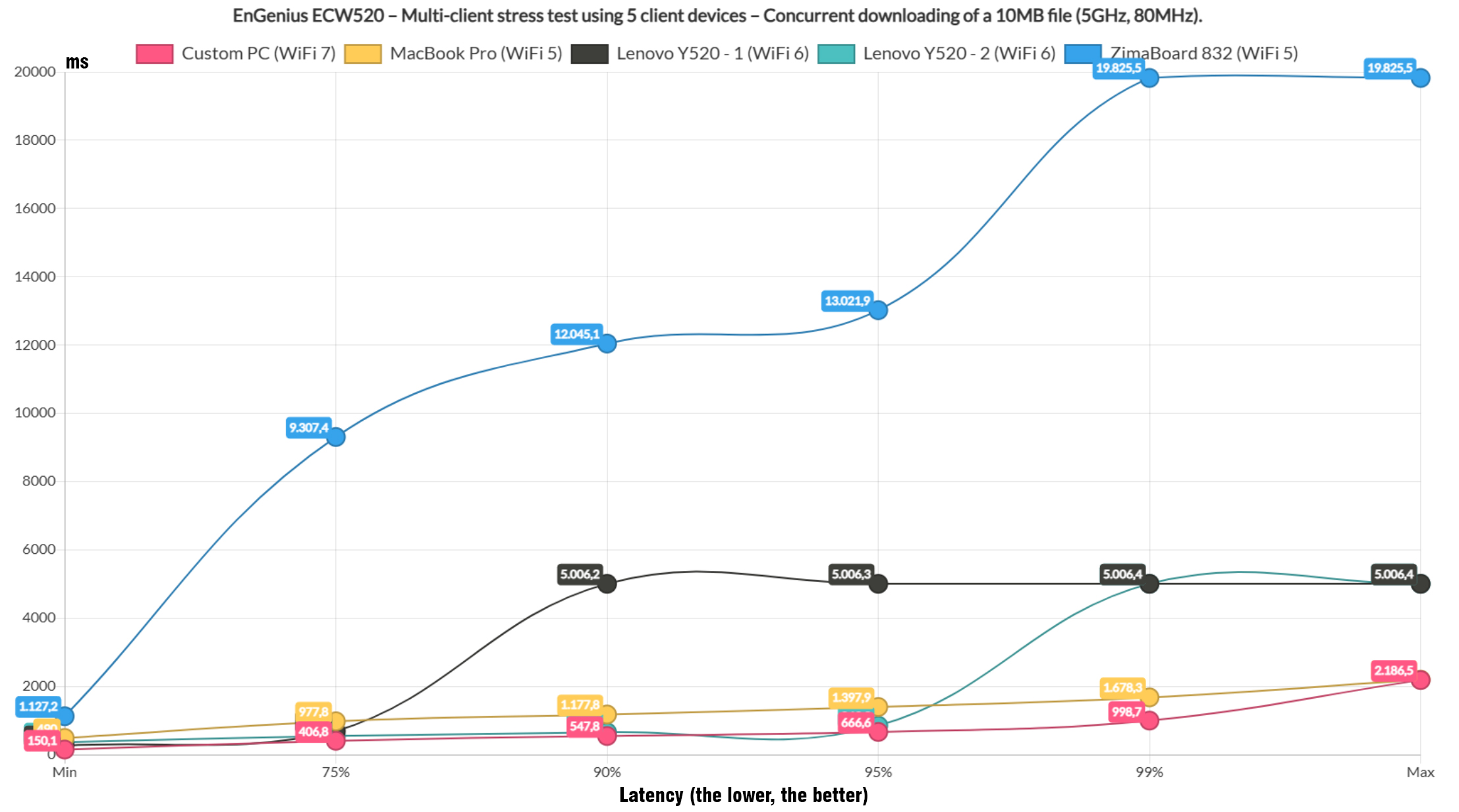
That being mentioned, let’s additionally obtain a 10MB file constantly, however restrict the variety of purchasers to 5, every with its personal kind of simulated visitors.
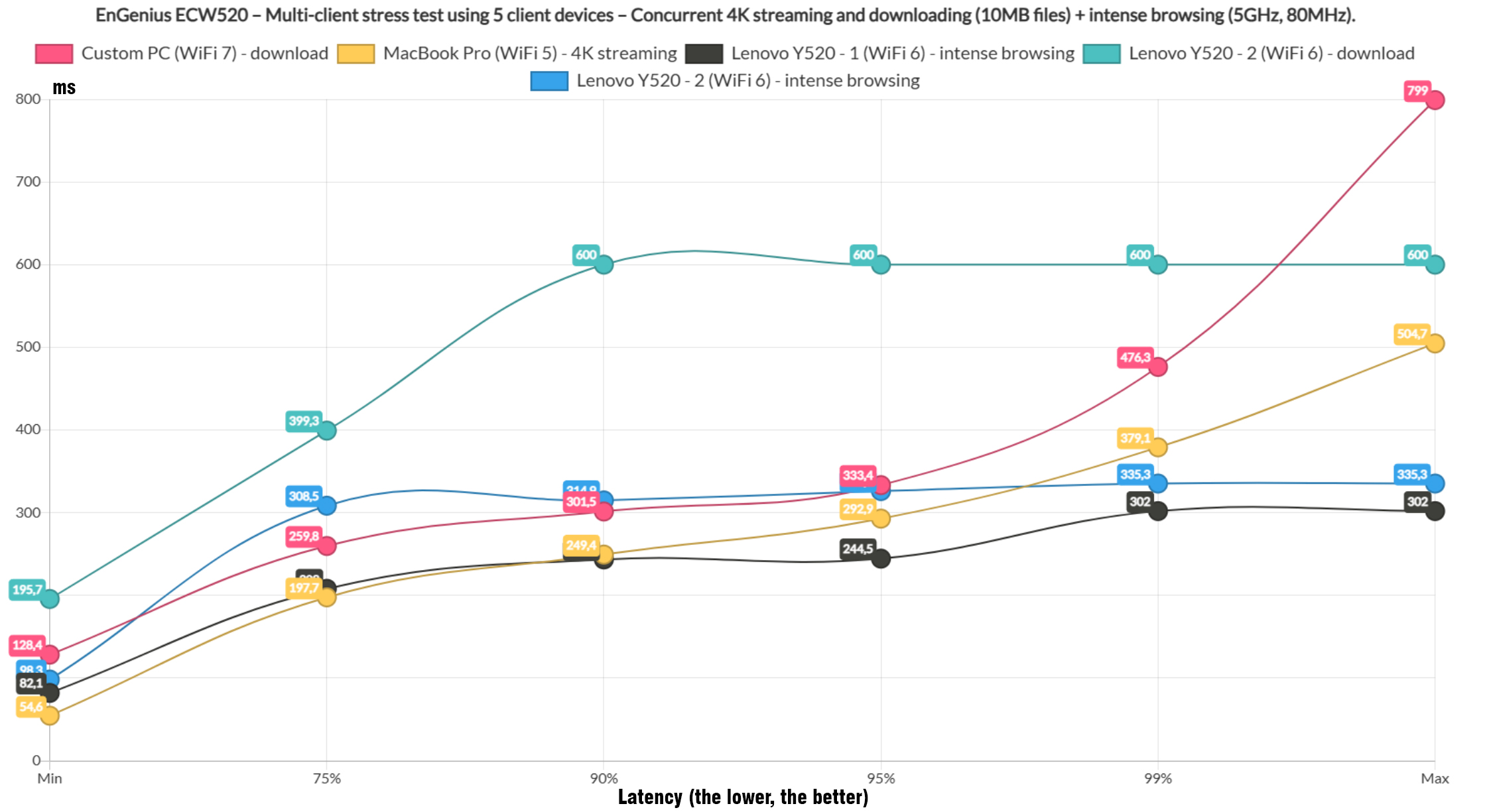
In fact, I began with a few downloading purchasers, one staying close to 300ms more often than not, the opposite going to 600ms virtually instantly and staying there for all the length of the check. There’s influence on the opposite purchasers as effectively, rendering them unusable so I made a decision to restrict the variety of downloading purchasers to at least one.
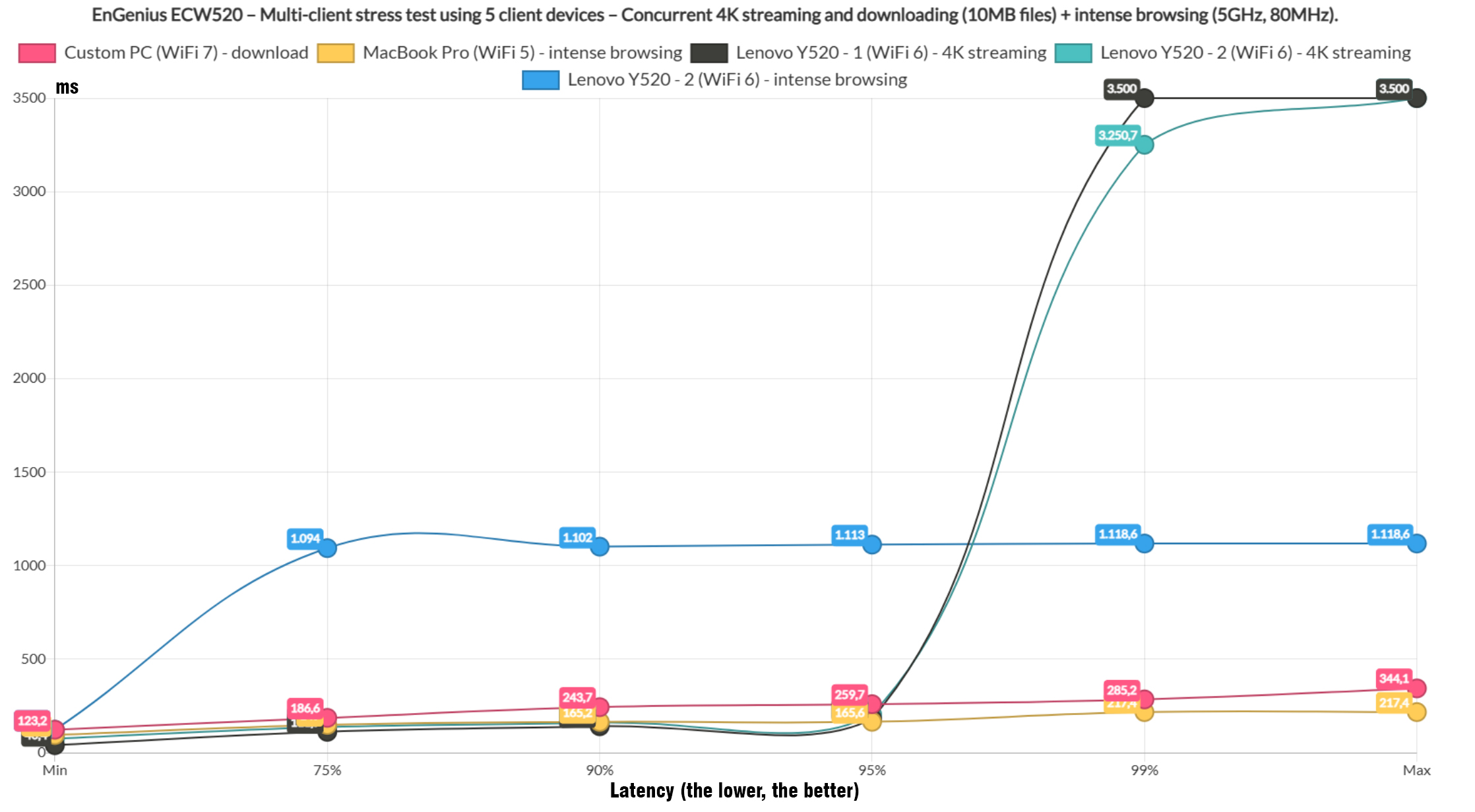
And the outcomes are peculiar. Certain, the downloading shopper stood close to of beneath 250ms more often than not, however the two 4K streaming purchasers had a pointy rise for five% of the time. The extreme searching shopper had a excessive latency, however inside cheap limits.
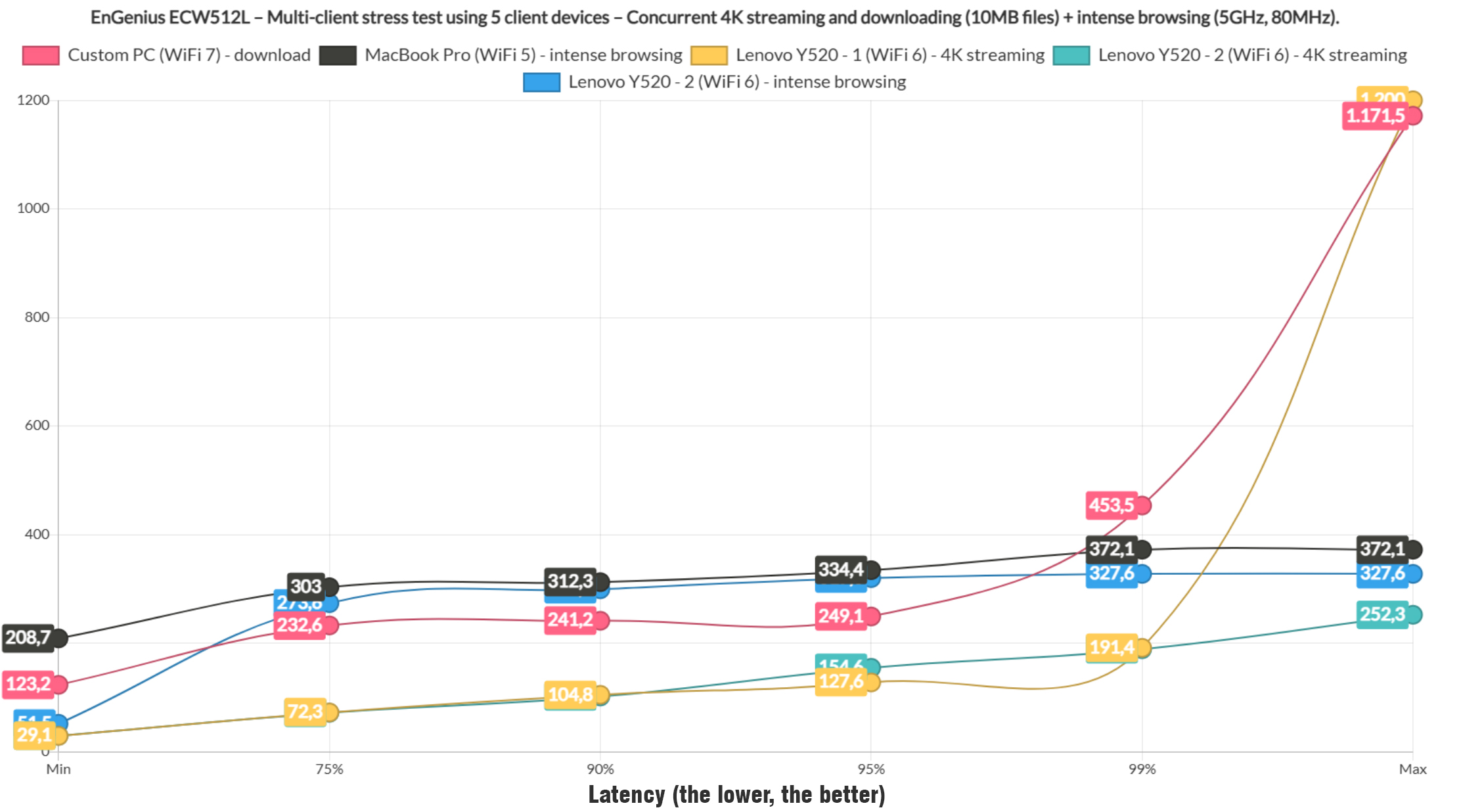
As a comparability, it’s not that a lot totally different than the ECW512L’s efficiency.
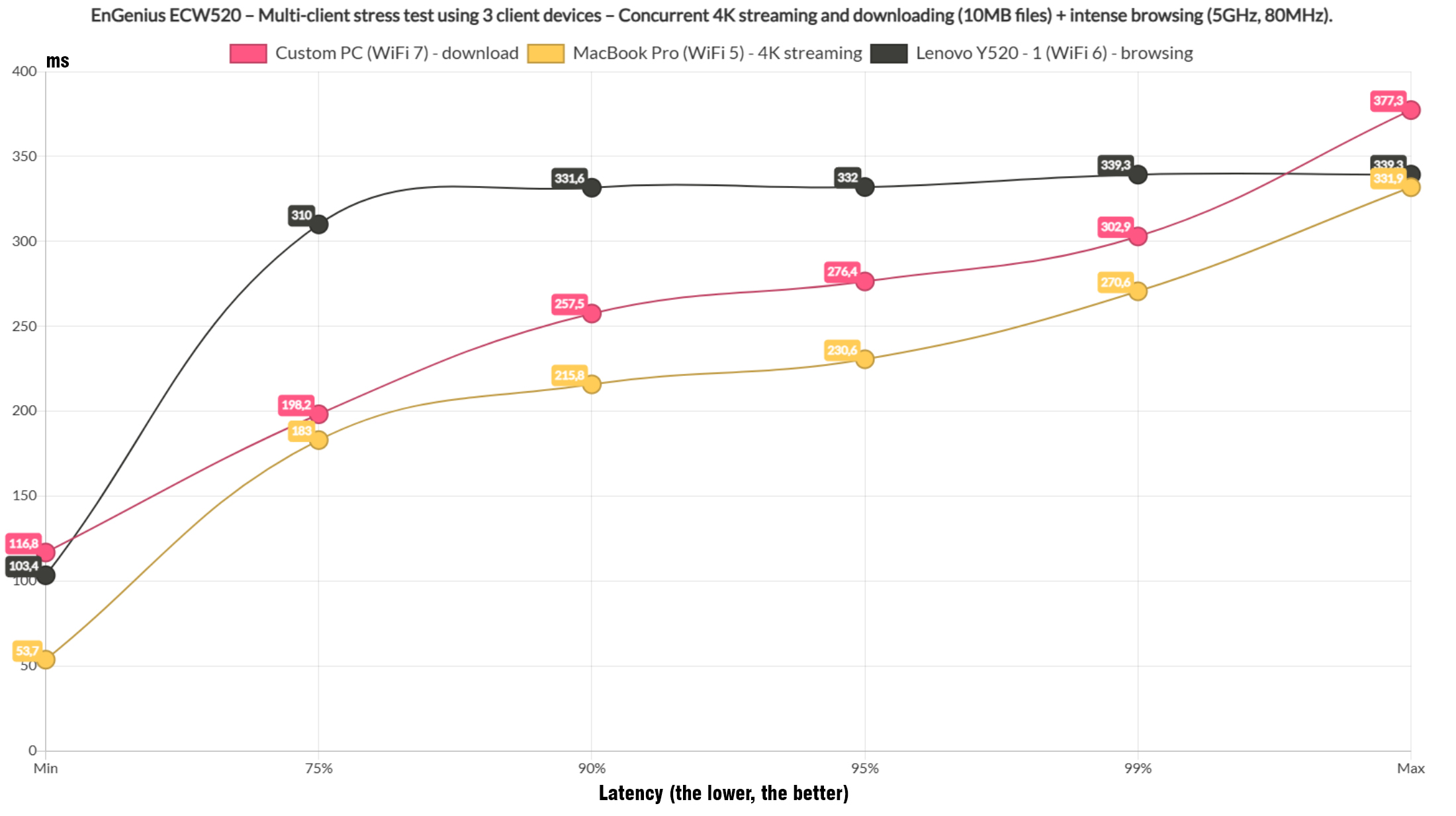
Subsequent, I restricted the variety of purchasers to 3, however downloading a 10MB file remains to be too taxing, so I made a decision to obtain a 1MB file and change the 4K streaming to VoIP.
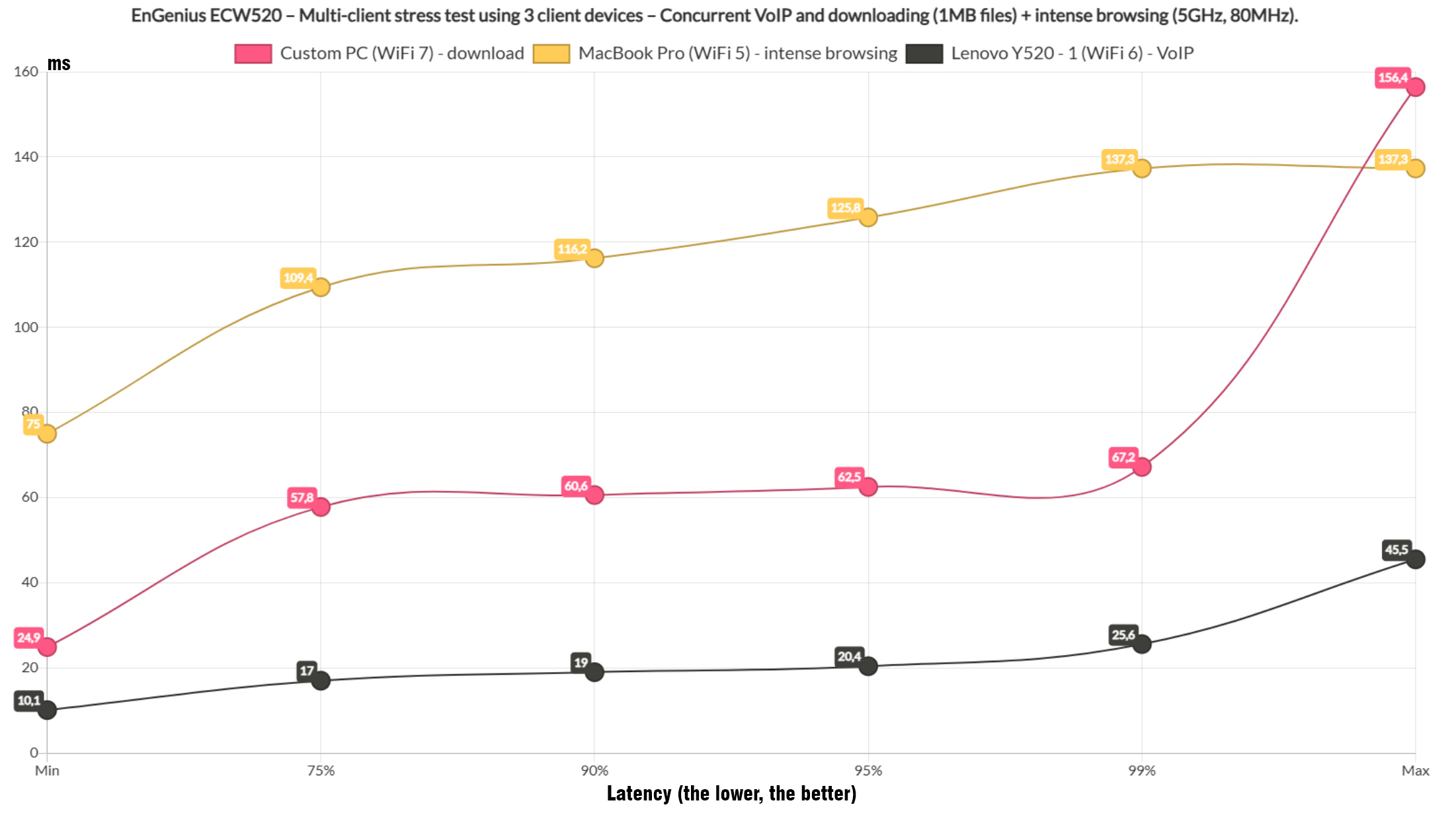
And the consequence is definitely first rate. In fact, I additionally included the latency when all 5 purchasers had been downloading a 10MB file constantly only for enjoyable.
The MLO Efficiency
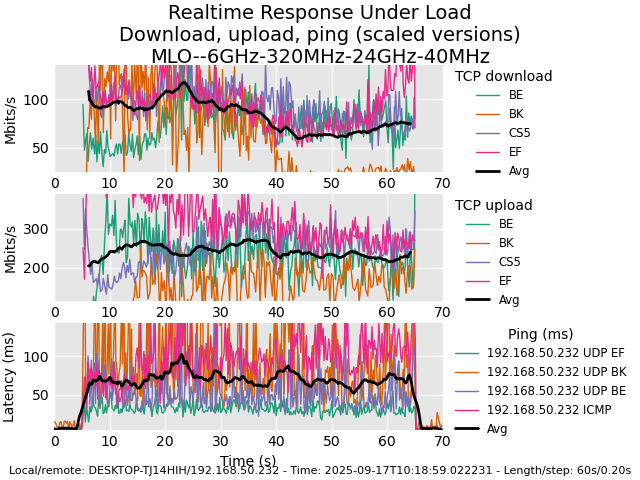
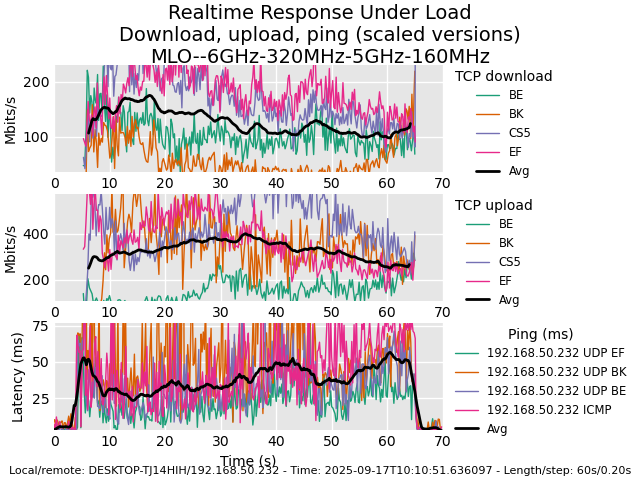
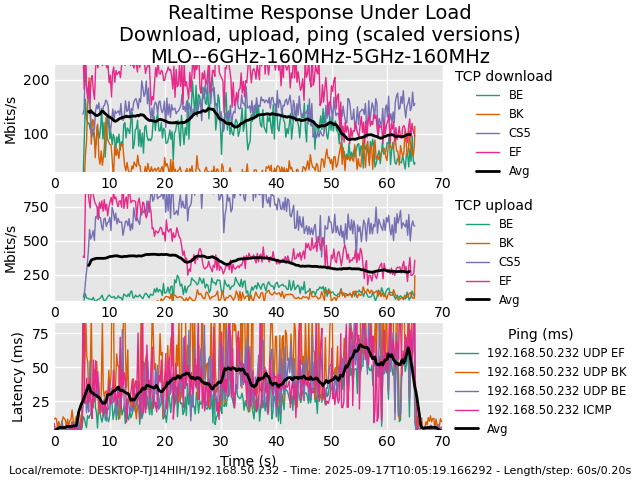
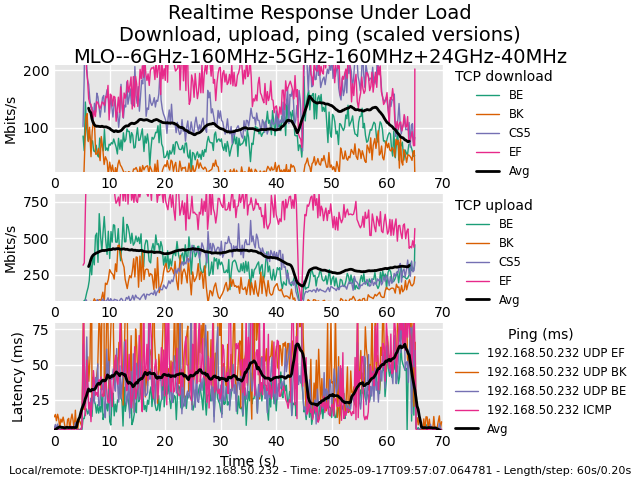
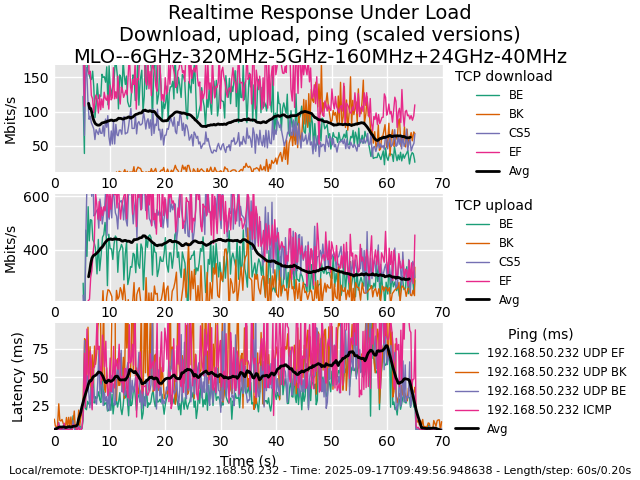
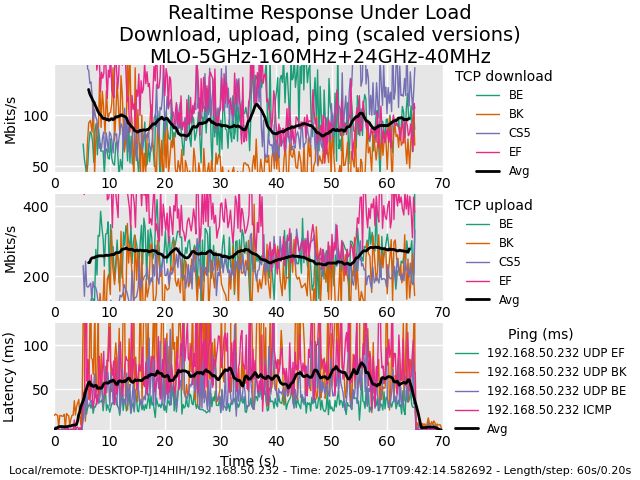
Transferring on the MLO efficiency, we get to see some fascinating issues.
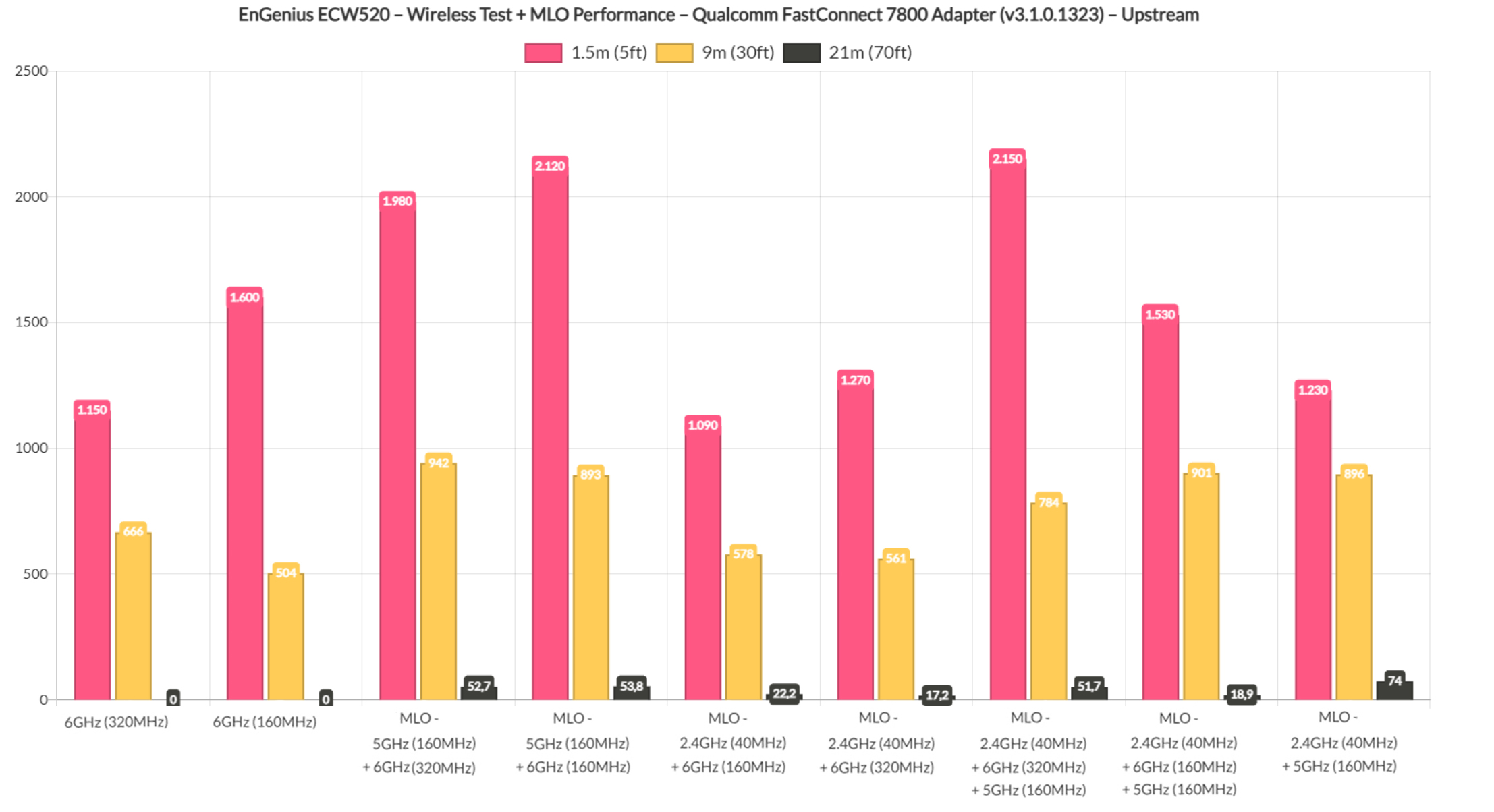
We instantly discover that no matter whether or not set to 320MHz or the 160MHz channel bandwidth, the 6GHz radio doesn’t get very far, however it does have the most effective near-the-access-point throughput. I did undergo all of the out there MLO configurations and it’s doable for the throughput to go above 2Gbps in sure cases, however that’s simply upstream.
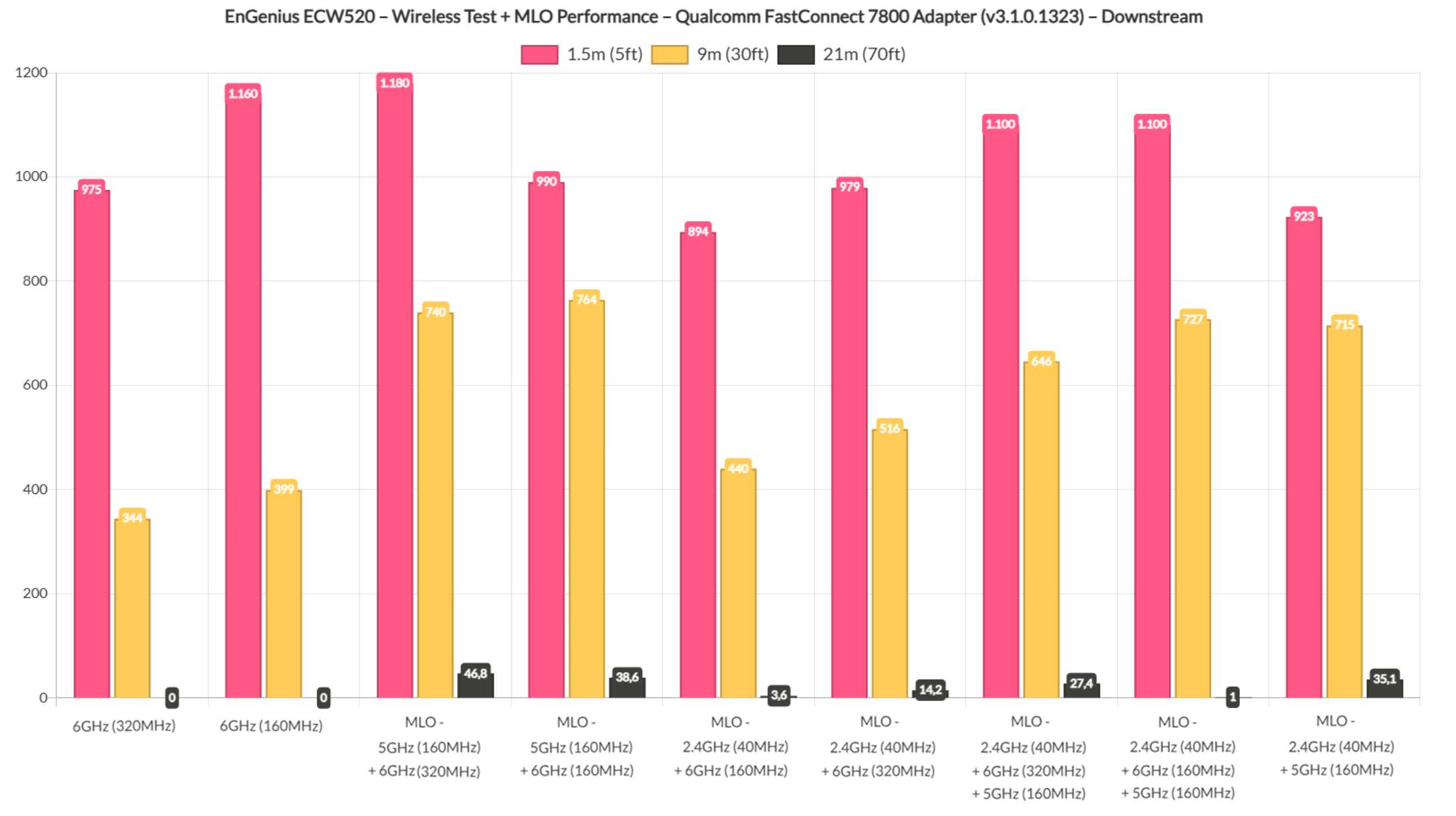
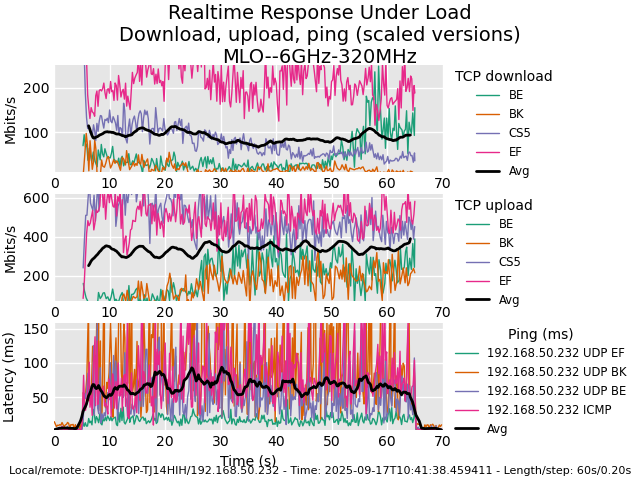
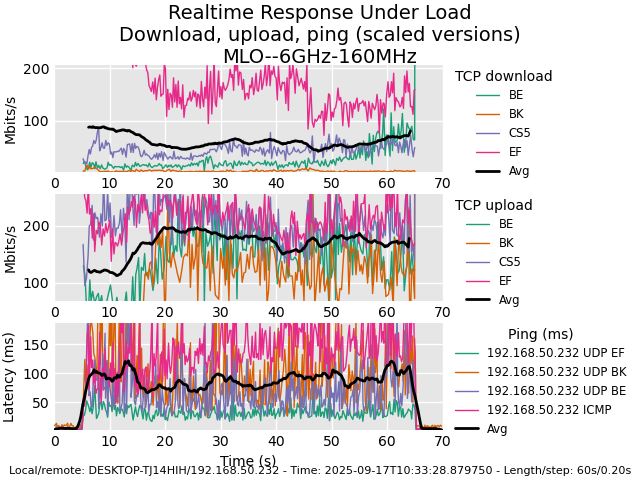
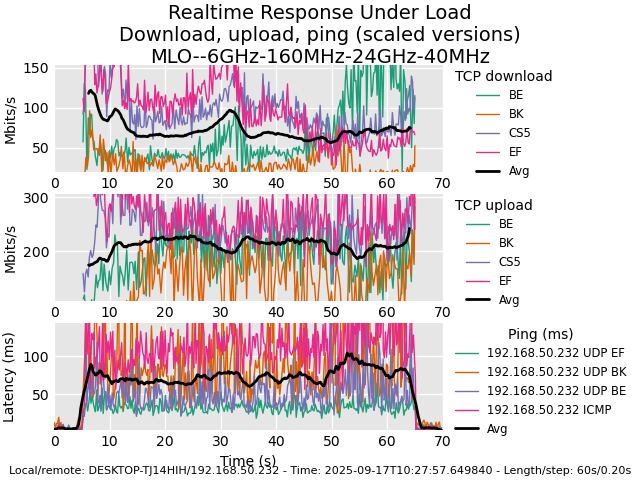
Downstream, the efficiency is a little more subdued, however nonetheless pretty first rate. If you need throughput each close to and farther from the entry level, I counsel going for the 5GHz and 6GHz combo, each set to the 160MHz channel width. In any other case, 2.4GHz and 5GHz is an honest mixture as effectively. On the finish, I’ve included the info I collected when operating FLENT.
The Standalone Mode
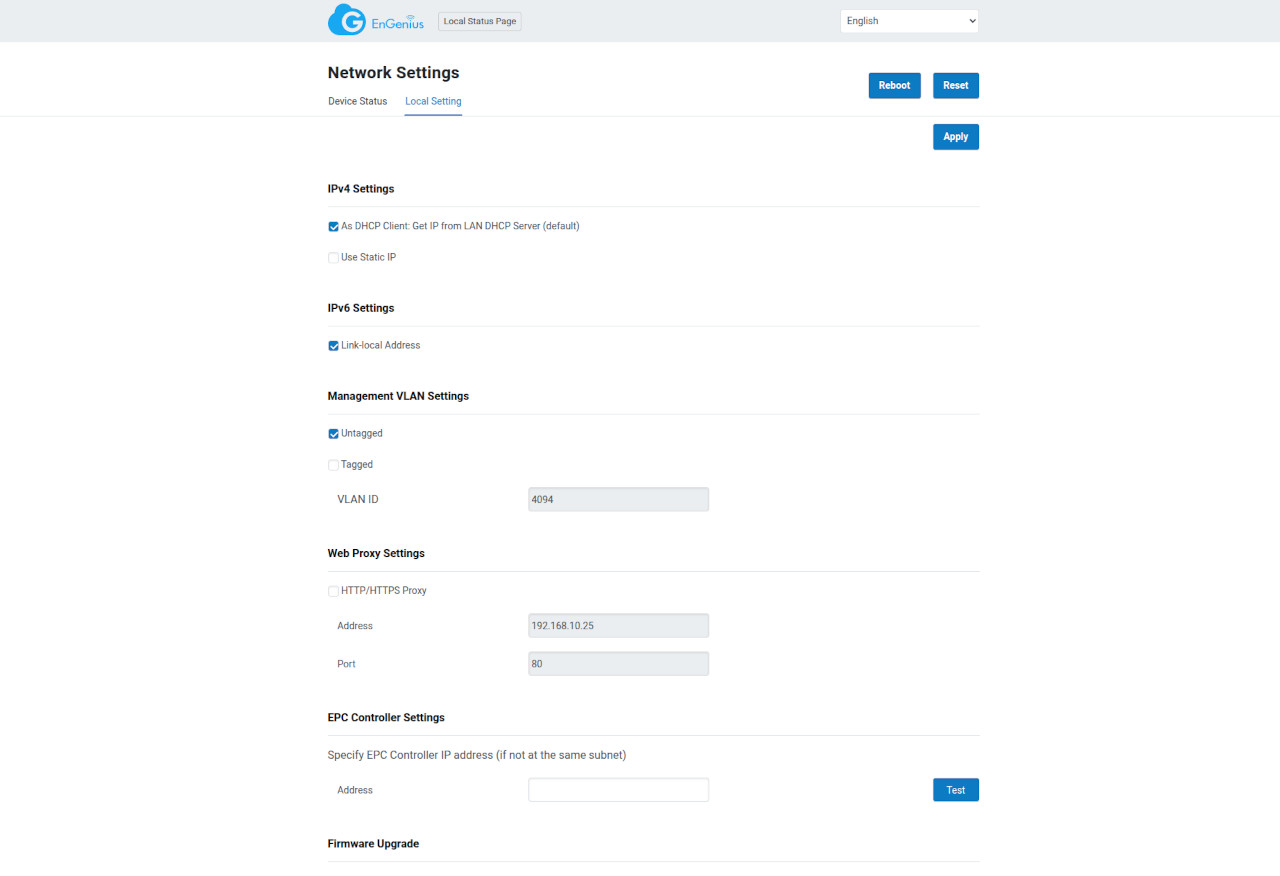
The EnGenius ECW520 does have a standalone mode, however it’s barely helpful. You get some primary monitoring information and what’s referred to as Native Setting. It features a few network-related settings and nothing extra, so that you do must depend on the Cloud for the right expertise. This might be an issue sooner or later if EnGenius decides to not help this mannequin anymore.
The Cloud Platform
I did point out the ECW512L a number of instances, however whereas this one get the Lite model of the Cloud, utilizing the ECW520 provides you with full entry to the EnGenius Cloud platform. The areas of curiosity are, as anticipated, the Dashboard and Entry Factors for the monitoring instruments of which there are fairly a number of.
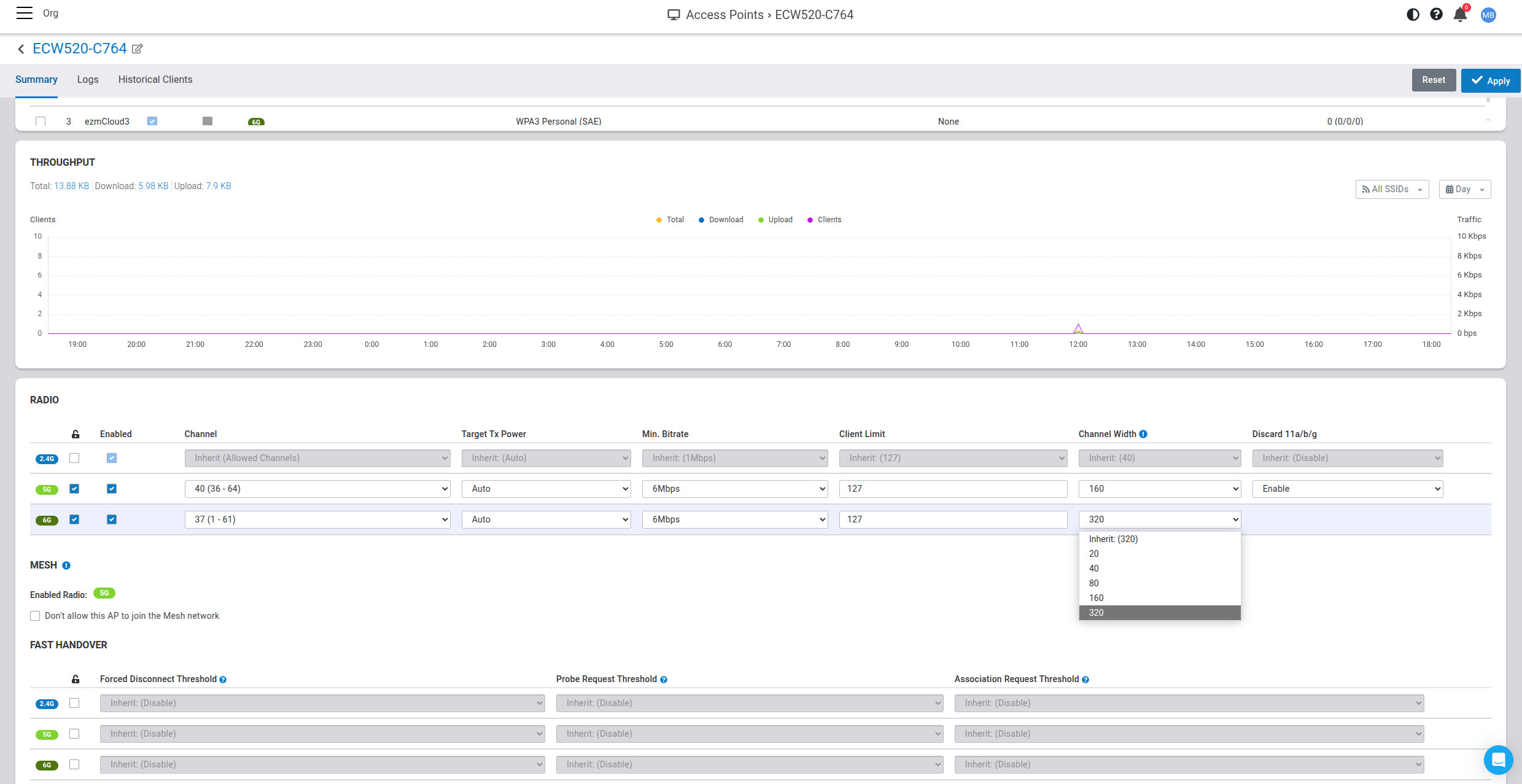
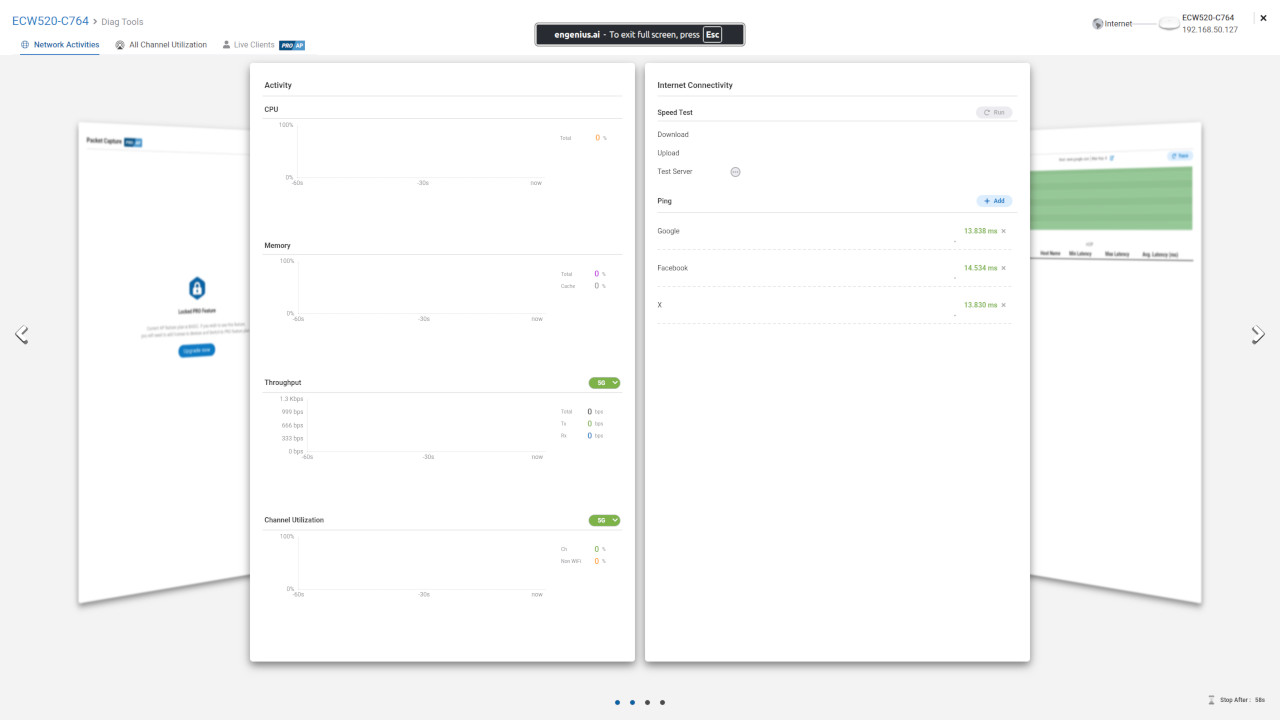
However for configuration, there’s the SSIDs and radio sections the place you’ll be able to set the overall settings which shall be utilized for all entry factors that shall be added to the community. You do get the choice to overwrite these settings on the machine degree with ease and we additionally get the enduring Diag instruments which do come to life in the event you get the Professional subscription. Then once more, even in its present default state, it’s nonetheless lots sufficient for many community admins.
The Conclusion
OK, so must you think about the EnGenius ECW520? SMBs will certainly have quite a lot of enjoyable with it. The value is pretty low, whereas getting a lot of the superior WiFi 7 options plus the flexibility of the Cloud platform. It’s straightforward to watch, configure and the Diag instruments shall be of nice assist to sys admins. Is it higher than the ECW516L? Probably not. I believe the ECW520 is the higher possibility.

Mark is a graduate in Laptop Science, having gathered helpful expertise through the years working in IT as a programmer. Mark can also be the primary tech author for MBReviews.com, masking not solely his ardour, the networking gadgets, but in addition different cool digital devices that you could be discover helpful on your day-after-day life.