
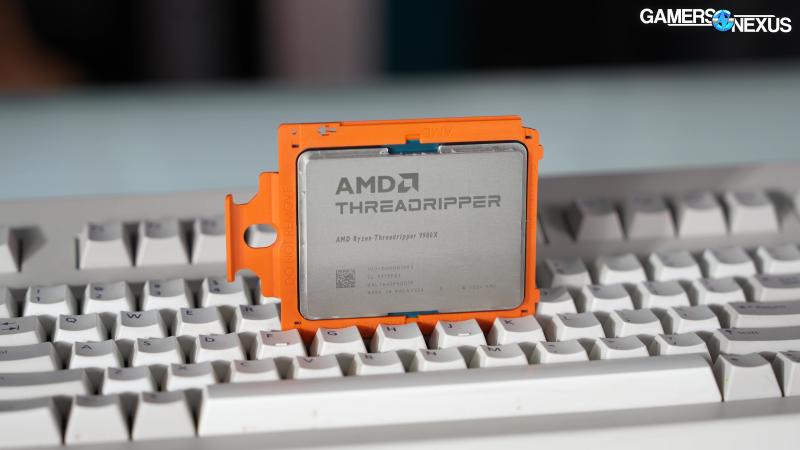
AMD Threadripper 9980X 64-Core CPU Review & Benchmarks Leave a comment
The short model up entrance is that the advance on the 7980X is anyplace from round 2% to that 58% quantity, however the overwhelming majority of checks are nearer to the vary of 5% to 18%. It actually closely will depend on the workload with these CPUs, notably AVX occupancy.
These are workstation CPUs meant for analysis, manufacturing work, or usually duties that both become profitable or advance science or one thing related. We’re nonetheless benchmarking gaming, however the focus can be totally on manufacturing workloads right now with gaming solely there to make sure there aren’t any main damaged outcomes.
These CPUs are costly. That limits the viewers. For that cause, we added all the brand new checks as a possibility to additionally re-run every part else, so all of this knowledge is model new. Even should you’re not available in the market for Threadripper, it will have attention-grabbing knowledge from extra “regular” CPUs on the market.
Overview
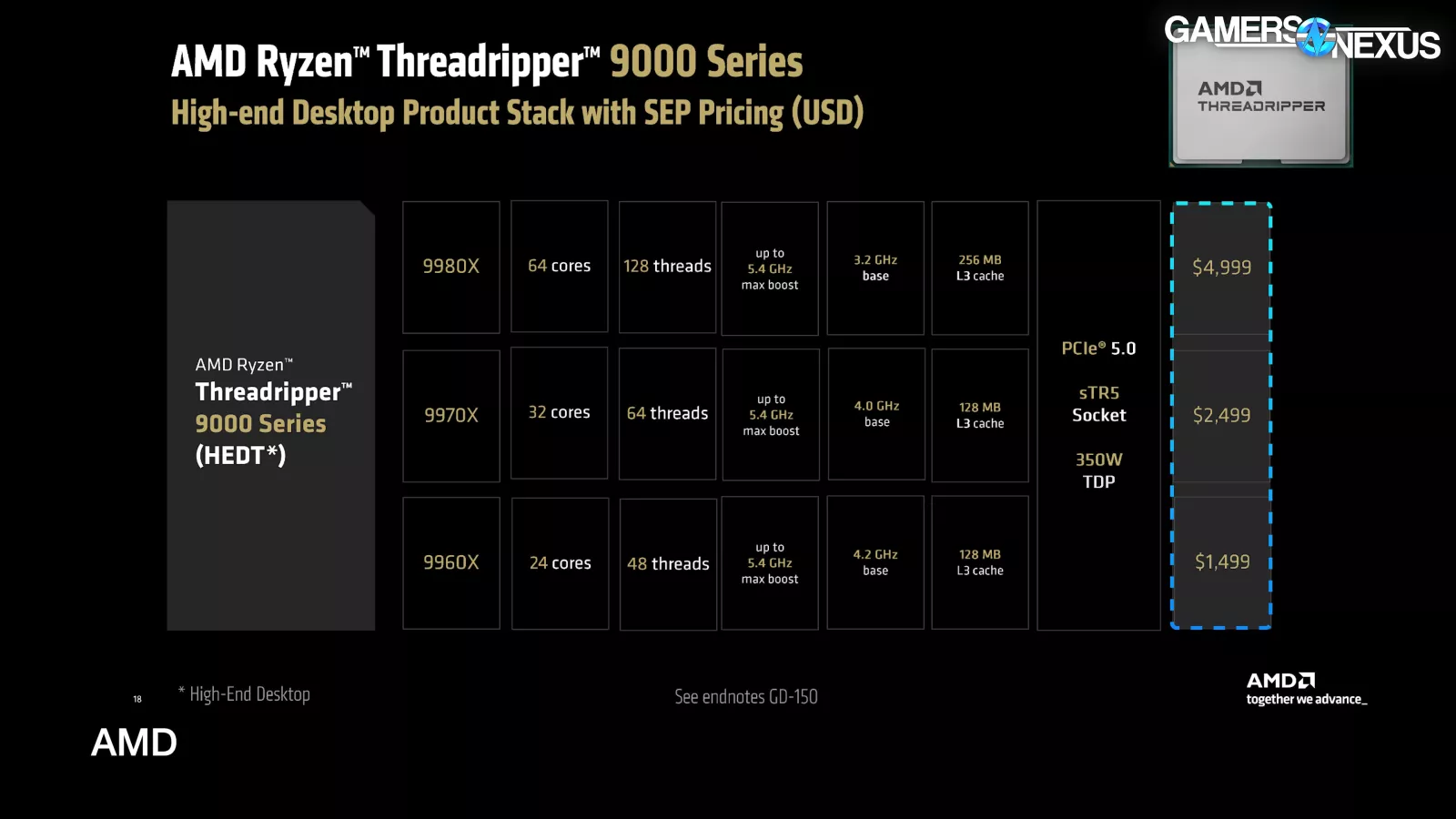
Right here’s the fast recap of the CPU lineup.
AMD is launching two variations of the Threadripper 9000 CPUs. These embody the non-Professional and Professional CPUs. The Professional CPUs had an earlier embargo; right now, we’re overlaying the HEDT (or “high-end desktop”) non-Professional Threadripper CPUs.
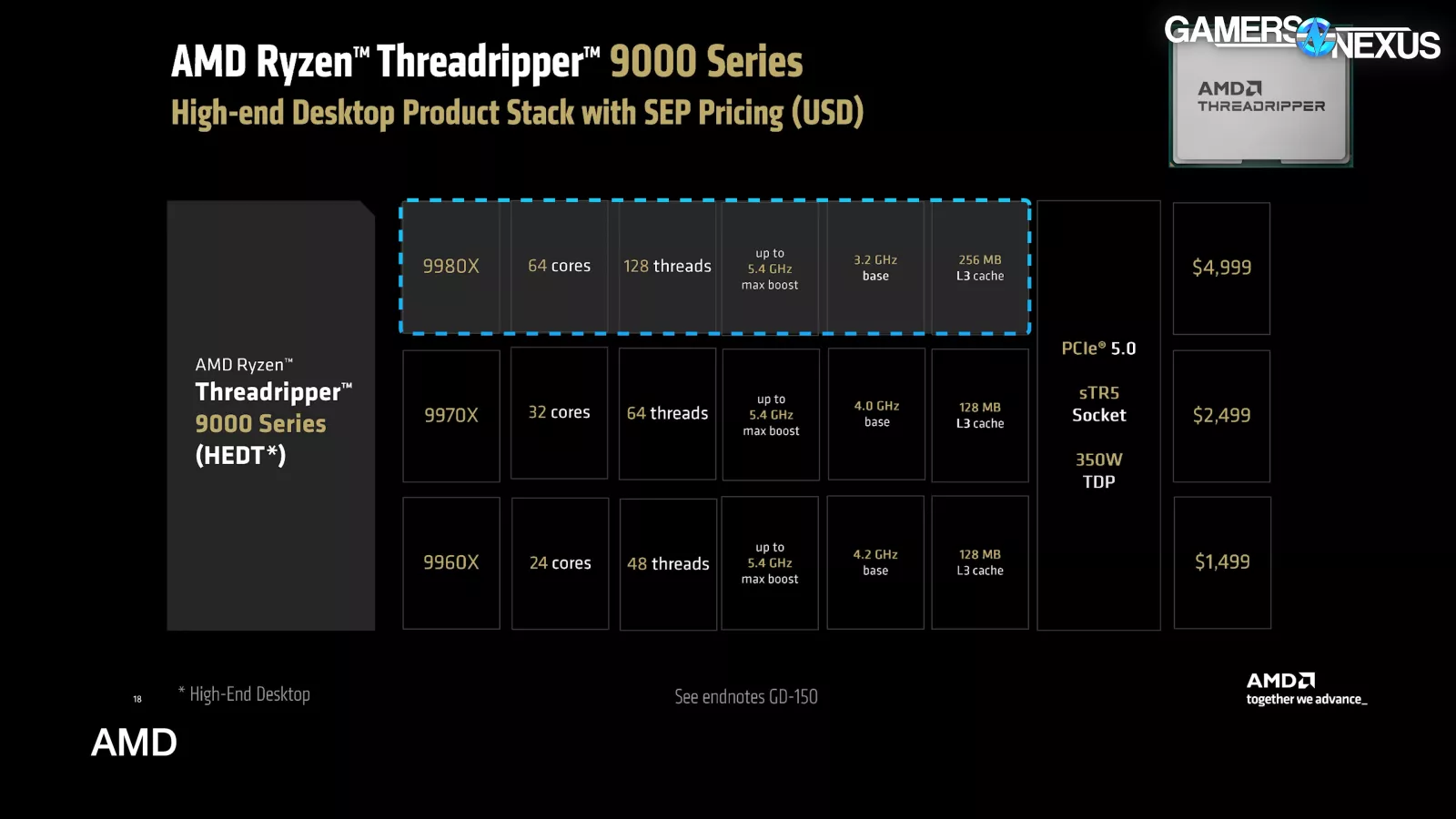
The 9980X is a 64-core, 128-thread half that reinforces as much as 5.4 GHz and has 256MB of L3 Cache. The CPU sockets into STR5 platforms and, like the opposite two fashionable Threadripper components launching with it, has a 350W TDP. It’s $5,000 for the 9980X.
The 9970X is a 32-core, 64-thread half. All of them share the identical enhance of 5.4GHz, however the base clock is increased on the decrease core-count CPUs on account of increased energy availability per core based mostly on energy funds. Cache is right down to 128MB L3 on the 9970X and 9960X, the latter of which is a 24-core, 48-thread half. Pricing is $2,500 for the 9970X and $1,500 for the 9960X.
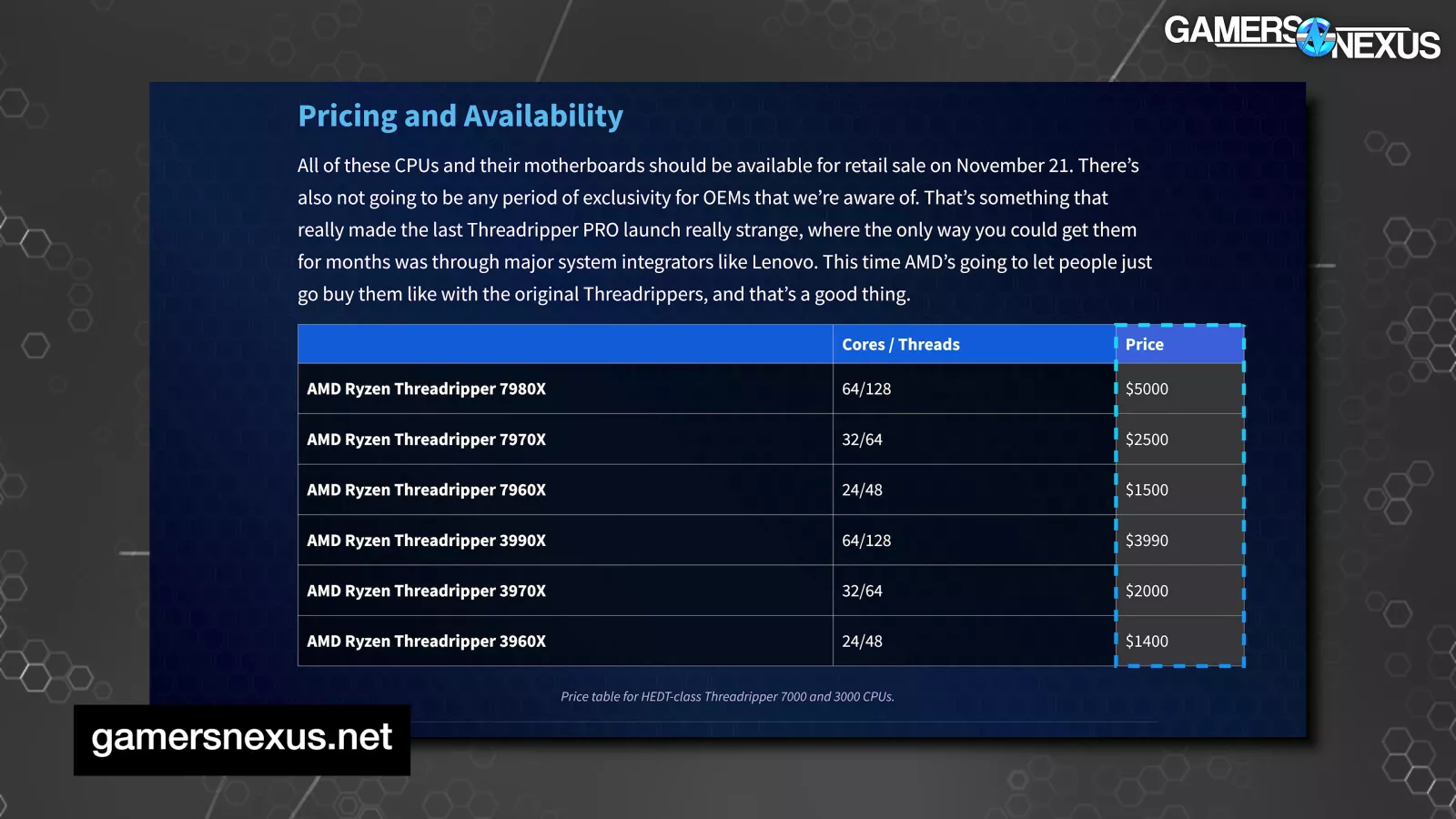
Compared to last time, costs are acquainted: The 7980X was $5,000, the 7970X was $2,500, and the 7960X was $1,500. Threadripper 9000 costs are elevated from a number of generations again to the 3000 sequence, however the identical because the 7000 sequence.
The architectural enhancements are the identical as in Zen 5 with the 9000 sequence launch. The largest one you’ll see right now is from the AVX modifications. Once we have been digging into the most important enchancment in our testing, AMD despatched this rationalization as a refresher on Zen 5:
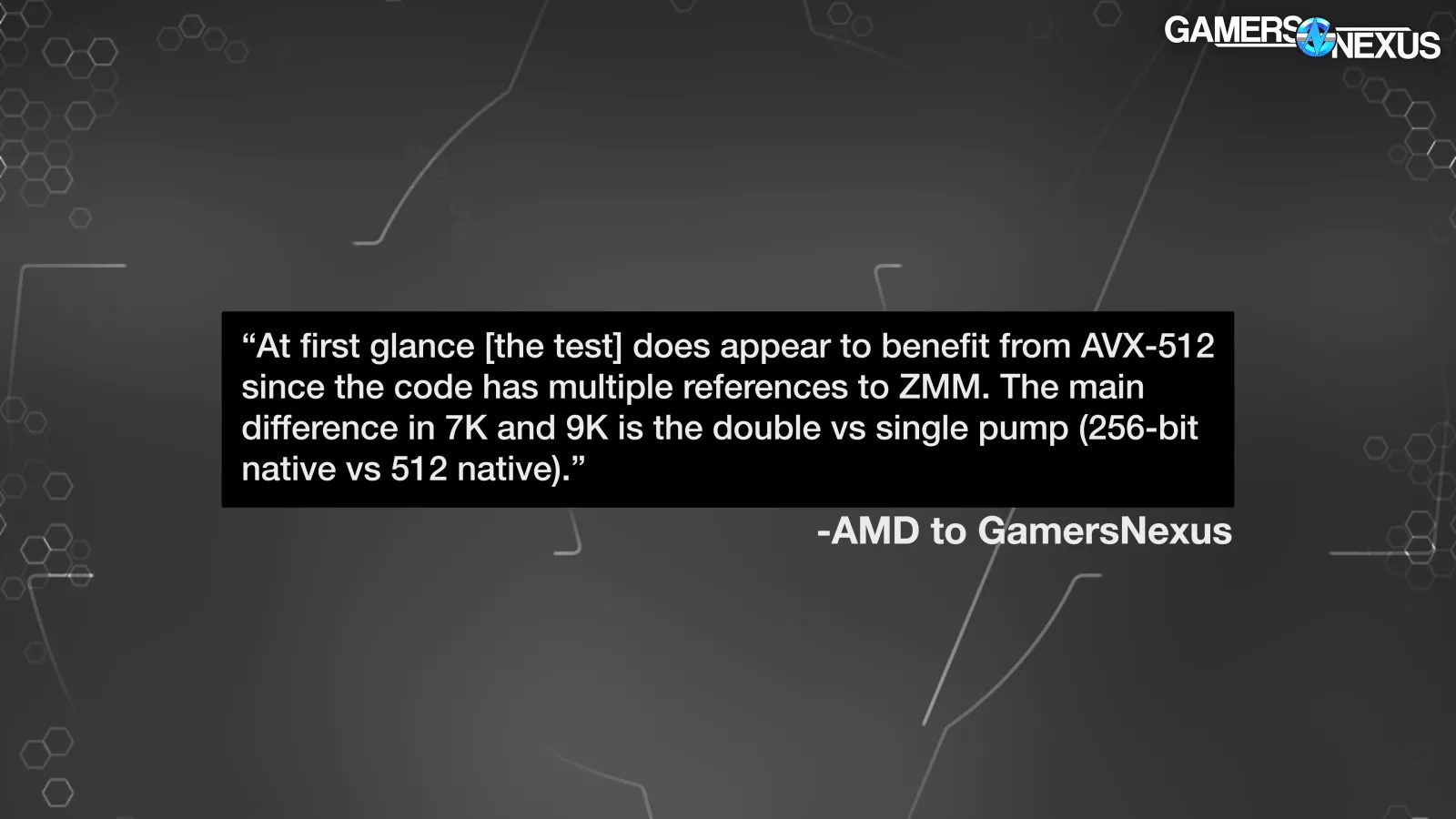
“At first look [the test] does seem to profit from AVX-512 for the reason that code has a number of references to ZMM. The principle distinction in 7K and 9K is the double vs single pump (256-bit native vs 512 native).”
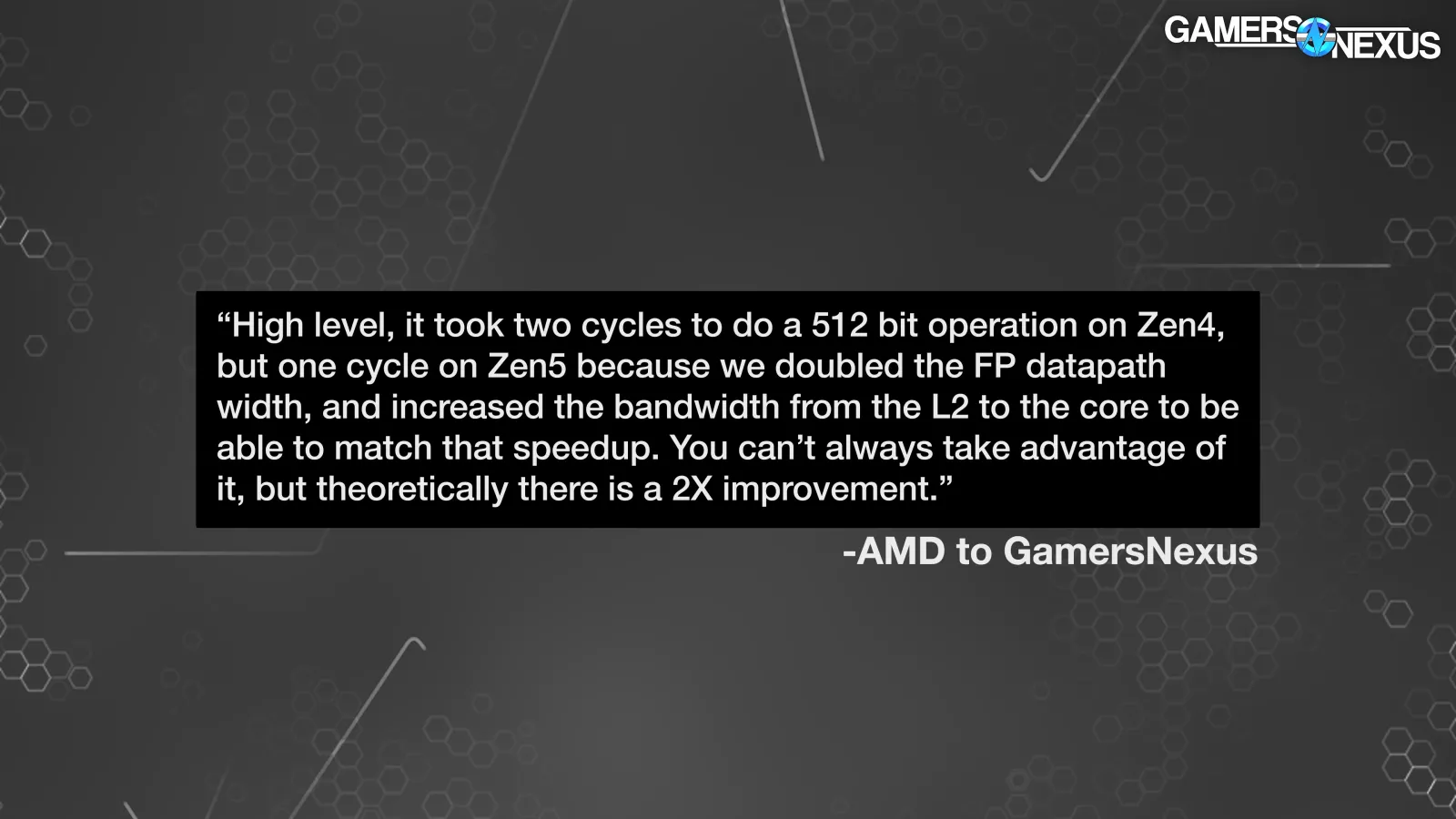
“Excessive degree, it took two cycles to do a 512 bit operation on Zen4, however one cycle on Zen5 as a result of we doubled the FP datapath width, and elevated the bandwidth from the L2 to the core to have the ability to match that speedup. You may’t at all times make the most of it, however theoretically there’s a 2X enchancment.”
That “theoretically” is vital, as a result of it doesn’t present up in most of our checks; nonetheless, in some, there’s a very giant uplift. This isn’t particular to Threadripper and is as an alternative particular to Zen 5 vs. Zen 4. We’ll spend a while on that in our overview.
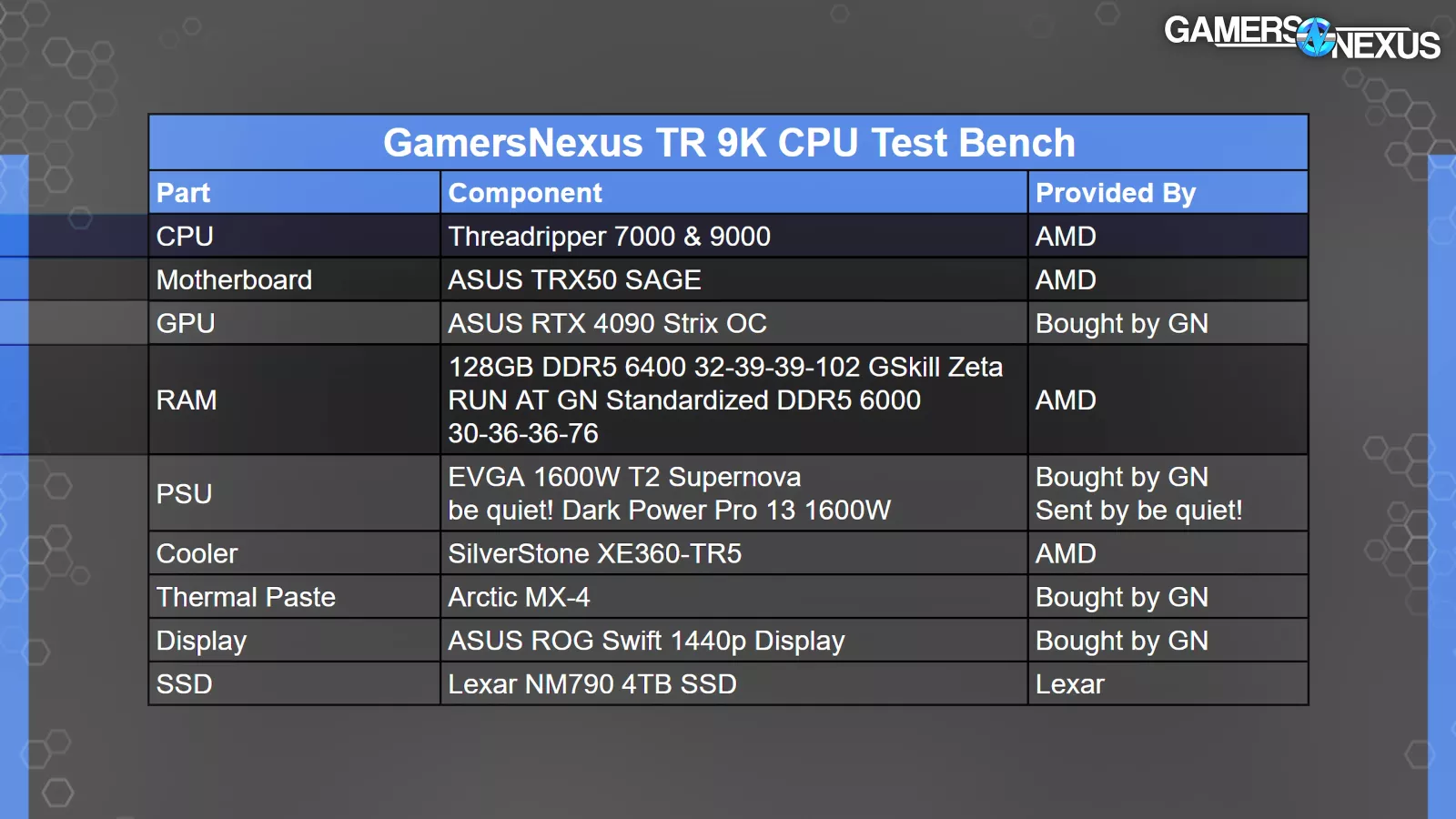
As for the check bench: Our chart subtitles apply to the desktop platforms, however the Threadripper CPUs are examined with completely different reminiscence and motherboards. It deviates from a number of the different benches.
Let’s get into the benchmarks. We’ll begin with manufacturing testing.
9980X Manufacturing Benchmarks
7-Zip Compression
7-Zip compression is up now.
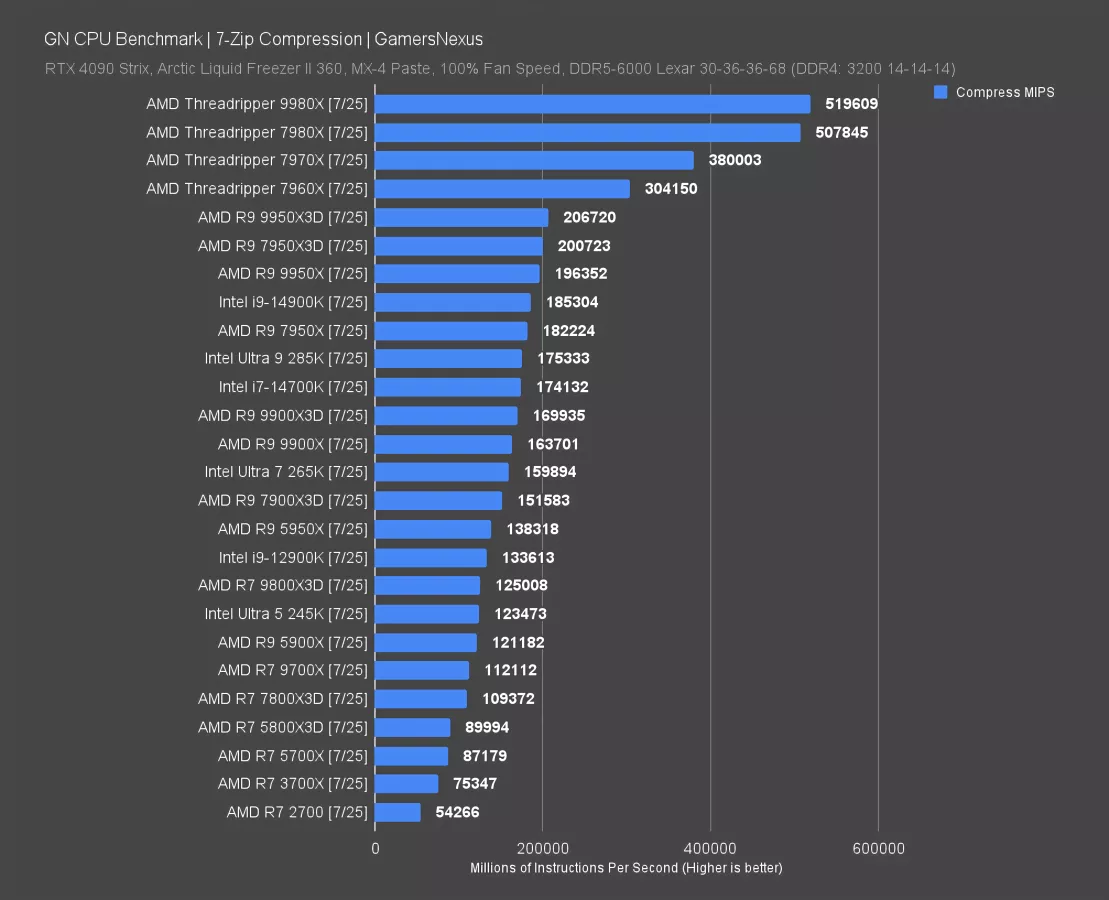
This check is measured in MIPS, or hundreds of thousands of directions per second. Greater is healthier throughput. The 9980X is the brand new chart-topper right here, at 520K MIPS versus the 7980X’s 508K MIPS. The advance is simply 2.3% right here. This is without doubt one of the decrease enhancements.
There’s clear profit to increased core counts on this check. The 7980X over the 7970X beforehand held a lead of 34%, or 67% over the 7960X.
Towards the highest-end desktop half, the 9950X3D, the 9980X sees an enchancment of 151%. Notably, further cache appears to assist right here: Each the 7950X3D and 9950X3D are benefitted over the 9950X.
Threadripper is in a wholly completely different class from desktop parts, though the uplift over the past technology’s 7980X is proscribed and comparatively boring right here.
7-Zip Decompression
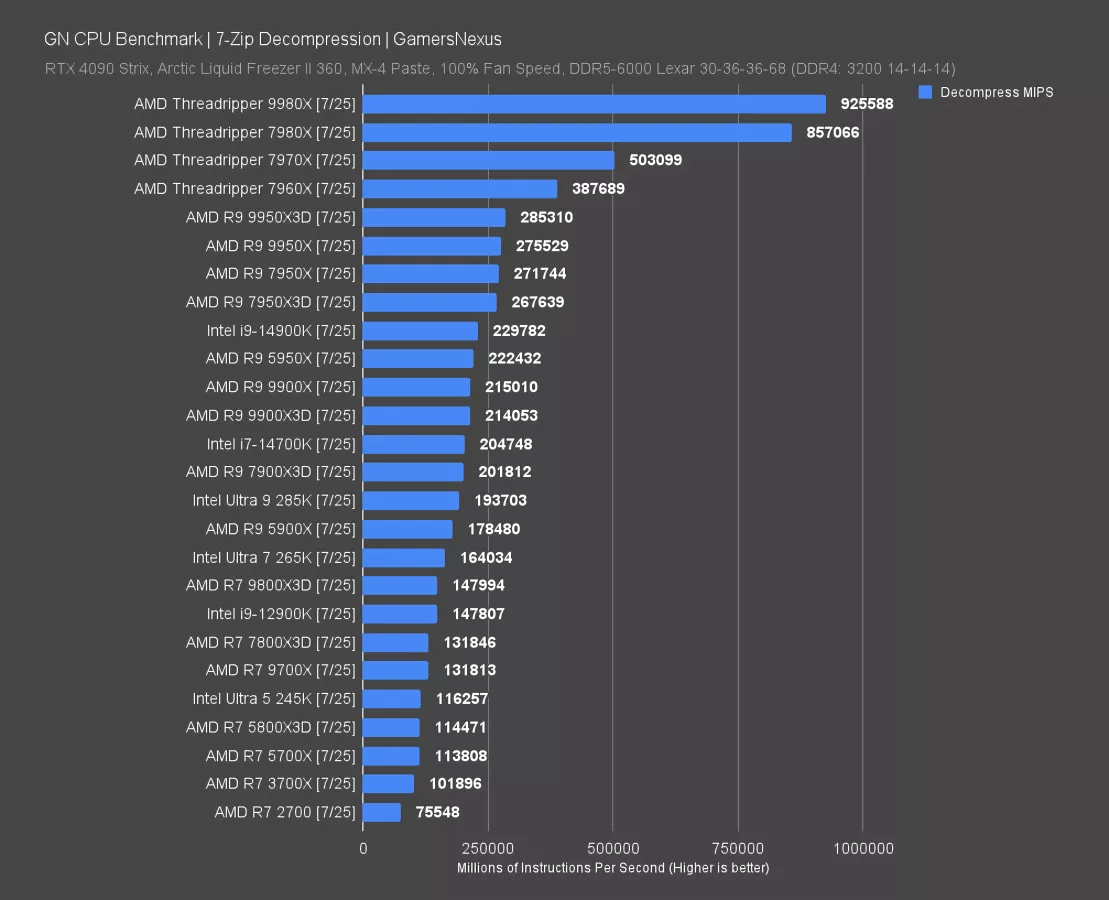
In decompression, the 9980X scaled as much as 926K MIPS, gaining 8% on the 7980X’s 857K MIPS. This can be a higher displaying than what we noticed in compression and posts higher scaling. The remainder of the lineup is acquainted to the prior examples. Additional cache doesn’t assist as a lot on this check as in comparison with the compression check, because the 7950X3D is now beneath the 9950X. This might align with the pace profit offering extra of an uplift on Threadripper as properly.
SpecWS: OptionsPricing
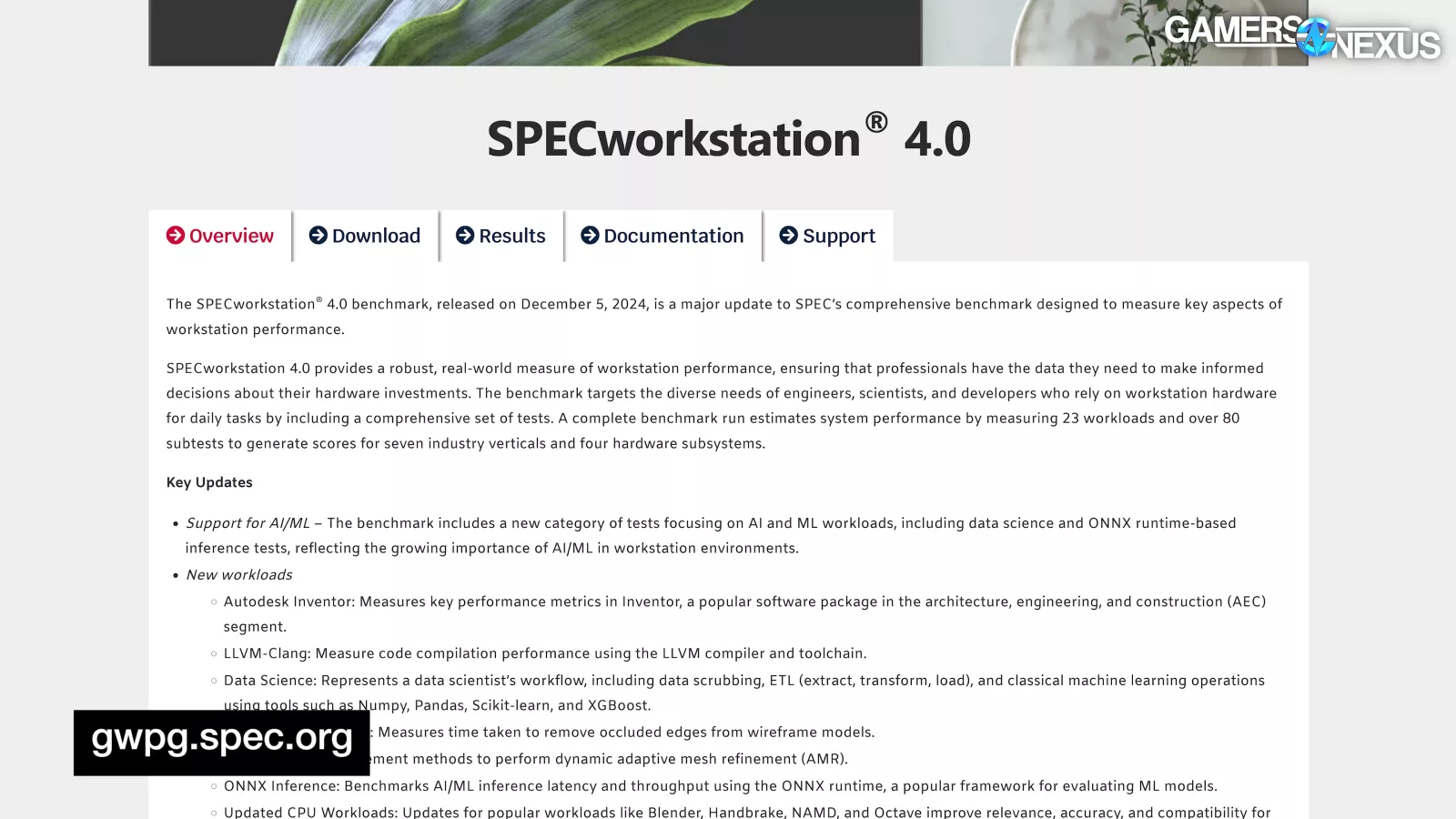
SpecWorkstation 4.0 is subsequent. This runs plenty of simulations and mathematical fashions that we aren’t specialists in, however we will not less than run the benchmarks. We’ll depend on the Spec web site to elucidate what the checks are.
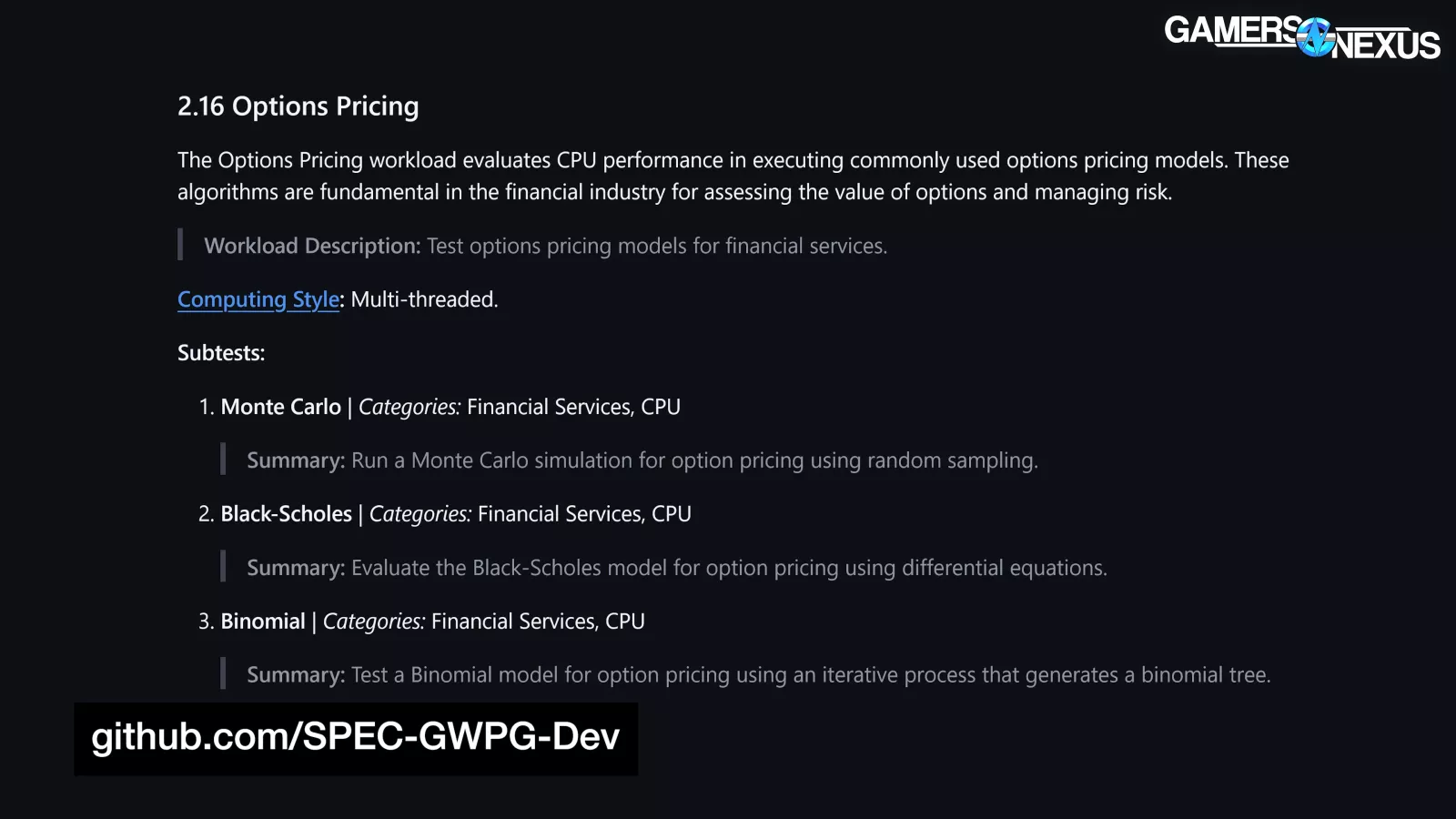
The primary is Choices Pricing. The website says that this runs Monte Carlo probabilistic simulations for monetary uncertainty, Black-Scholes pricing fashions for theoretical worth, and binomial choices pricing. We aren’t specialists in how these are used, however these of you in our viewers who’re specialists have repeatedly expressed an appreciation for this check.
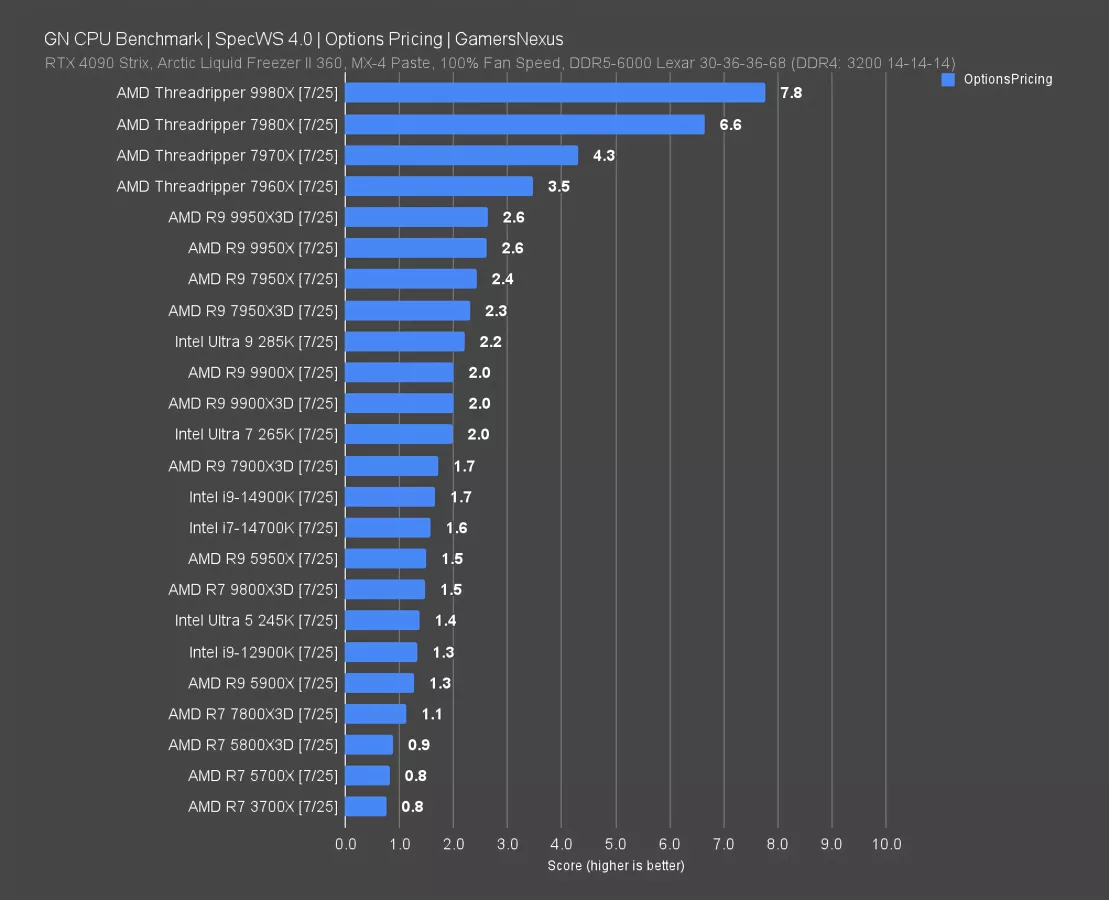
The outcomes have the 9980X on the prime, with a 7.8 rating. That has it improved on the 7980X by a powerful 18%, aligning with the findings of the 9000 sequence desktop components towards the 7000 sequence on this identical check. You may see that within the 9800X3D towards the 7800X3D or the 9900X3D vs. 7900X3D. That is an architectural profit. It’s one of many uncommon break-outs for Zen 5 that we talked about after the preliminary spherical of opinions after we had validated it as a professional deviation.
The 9980X improves on the highest-end desktop 9950X3D by 200%, principally being the distinction between being runnable and never. Threadripper actually makes an affect right here, and the generational acquire is actual however uncommon on this one check.
SpecWS: OpenFOAM
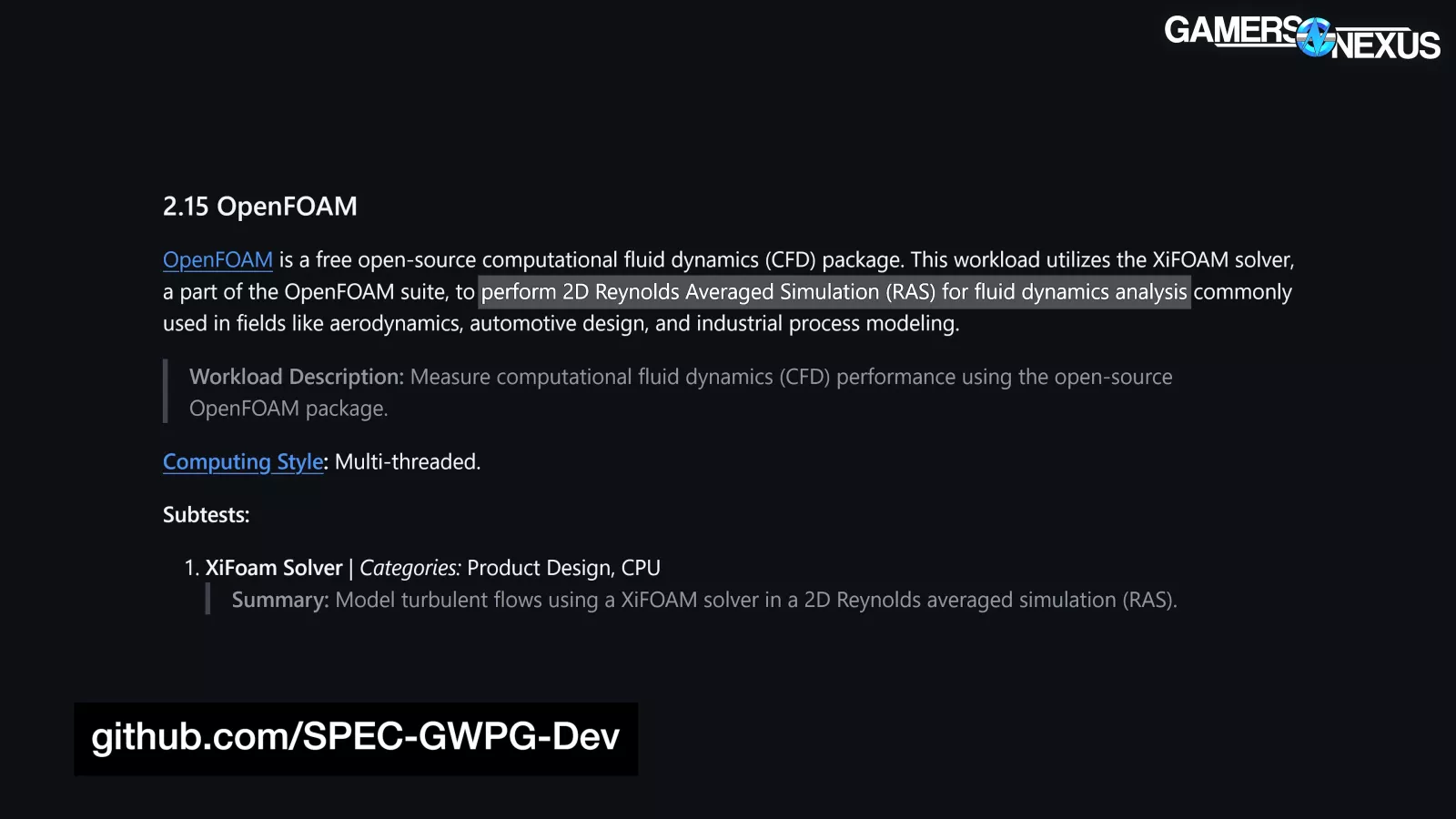
OpenFOAM is subsequent. Per the Spec website, OpenFOAM is a CFD check that “performs 2D Reynolds averaged simulation for fluid dynamics evaluation.” It additionally runs a solver check.
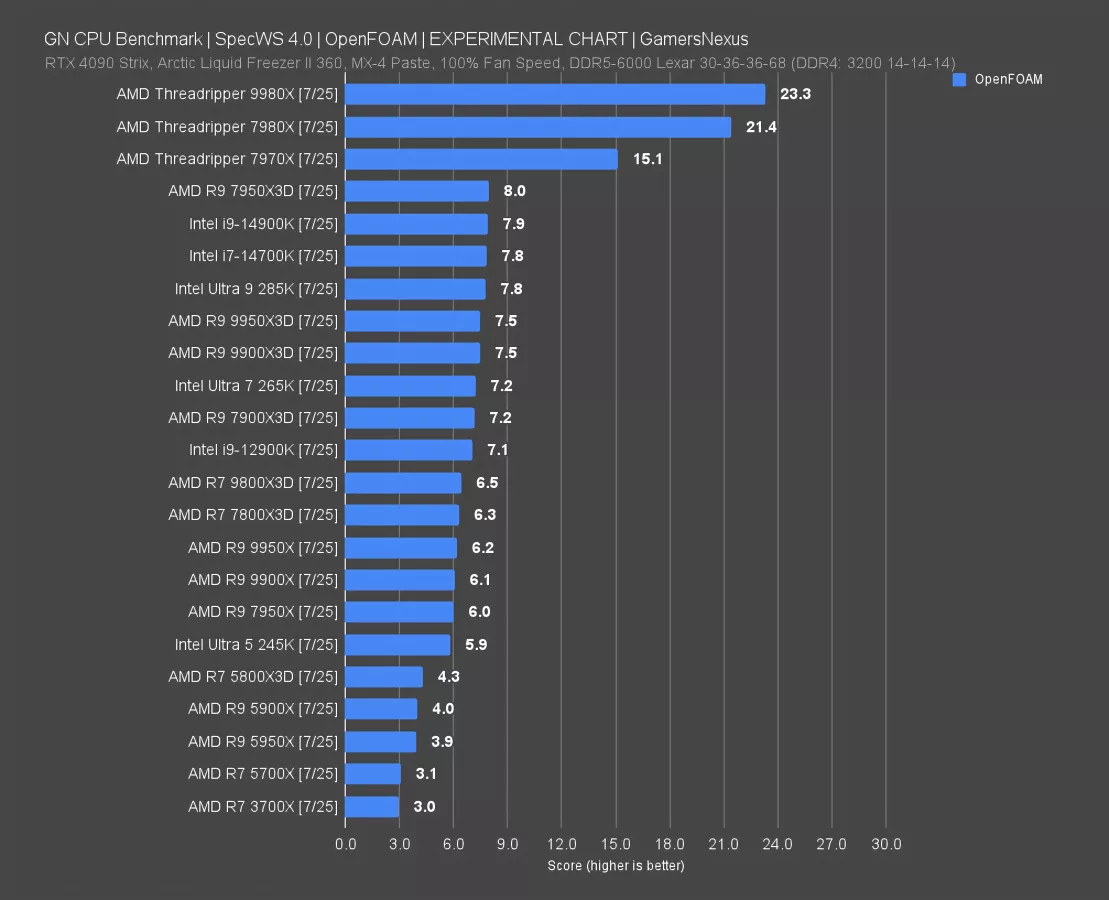
The 9980X scores 23.3 right here, main the 7980X prior technology by about 9%. Not as spectacular as Choices Pricing, however higher than another checks we have now right now.
The lead over desktop components just like the 9950X and X3D is sufficient that it’s actually not in the identical class, with multiples of uplift.
SpecWS: Convolution
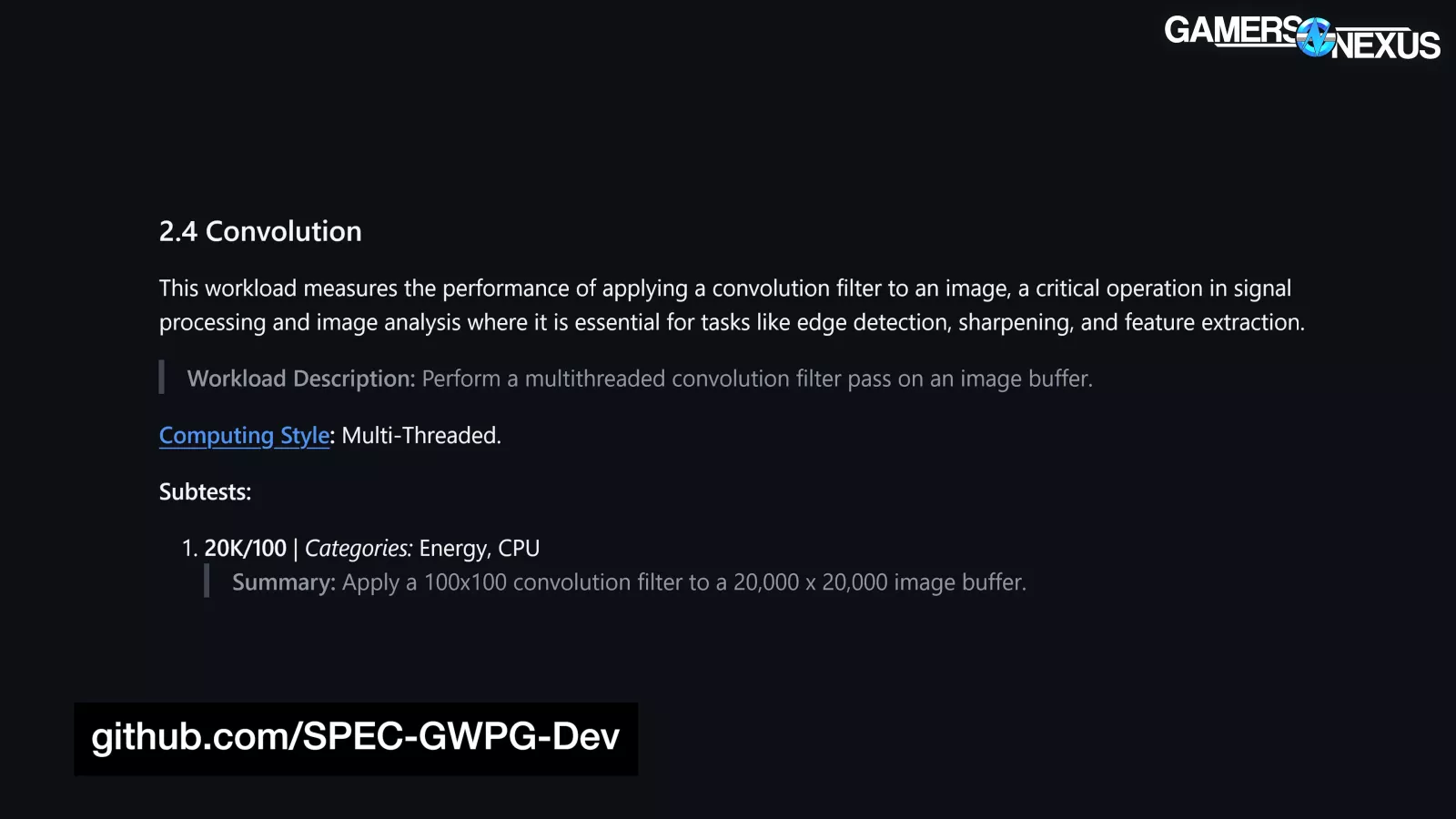
Convolution testing is subsequent. Spec says that this check applies “a convolution filter to a picture, a vital operation in sign processing and picture evaluation” for edge detection and have extraction. That is closely multi-threaded.
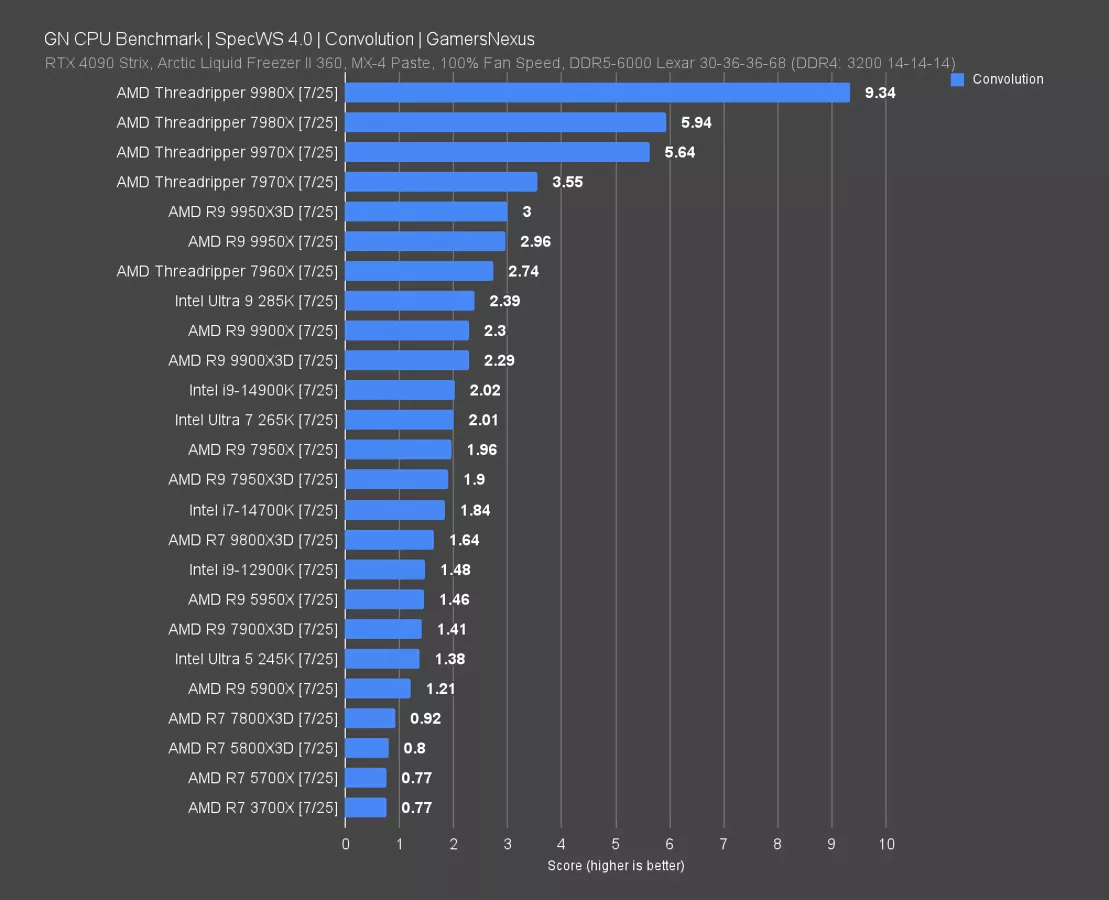
On this check, the 9980X scored 9.3 to the 7980X’s 5.9, an enormous uplift of 58%. That is fully out of alignment with another checks. We contacted Wendell of Level1 Techs and AMD’s engineers to get each a first-party and a impartial third-party test of those numbers. Wendell famous that that is anticipated habits and had seen related ends in different checks, believing it to be associated to AVX enhancements along with being a check that runs lengthy sufficient to profit from them. AMD famous that it has additionally seen outcomes round 60% for sure related checks.
Though we have now our 9970X overview arising individually, we’ll be aware that it additionally noticed a 56% enchancment right here over the 7970X predecessor. The outcomes align. final gen, the 9950X improved on the 7950X by 50%, which is constant generationally. The outcomes look like constant and are current throughout quite a few CPUs cross-generation, which implies the one factor left to think about is whether or not this benchmark represents real-world situations. We’re undecided: This specific check exits our experience, as we don’t do sign processing or picture evaluation work. We’d love to listen to from these in our viewers as as to whether the Spec Convolution check aligns with real-world purposes that you simply use in your work life.
Regardless, the result’s repeatable — it’s solely a query of whether or not it’s successfully a microbenchmark or is one thing that scales to real-world use.
SpecWS: LAMMPS
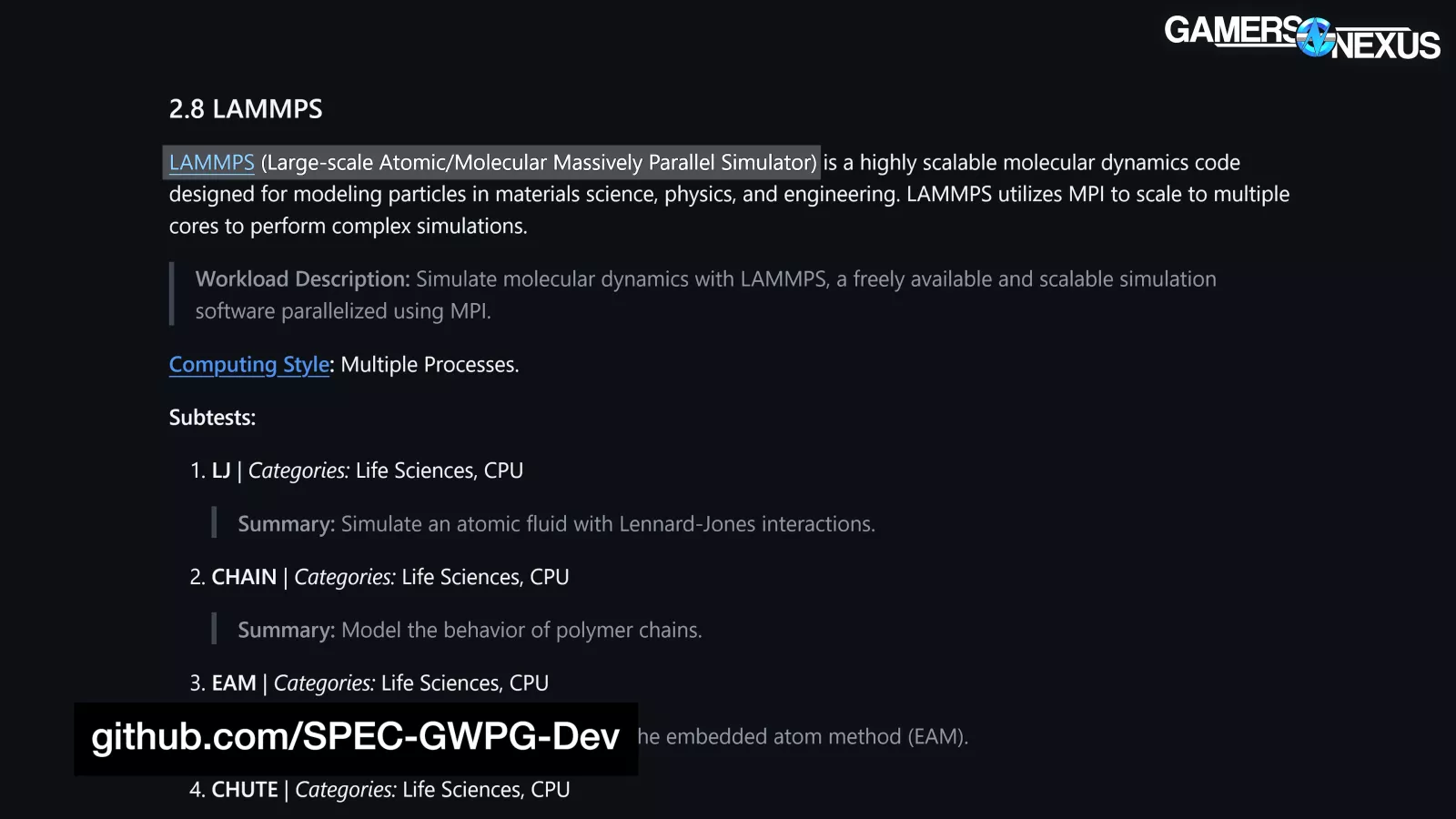
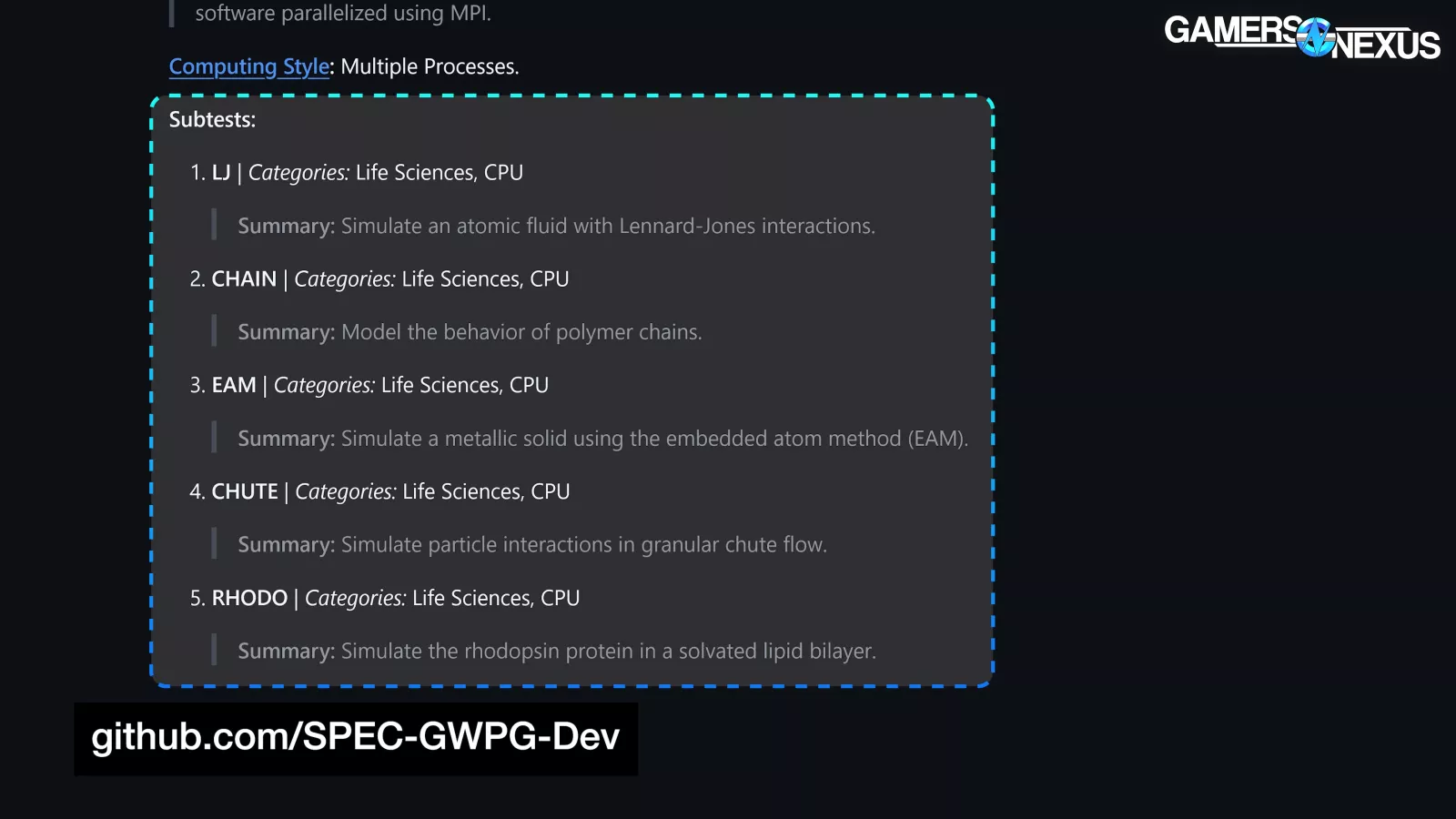
LAMMPS testing is subsequent. Based on Spec, this check is for large-scale atomic and molecular massively parallel simulation, which Spec says “makes use of MPI to scale to a number of cores to carry out advanced simulations.” This contains life science subtests, equivalent to for polymer chain calculations and protein calculations for, what we assume are, medical makes use of.
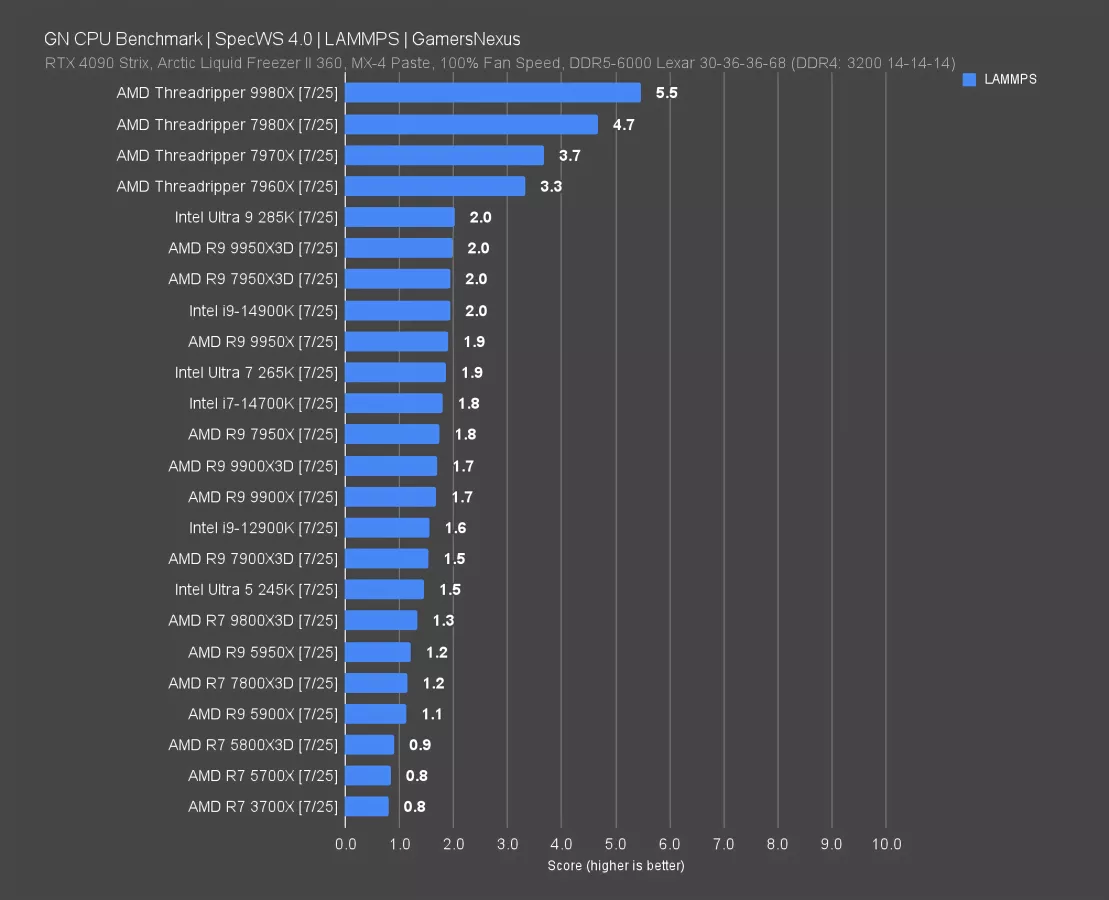
LAMMPS has the 9980X at a 5.5 rating in Spec, main the 7980X by 17%. That is near the Choices Pricing outcomes. Though Spec has a number of checks the place there’s no actual affect, like Handbrake, it additionally has a better saturation of checks with bigger generational enhancements.
SpecWS: Information Science
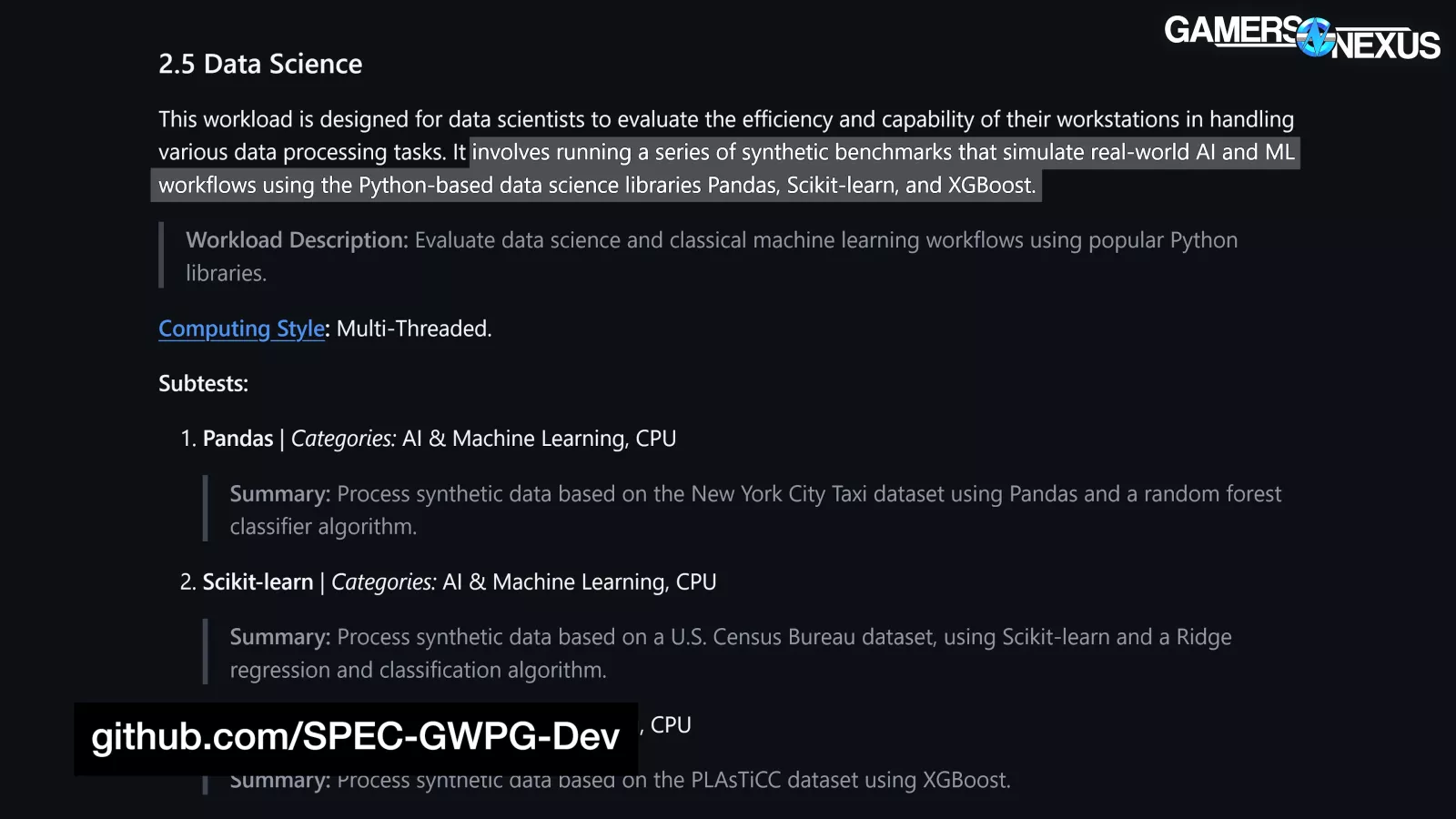
The Spec Information Science check is subsequent. Spec says that this check “includes working a sequence of artificial benchmarks that simulate real-world AI and ML workflows utilizing the Python-based knowledge science libraries Pandas, Scikit-learn, and XGBoost.”
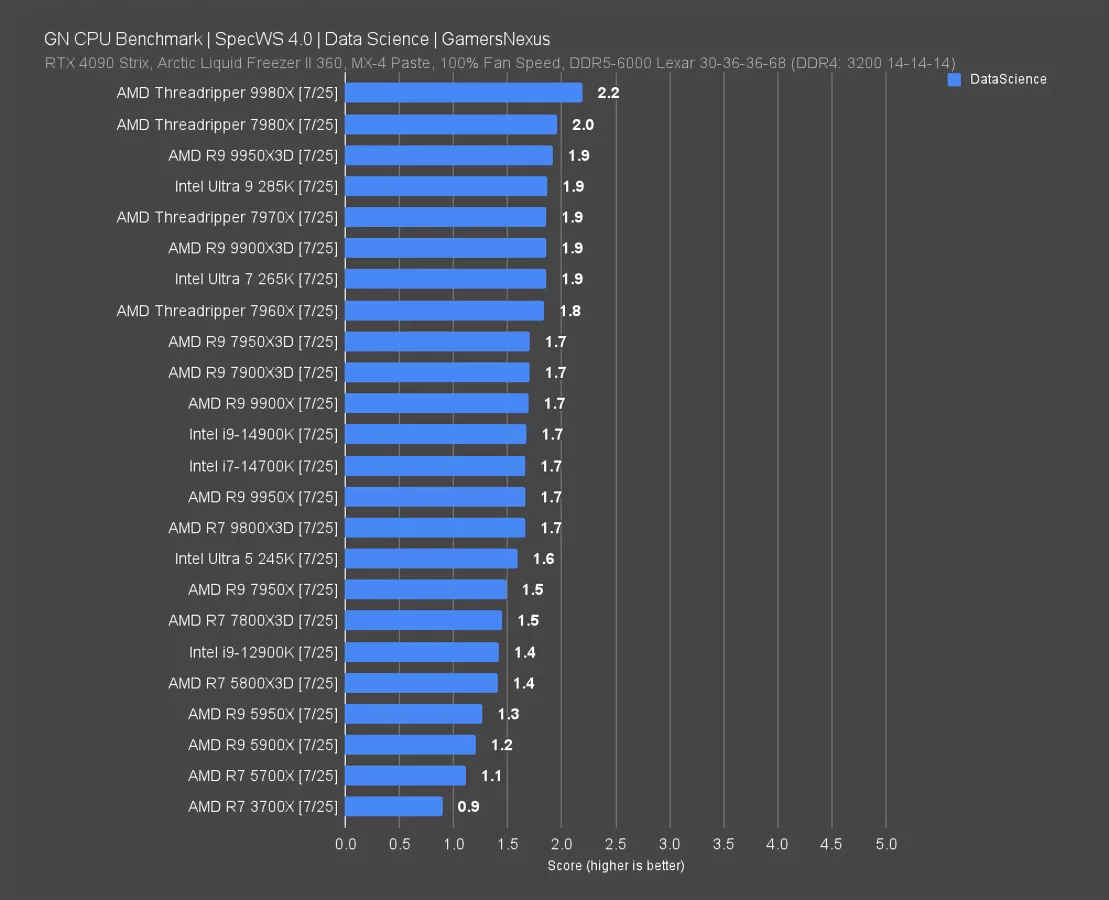
Generationally, the 9980X improves on the 7980X by 10%, going from 2.0 to 2.2 within the scoring. For reference, the 9950X improved on the 7950X by 13% at 1.7 from 1.5.
SpecWS: NAMD
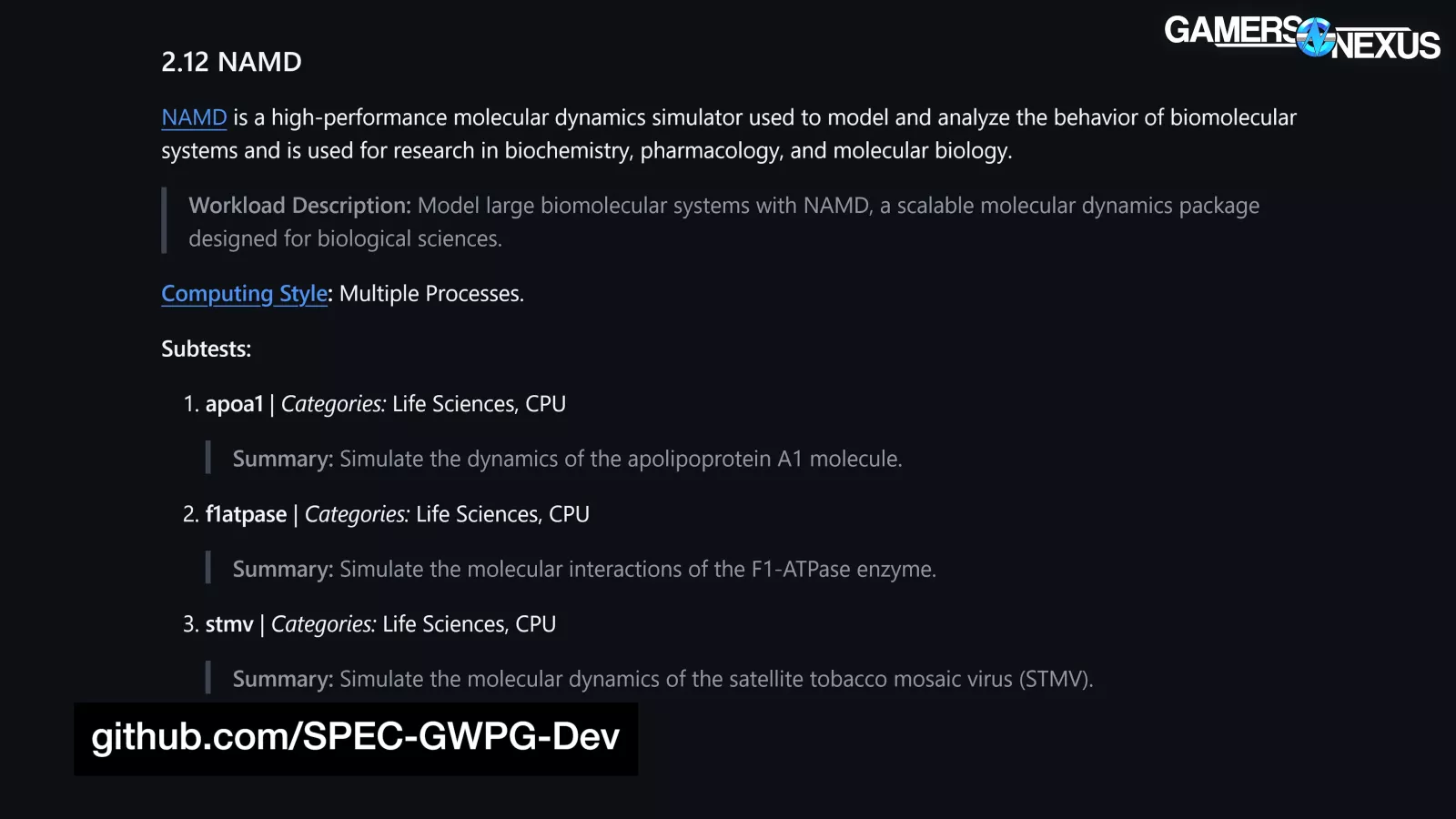
NAMD is subsequent, one other check our viewers preferred earlier than. This can be a molecular dynamics simulator for modeling “habits of biomolecular programs,” with Spec saying that it’s “used for analysis in biochemistry, pharmacology, and molecular biology.”
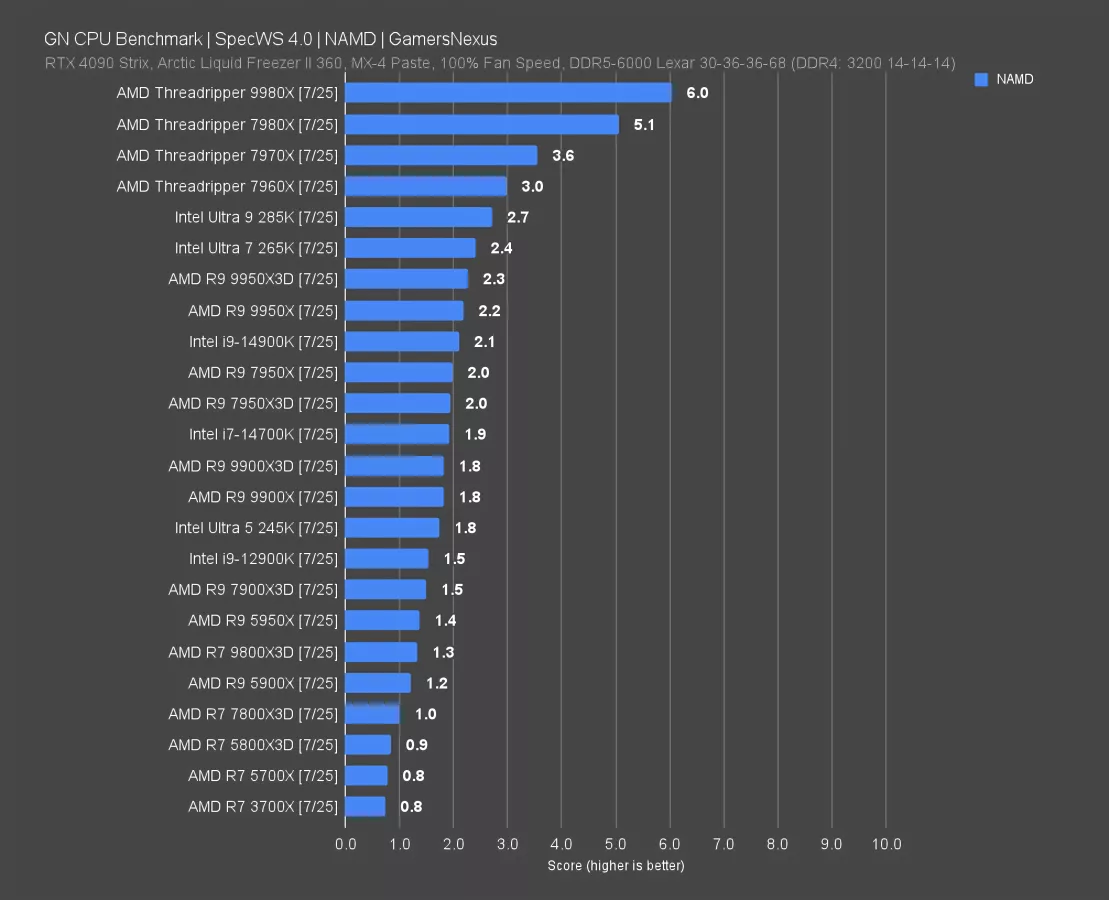
The 9980X scored 6.0, with the 7980X at 5.1. That is an enchancment of just about 18%, which aligns once more with LAMMPS and choices pricing benchmarks.
SpecWS: RodiniaCFD
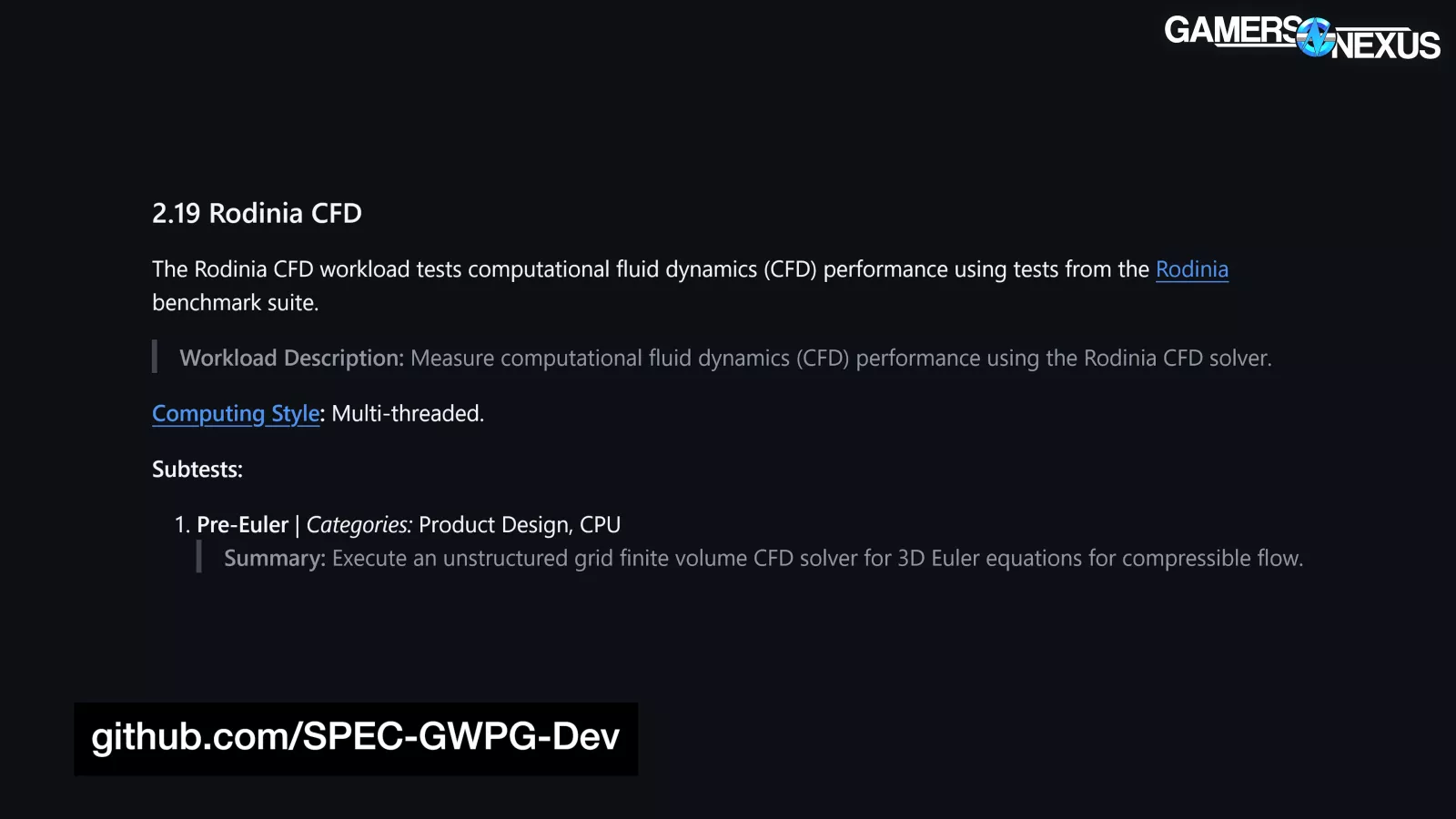
We now have much more Spec outcomes, however we’ll shut on one which’s much less attention-grabbing to deliver it again right down to earth and stability the upper outcomes. That is for RodiniaCFD, which the location explains has a pre-euler subtest that “executes an unstructured grid finite quantity CFD solver for 3D euler equations for compressible circulation.”
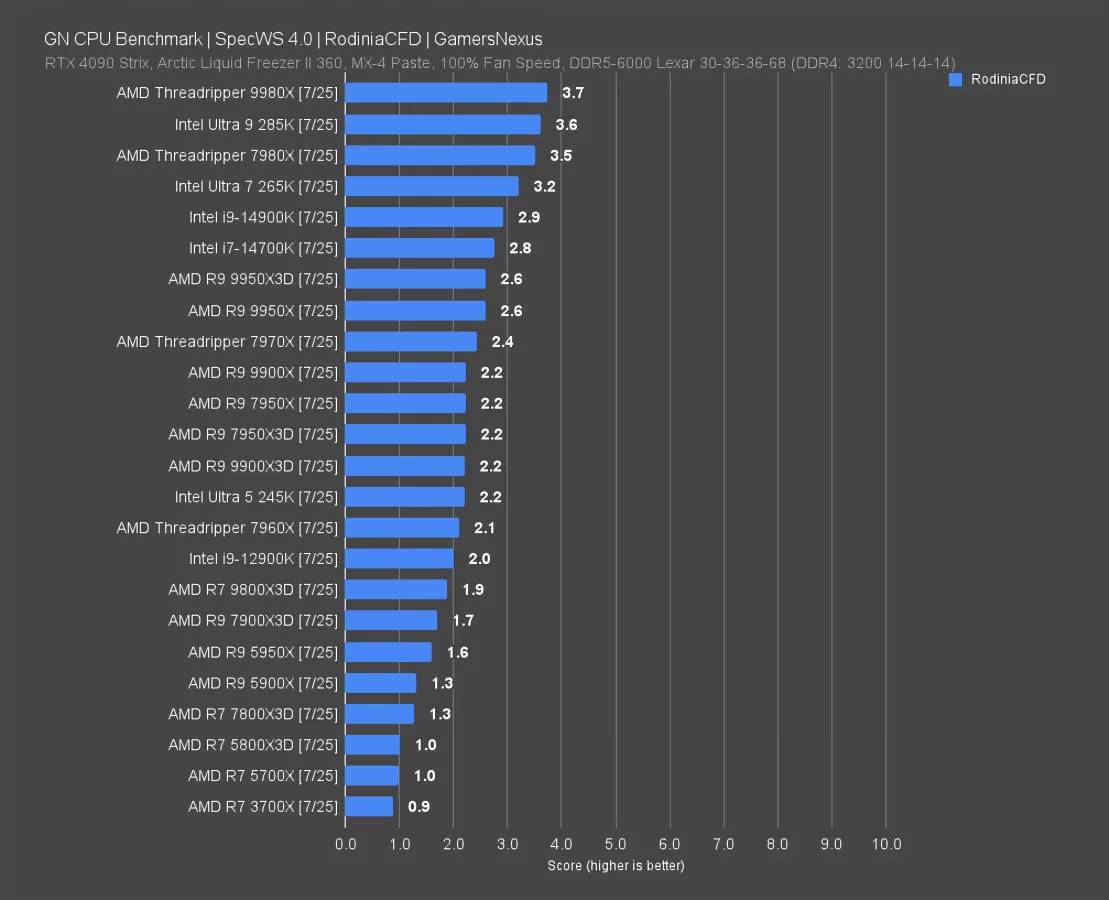
The 9980X scored 3.7 right here, with the 7980X at 3.5. That is one the place the advance is much less thrilling, again right down to a few 5-6% enchancment generationally.
Chromium
Up subsequent is Chromium code compile. There are numerous forms of code compile, similar to there are numerous forms of video encoding or photograph enhancing or 3D rendering workloads, so we’re simply representing one right here as we do with another manufacturing check.
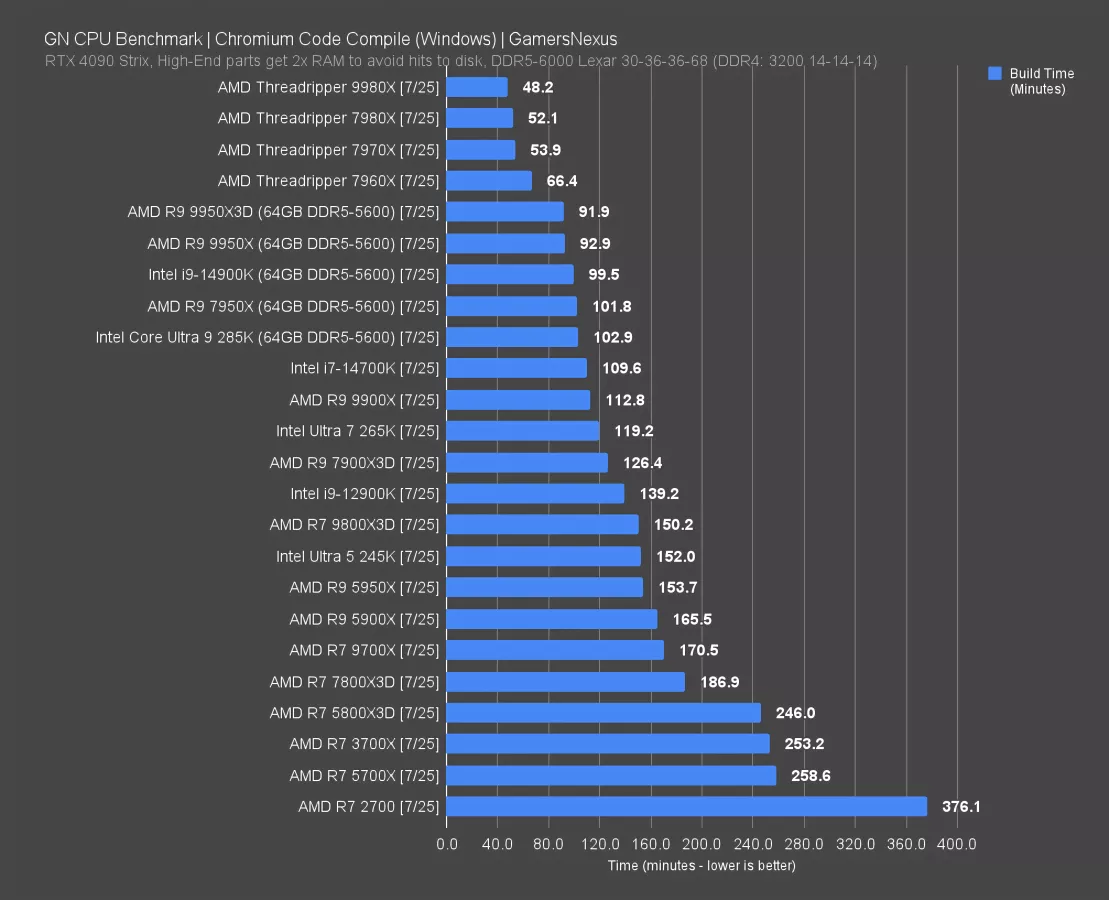
The 9980X completes the compile the quickest, at 48 minutes complete. The compile time is 7.5% lowered from the 7980X. Elsewhere, with the newer model of this check, we’re seeing minimal impact in comparison with prior check iterations. The 7980X and 7970X are comparatively shut to one another, with the 9950X3D and 9950X additionally close to one another. A few of these CPUs are working with lowered reminiscence pace as they required increased reminiscence capability and had extra hassle holding our regular settings, so these are famous the place true.
The 14900K is Intel’s greatest performer, requiring 100 minutes to finish the compile. The 9950X outperforms this.
Blender
Blender tile-based rendering is up subsequent.
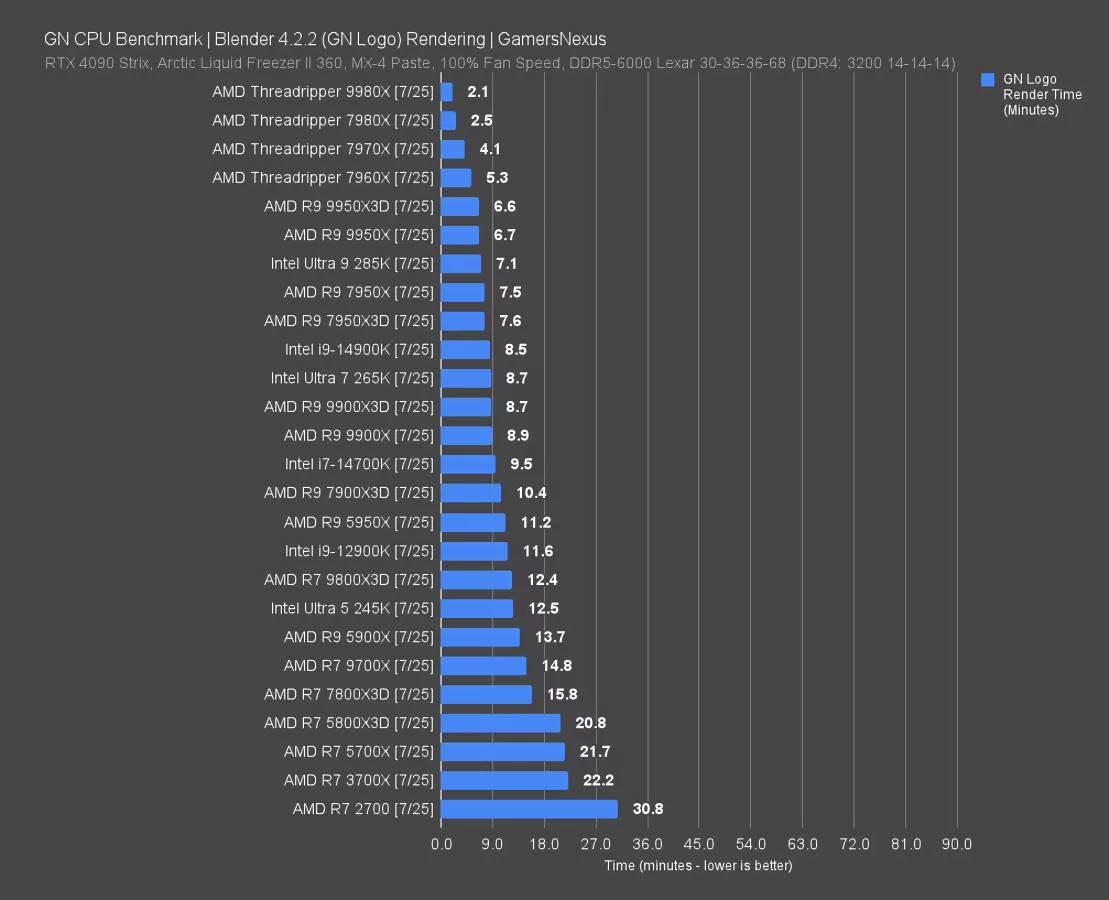
For this course of, the 9980X is the brand new chart-topper at 2.1 minutes to finish a render of a single body from the GN intro animation brand. The subsequent quickest is the 7980X at 2.5 minutes, which is smart: This check is closely thread-dependent, so threads will outrank frequency the place giant variations emerge.
Intel’s newer technology does OK on this check, with the 285K between the 9950X and 7950X. It’s additionally one of many checks the place Intel doesn’t see regressive efficiency, although we nonetheless wouldn’t advocate the 285K. That complete platform is useless, anyway.
Photoshop
Adobe Photoshop is subsequent, examined with the Puget Suite. This makes use of an mixture rating of filters, resizes, and different capabilities inside Photoshop.
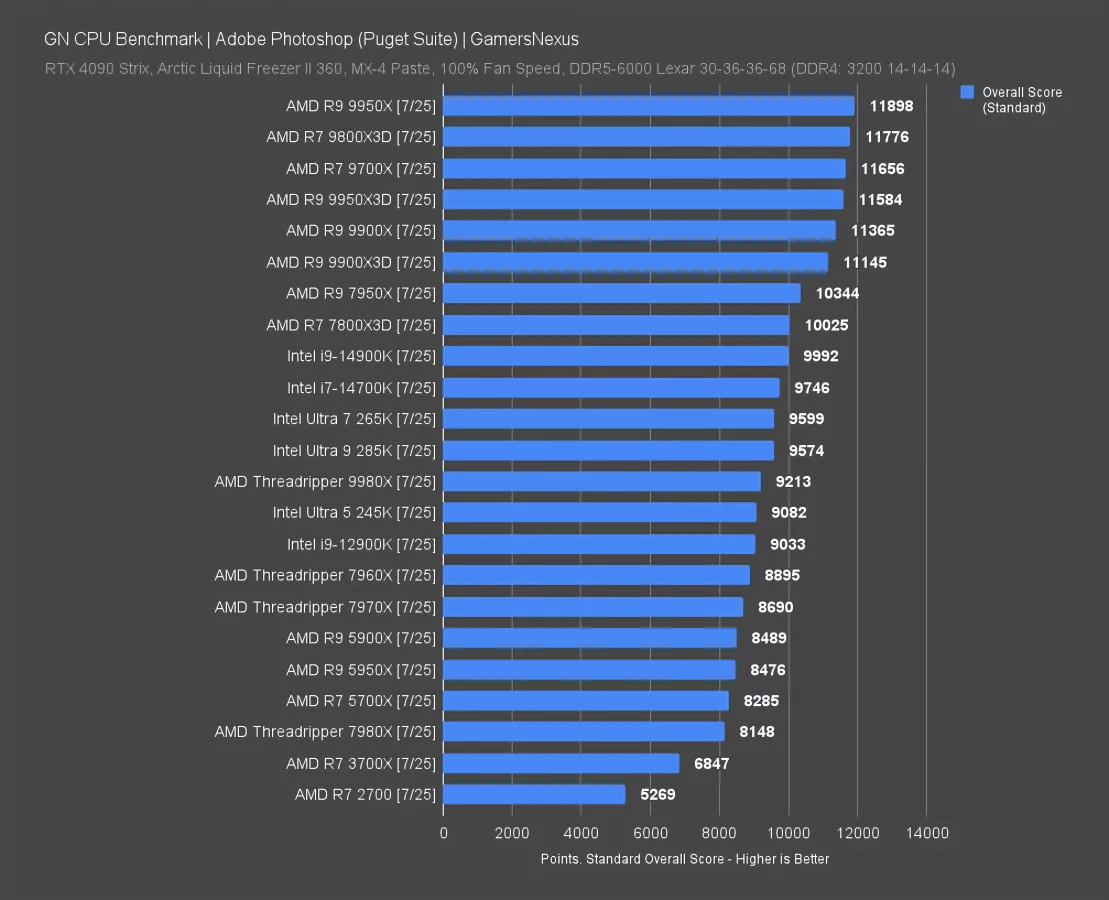
The perfect performer right here is the 9950X, adopted by different desktop CPUs. The Threadripper components fall additional down the chart, with the 9980X specifically underperforming. We’ve seen this previously, equivalent to with the 7980X: They simply have too many threads for their very own good and Photoshop isn’t capable of make the most of them. The 7980X is outperformed by the 7970X and 7960X, so the 9980X touchdown within the center isn’t a shock. Its fundamental enchancment comes from the frequency.
It does OK right here if this is only one of many purposes you utilize, but when Photoshop is the one factor you do, there are higher and cheaper CPUs for the job.
Premiere
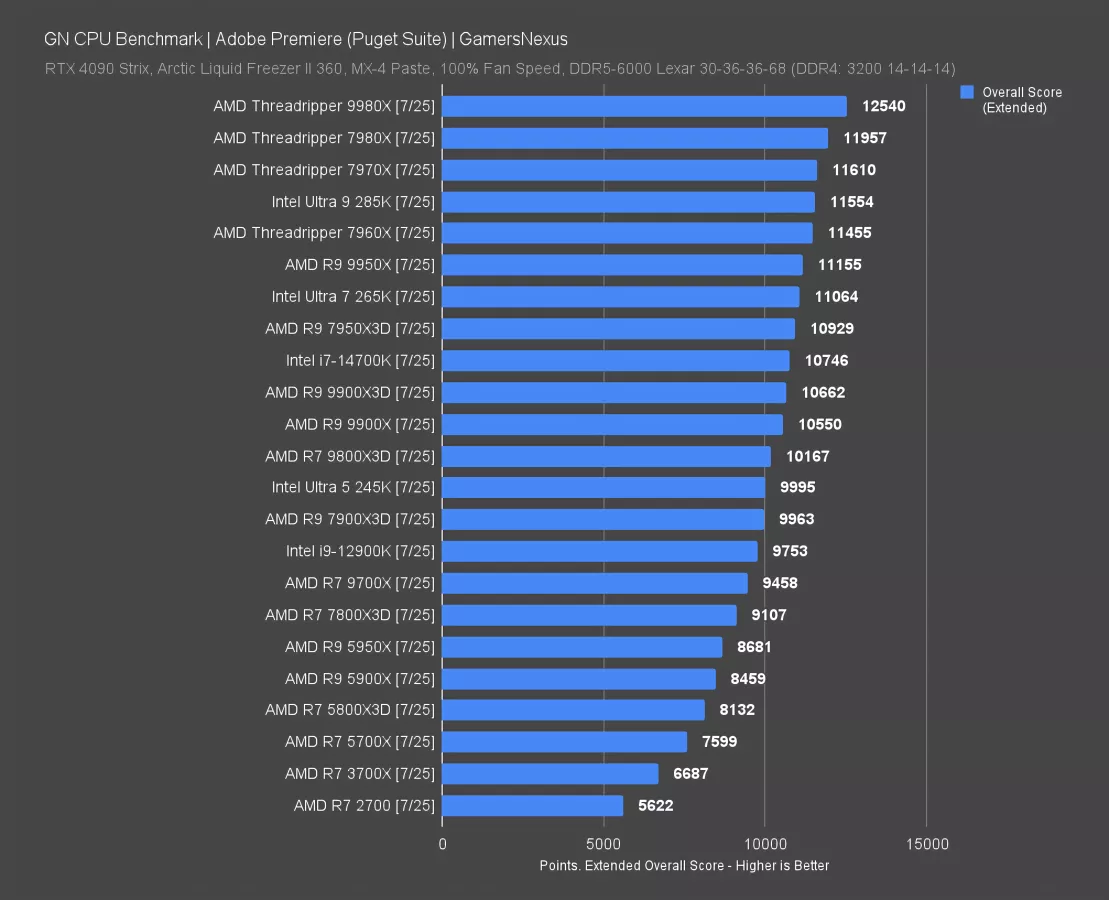
Adobe Premiere is subsequent, our greatest frenemy that we see each day.
On this one, the 9980X improves upon the efficiency from the 7980X and 7970X, however solely barely. It’s positively not price a single generational improve, although we usually don’t advocate that anyway.
The advance is sort of 5% from the 7980X to the 9980X within the prolonged rating for Premiere. Intel’s 285K trails most Threadripper CPUs within the chart and roughly ties the 7960X. It additionally technically outperforms the 9950X. Intel’s largest benefit stays in its QuickSync answer with the IGP, which might present up disproportionately in additional focused checks relatively than the total sweep achieved right here.
Threadripper does properly total right here and is not less than higher than its Photoshop displaying, however with out different purposes leaning on threads, a desktop CPU would get a lot of the identical efficiency. The perfect use for Threadripper right here could be assigning its extra threads to different duties, like separate audio compositing, whereas working Premiere duties.
DaVinci Resolve
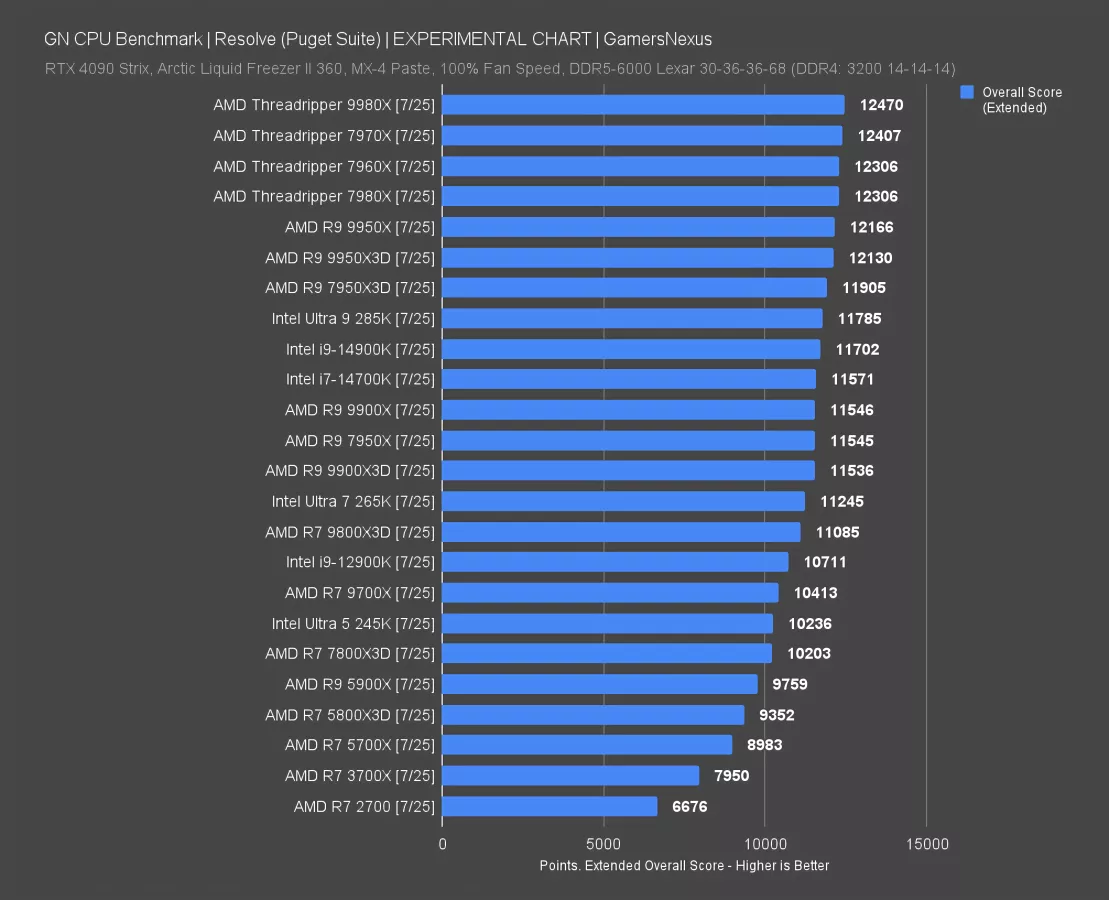
DaVinci Resolve is subsequent. We haven’t examined this in years, so that is an experimental chart.
On this check, the 9980X’s frequency enhance permits it to realize on prior Threadripper CPUs. The earlier lineup had the 7960X and 7980X tied, with the 7970X marginally forward. We noticed this with the 7000-series Threadripper opinions the place 64-core components generally triggered slight losses in comparison with 32-core counterparts.
The 285K falls behind the 9950X on this one, although not by rather a lot, with the 14900K roughly inside re-run distance of the 285K.
Threadripper is not less than the most effective performer right here as properly, regardless of not offering clear worth over desktop components. It’s simply not constructed for these sorts of workloads, however nonetheless being the most effective is vital.
Gaming Benchmarks

We’ll preserve gaming brief. The one goal of gaming checks on Threadripper, usually, is to verify there isn’t some main downside, however cheaper desktop components are going to be higher for pure gaming builds. Threadripper is definitely detrimental if all you do is gaming.
You are going to discover that the Threadripper chips do not at all times observe a strictly logical order, particularly once they’re inside just a few frames per second of one another. That is due to the elevated run-to-run variance inflicting much less significant averaged outcomes.
Stellaris Simulation Time
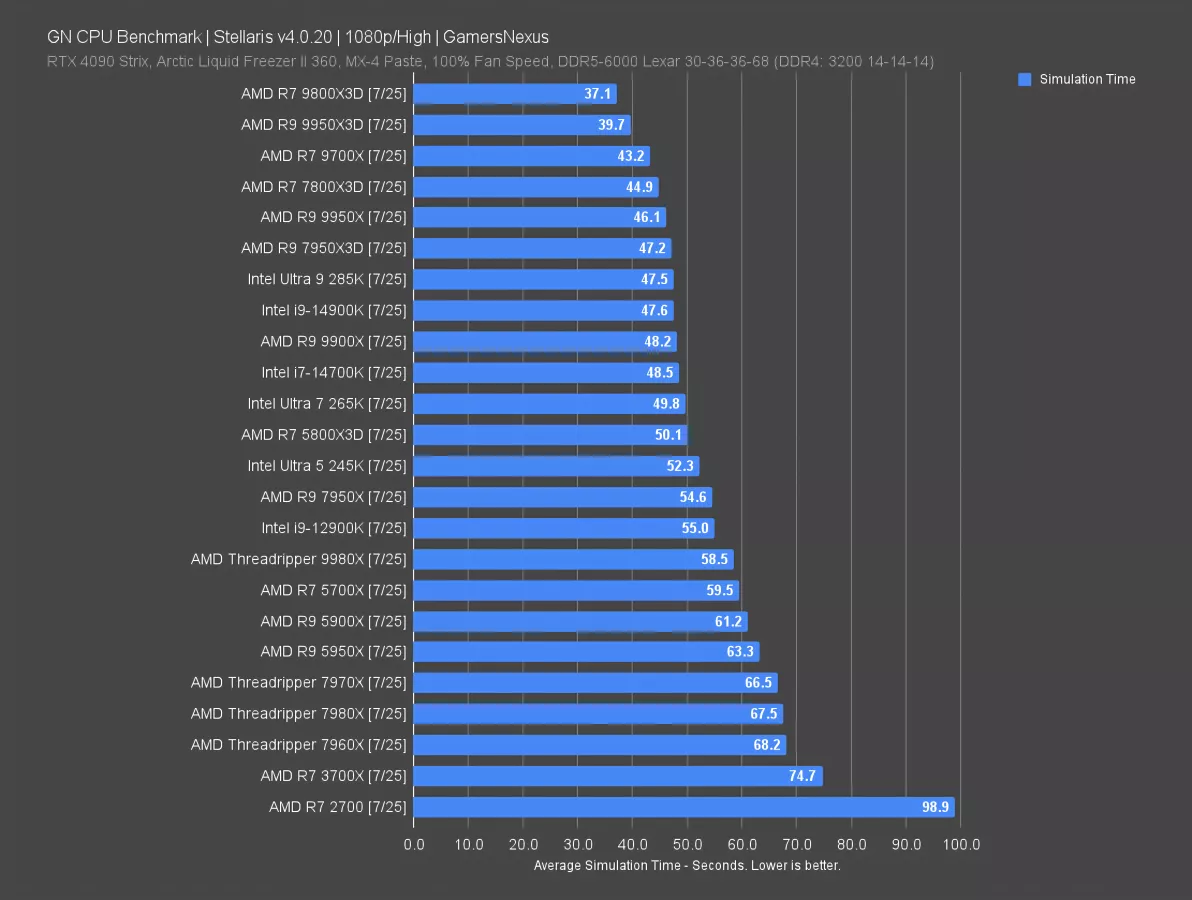
Stellaris simulation time is first. The 9800X3D is the present chief at 37.1 seconds on common for simulation time. The 9700X follows this at 43.2 seconds, benefitting from Zen 5 architectural enhancements over the prior technology. The 285K isn’t what we’d name “good” right here, however not less than matches its predecessor.
Threadripper is method on the backside, with the 9980X not less than bettering on the 7980X notably, but it surely’s nonetheless far worse than another fashionable gaming CPU. The 5700X is almost on the degree of the 9980X. It’s simply detrimental to have this CPU configuration for this recreation, which isn’t actually information to anybody. It will probably not less than play video games, however the distinction in simulation time between the 9800X3D and the 9980X could be noticeable in actual recreation play.
FFXIV: Dawntrail – 1080p
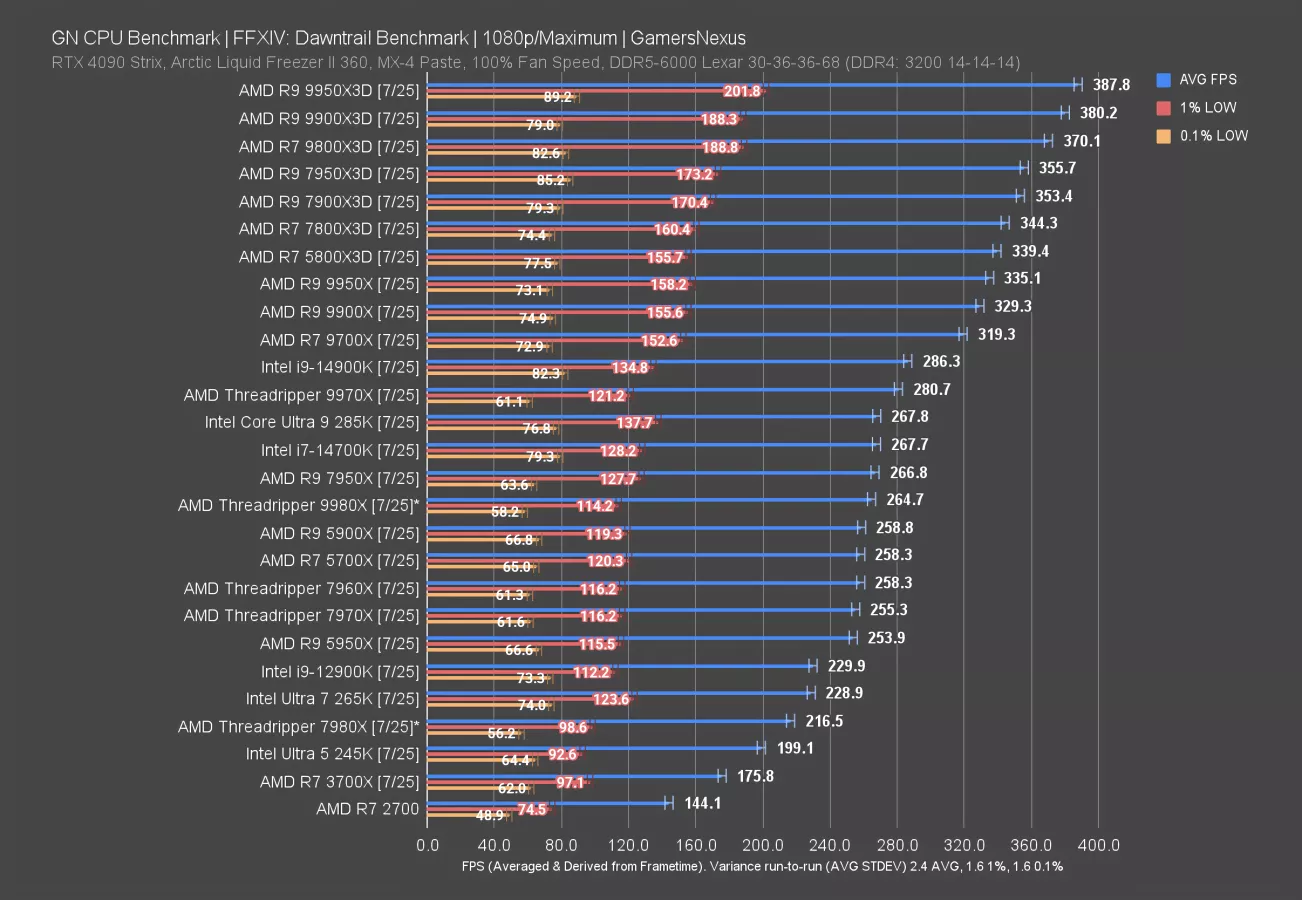
Last Fantasy 14: Dawntrail is subsequent. The 9980X and 7980X excessive core-count CPUs had some main inconsistency points on this recreation, so there’s an asterisk subsequent to their entries.
We’re nonetheless displaying the averages of 4 runs, it’s simply that the runs are extra variable than sometimes. The 9980X, as an example, had a spread from 274 to 248 FPS AVG, which is a big swing. Our typical commonplace deviation on this recreation is a pair frames per second for the common. The sport was playable, however everywhere for the common framerate. Lows have been worse total as properly, however once more, technically playable.
For this reason we nonetheless check video games with Threadripper, although.
Dragon’s Dogma 2 – 1080p
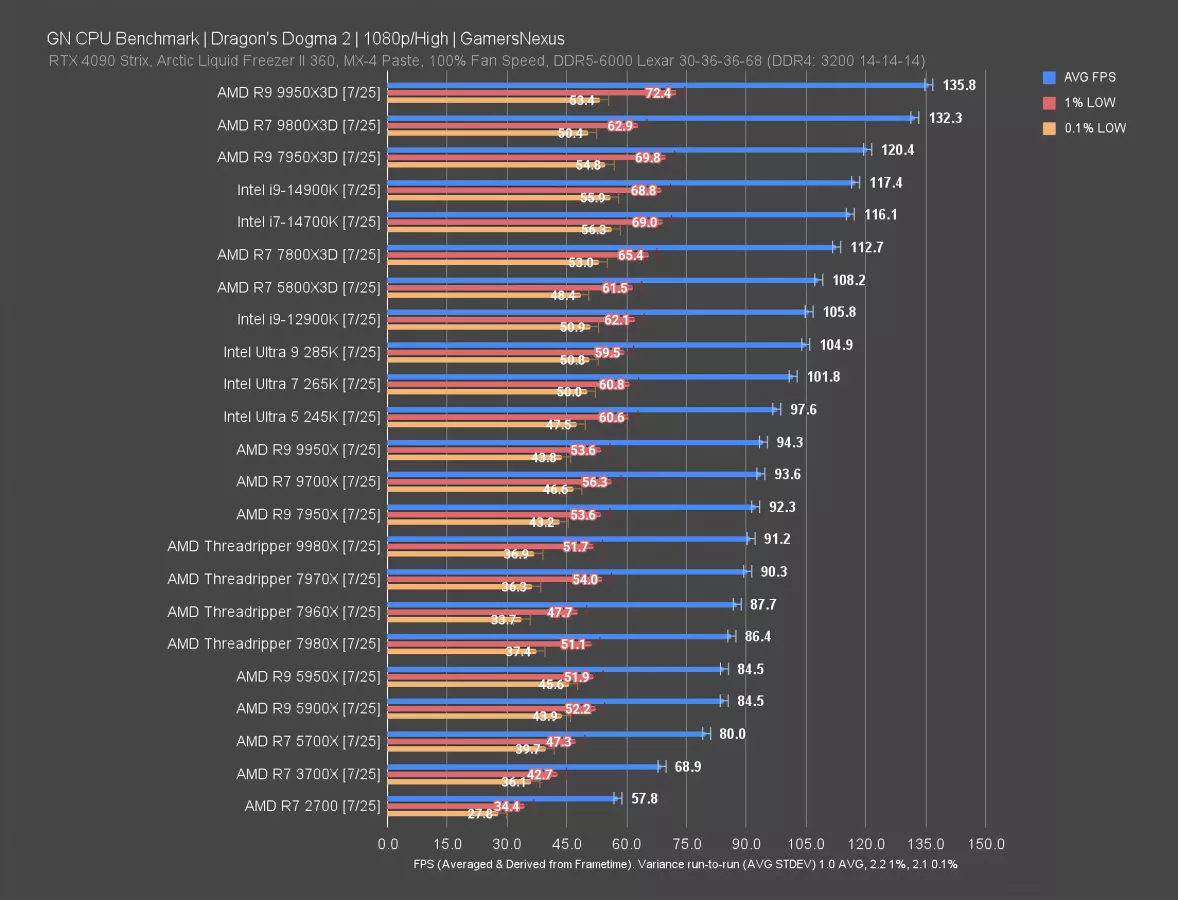
In Dragon’s Dogma 2 at 1080p, the Threadripper CPUs find yourself within the decrease half of the chart. The 9980X is worse than the 7950X right here and about the identical because the 7970X. The 7980X was beneath the 7960X and 7970X, indicating that these extraordinarily excessive core counts are detrimental to gaming efficiency. The upper frequency issues greater than the additional cores, so the trade-offs are dangerous to gaming efficiency right here. This has been true without end with Threadripper, so none of that is information.
What issues extra is that they’re nonetheless playable. Threadripper does undergo from worse lows, notably 0.1%, however not so dangerous that they render the sport stuttery. You could possibly nonetheless play video games on a Threadripper system, however once more, gaming-only customers can purchase one thing else.
Cyberpunk 2077: Phantom Liberty – 1080p
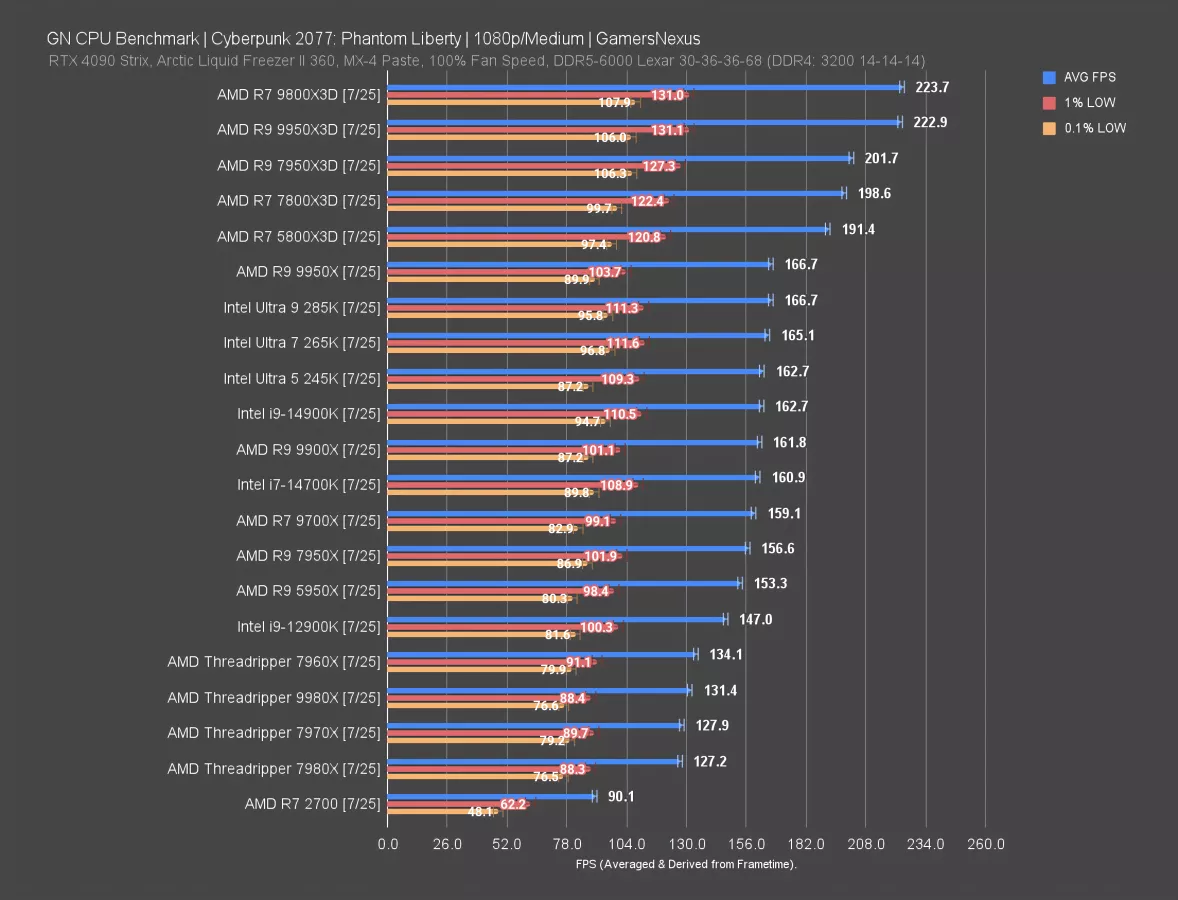
Cyberpunk is subsequent. On this one, the 9980X outperforms the 7980X on a technicality, however each are nearer to the R7 2700 than they’re to the 9800X3D. The run-to-run consistency was fantastic, with the 9980X solely exhibiting a 1.9 AVG FPS commonplace deviation, so it’s not like what we noticed in Last Fantasy — it’s simply not notably good. That is nonetheless a satisfactory framerate, so within the context of a pc constructed for particular work duties that may nonetheless play video games when wanted, it passes that want.
Baldur’s Gate 3 – 1080p
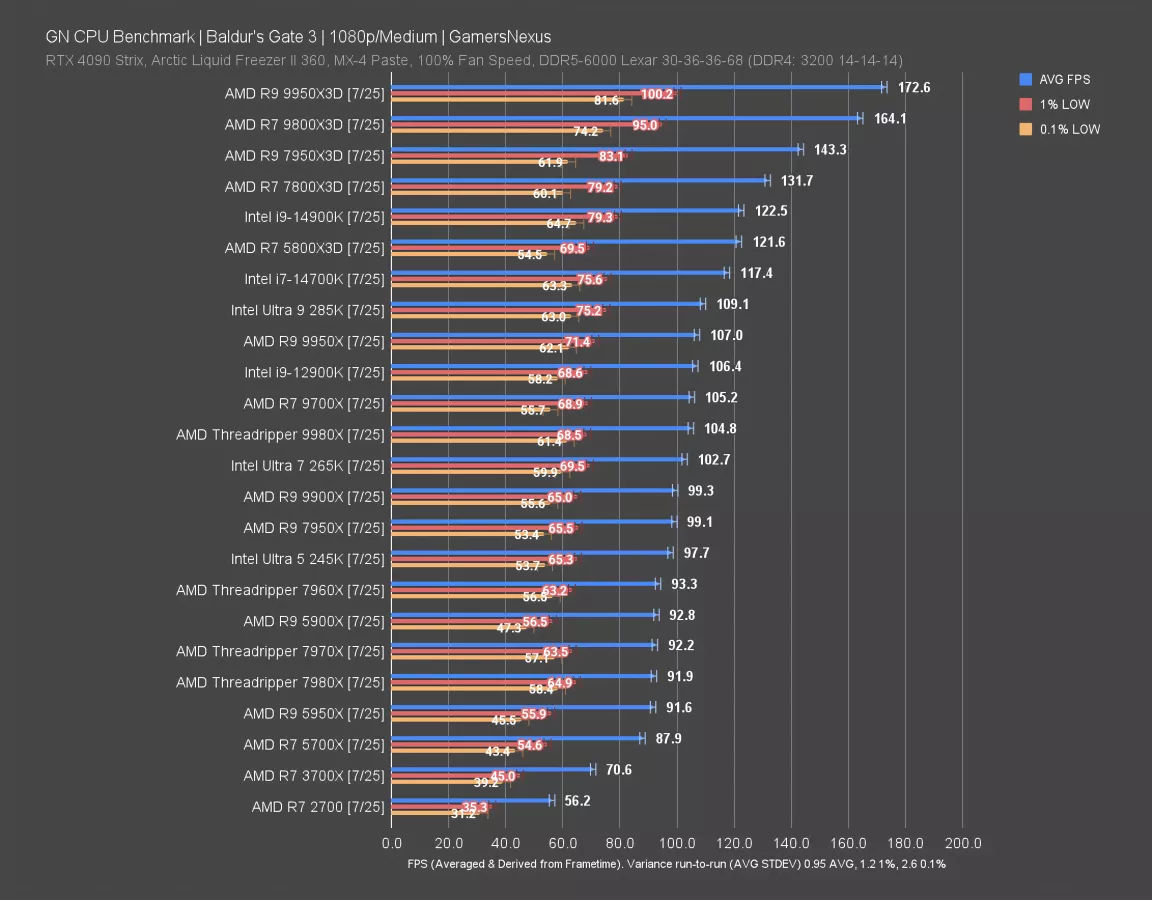
In Baldur’s Gate 3, the 9980X finally ends up across the degree of the 265K — which is actually simply extra embarrassing for Intel than anything. We already know Threadripper isn’t notably good at gaming, regardless of being OK at it, however the 265K must be doing higher right here. That is additionally a recreation the place the 285K was vastly regressive, although, at 109 FPS AVG towards the 14700K’s 117 FPS AVG and 14900K’s 123 FPS AVG.
We did check different video games, however they’re simply not related past proving the purpose we have already got: Threadripper is satisfactory if gaming is just not your main want. It’s simply not the only option for it.
Energy Consumption
9980X Energy Consumption – Blender
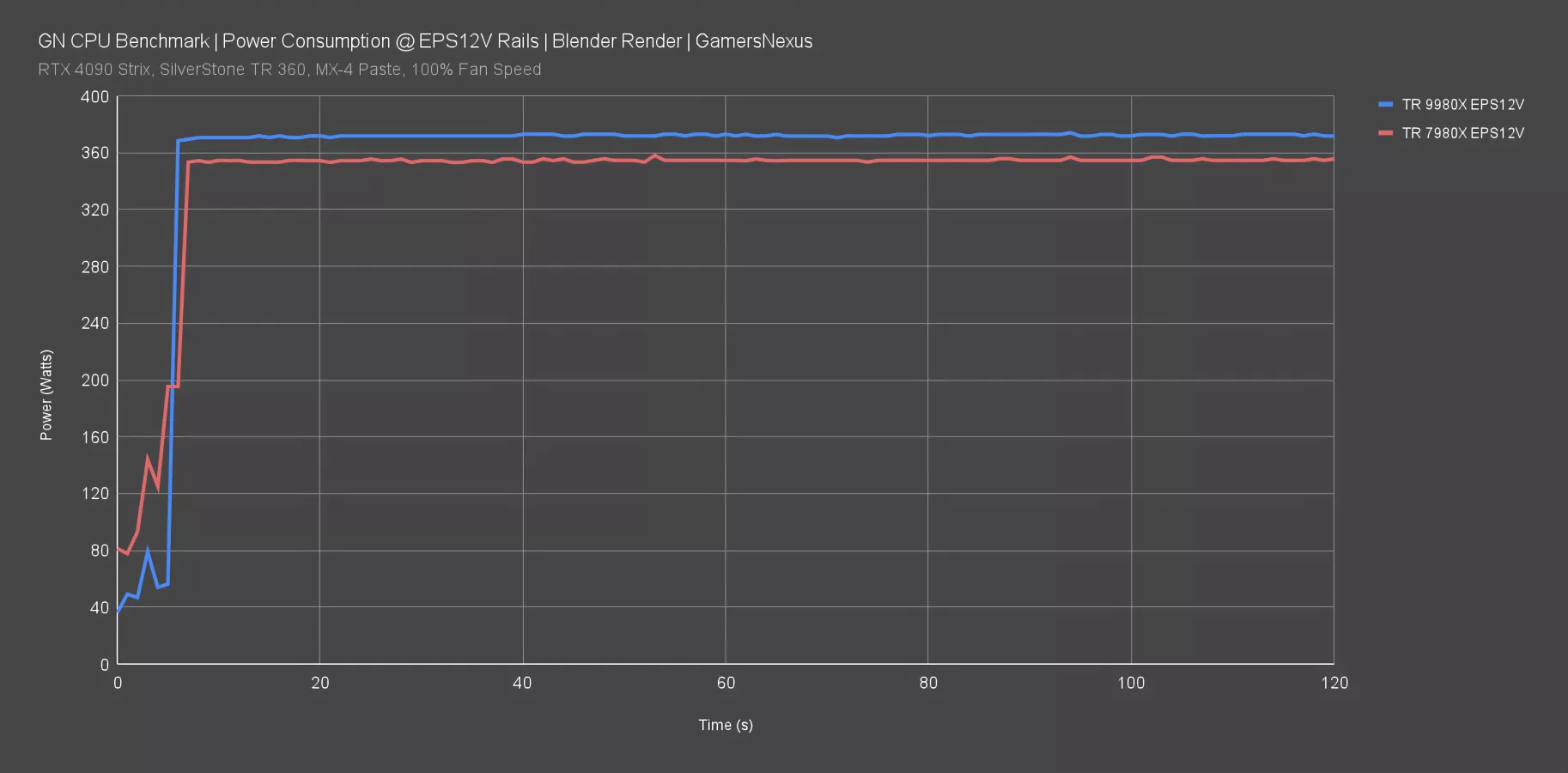
This subsequent chart reveals the ability consumption as measured on the EPS12V cables with an influence interposer between the motherboard and energy provide. Examined with an all-core workload in Blender, we noticed steady and constant energy draw throughout each the 7980X and 9980X CPUs, with the 9980X measuring at 371W from 354W on the last-gen Threadripper flagship. That’s numerous energy to chill.
This doesn’t present transients.
9980X Thermals
Thermals – Blender
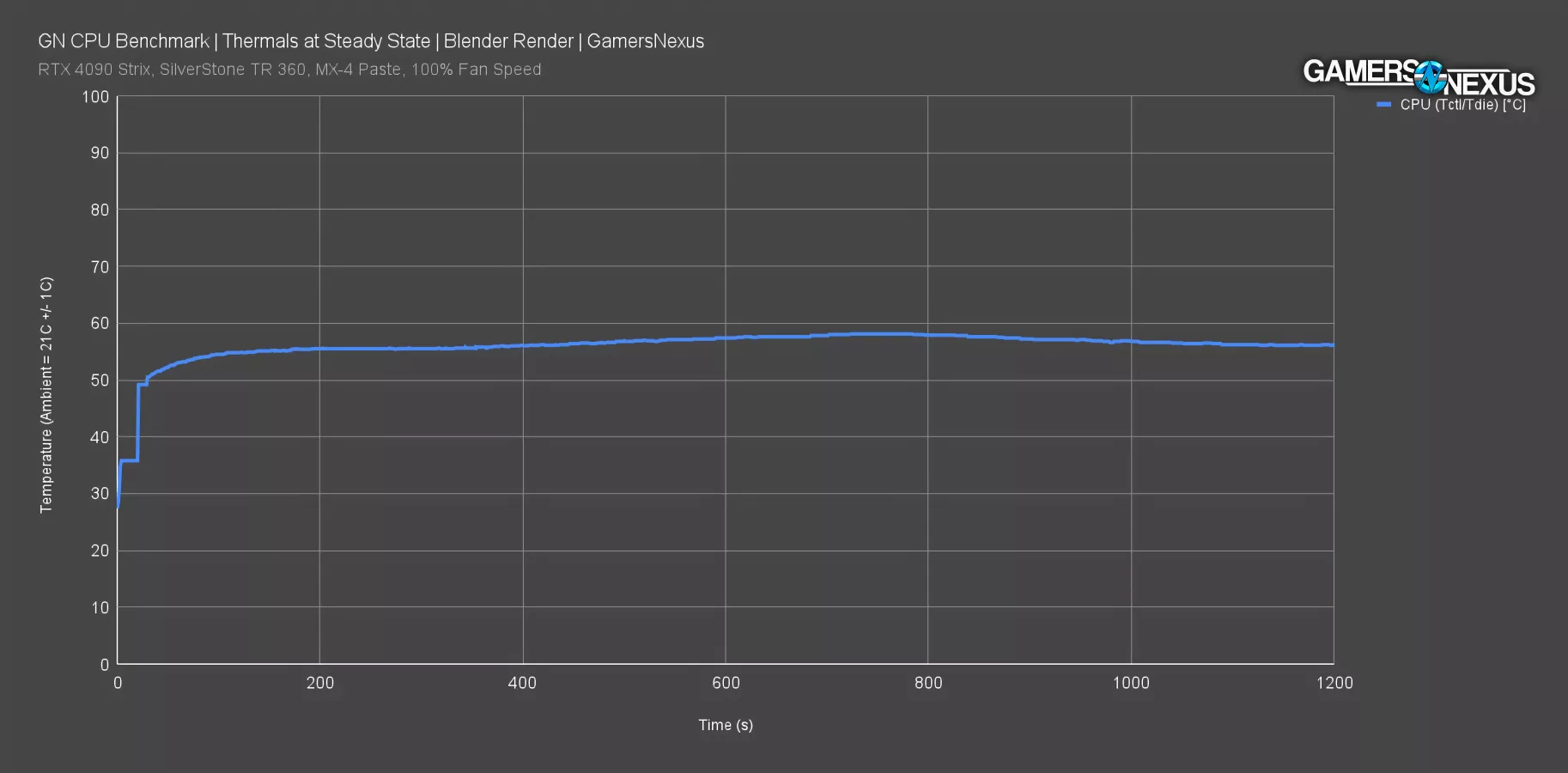
This chart reveals the thermal habits of the 9980X. We’re utilizing a SilverStone 360mm liquid cooler with a Threadripper-sized coldplate for this, so the outcomes should not akin to our 7980X review thermal outcomes from its launch. Additionally, as regular, thermal testing could be greatest achieved with numerous coolers in contrast and noise-normalized, however that is saved easy for the overview and to assist get an thought (as that’d be a cooler overview).
The 9980X below an all-core workload ran at round 58 levels Celsius when working the comparatively loud 100% fan speeds on the 360mm liquid cooler.
Thermals – Equilibrium
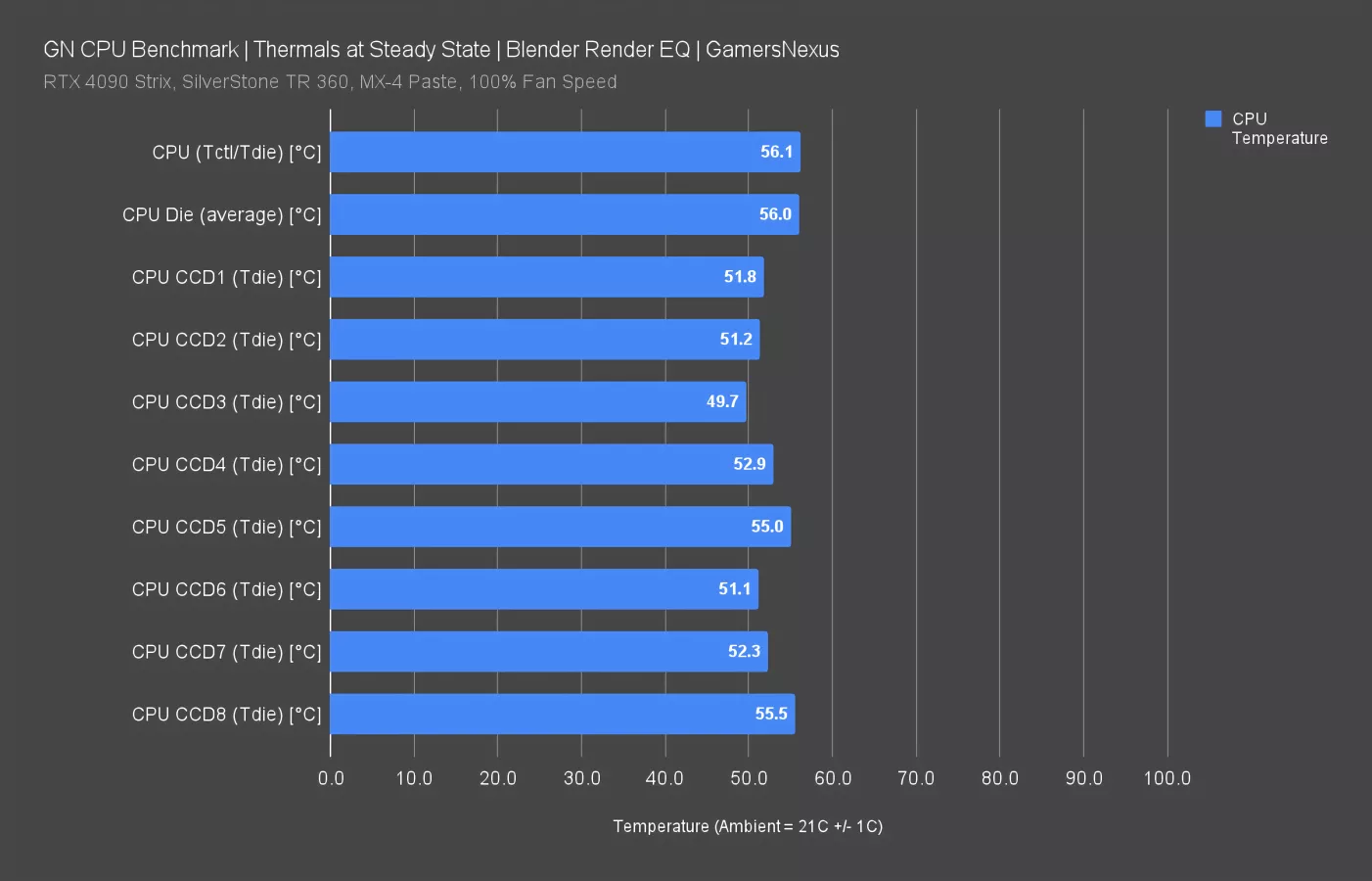
This chart reveals thermals at regular state throughout the assorted CCDs. The CCD-to-CCD delta right here is 6.7 levels Celsius, at 49.7 to 56.1 levels in an ambient of 21 levels Celsius, +/- 1C. Typically talking, this may be cooled at decrease noise ranges with 360mm coolers with out main points if assuming a well-ventilated case. The floor space is so large on this CPU that the ability is distributed throughout a big space, making it simpler to chill than a 200W warmth load could be on a standard desktop-sized Ryzen CPU with 2 CCDs.
9980X Frequency
Frequency – Blender All-Core
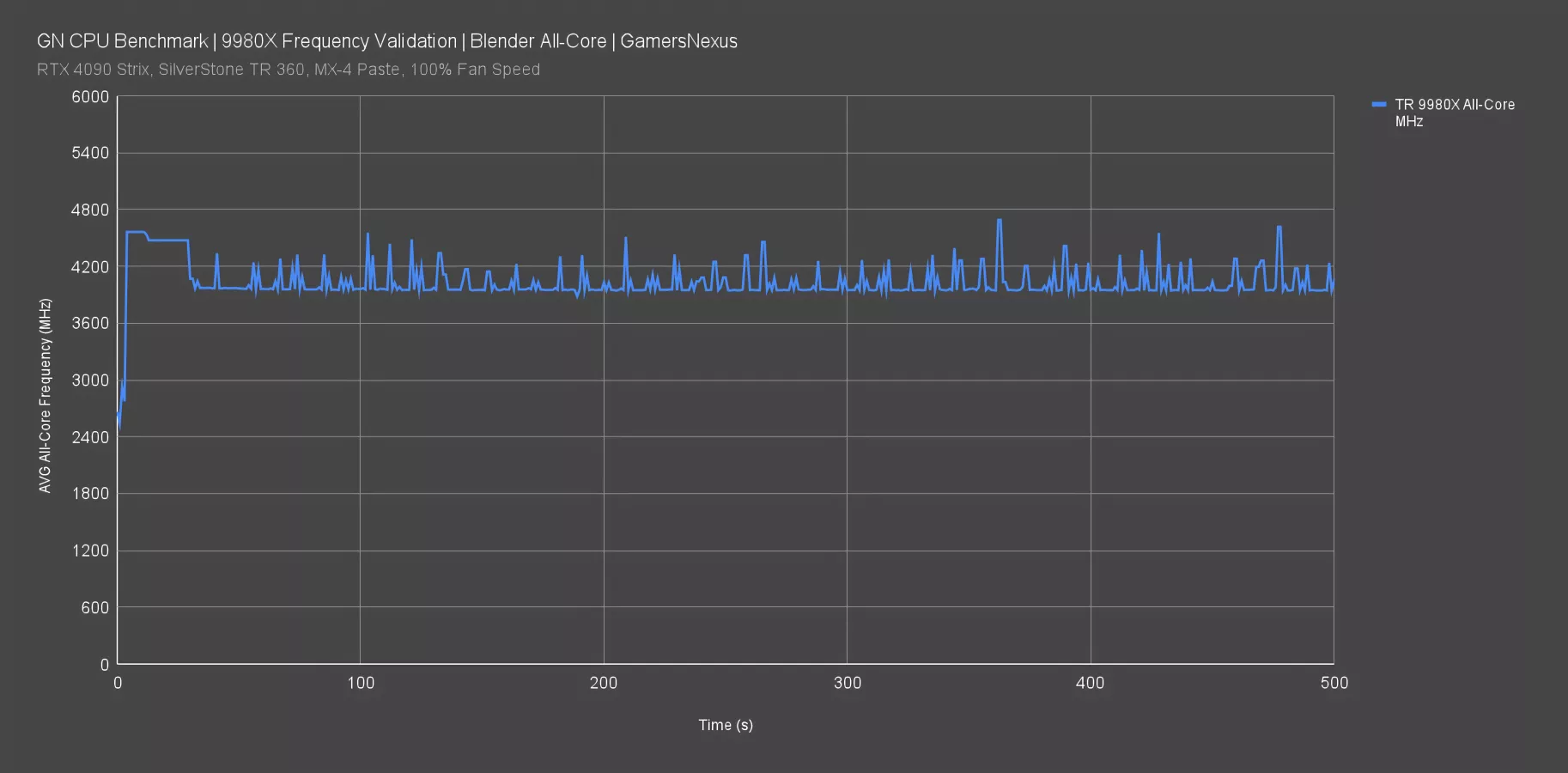
With all cores working, the CPU sometimes ran at round 3950 MHz, with occasional spikes to 4200 MHz whereas some threads have been bringing in knowledge for brand new tiles to render. The bottom clock is 3.2 GHz, so it’s not dropping that low throughout this specific workload, but it surely’s additionally distant from 5.4 GHz. That is typical habits for all-core workloads.
Frequency – Blender vs 7980X
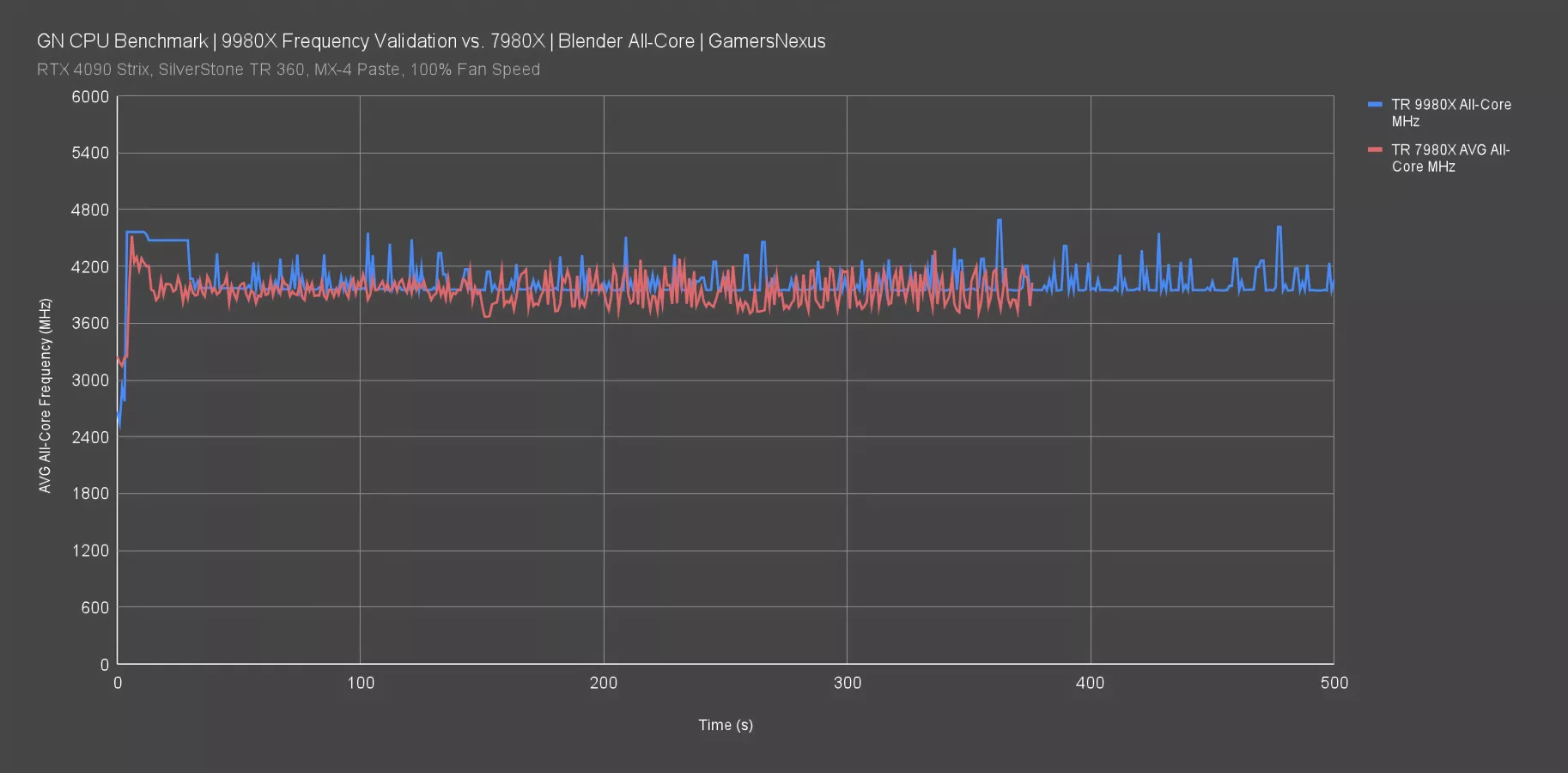
This chart reveals the 7980X for a similar check. The frequency bottoms-out at round 3.7 GHz, however is everywhere throughout this workload. The 9980X has improved upon the frequency in all-core situations total.
Frequency – CB Single-Thread
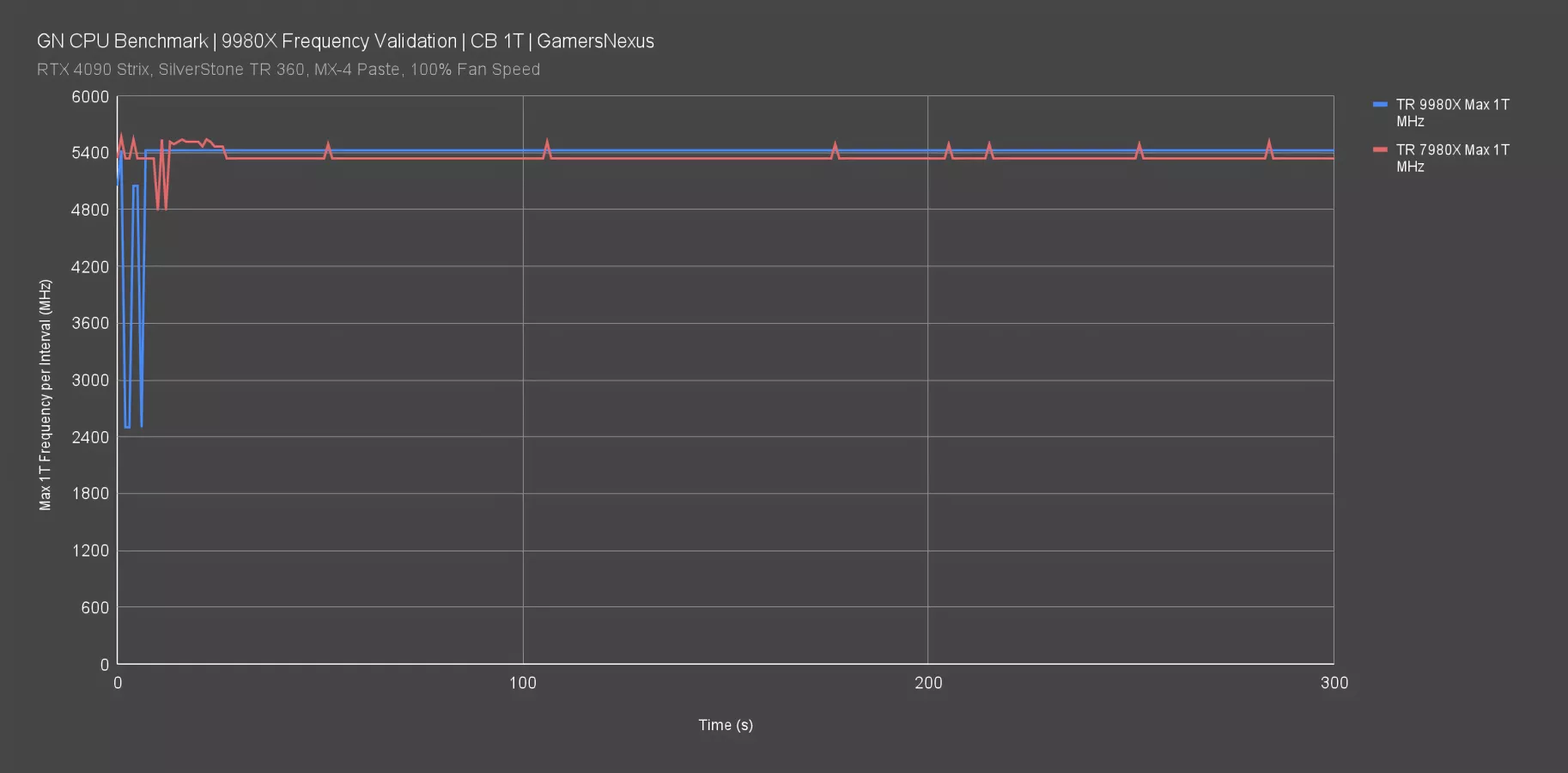
In a single-threaded check with Cinebench, the 9980X ran at 5425 MHz, exceeding the spec itemizing of 5.4 GHz for enhance. That is additionally anticipated habits, with the extra restricted load boosting increased. The 7980X in the identical check ran at about 5340 MHz, so the single-thread frequency has improved generationally — however not a lot, and that’s why some benchmarks solely present a pair share factors of change.
9980X Conclusion
On the gaming facet, there are generally points with consistency. This implies, run-to-run, you don’t get the identical expertise. There’s way more deviation right here in common body fee and the frametime consistency is worse than conventional desktop components. That is very true with 64-core Threadripper CPUs. This isn’t actually surprising. These excessive core depend CPUs generally simply have so many cores that it begins inflicting scheduling issues. Typically you’ll additionally find yourself in conditions the place, as a result of the clocks aren’t boosting as excessive (due to the upper core depend), you’re dropping that frequency benefit. Once more, this isn’t surprising. The excellent news is that the video games we examined on the 9980X weren’t damaged. They have been capable of run and weren’t terrible experiences, which wasn’t the case with the earliest Threadripper CPUs.
In comparison with the 32-core Threadripper, the 64-core half technically runs cooler. That’s since you’re taking the identical energy and distributing it throughout extra silicon. This implies you’re going to get decrease temperatures per die per scorching spot. That is still true right here the place the 64-core CPU could be cooler than the 32-core processor.
With its costs, these Threadripper CPUs aren’t one thing you’re shopping for for “worth.” The goal demographic for these processors might be getting cash with their computer systems.
Threadripper additionally has the good thing about PCIe lane availability for machines with a number of accelerators or numerous I/O, that are extra restricted with conventional desktop CPUs.
64 cores don’t at all times scale properly. Typically a 32-core CPU could be a higher match. Be certain that to do analysis on-line to your wants. For instance, we discovered {that a} 32-core CPU would work higher for us whereas utilizing Adobe Premiere for video manufacturing. So it’s greatest to analysis these CPUs along with your wants.