
22V stereo Class-D audio amplifier quiescent at 6mW Leave a comment
MAX98415A and MAX98425A are related, and each together with envelope monitoring management that saves energy by instructing an exterior dc-dc converter to supply the amplifiers most important energy enter with simply sufficient voltage for clear output alerts.
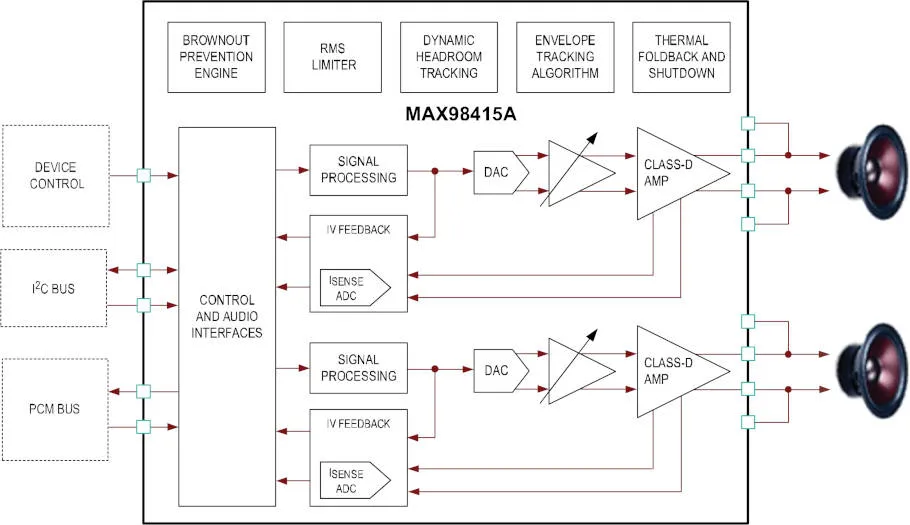
The distinction between the 2 is that MAX98415A contains additional {hardware} (‘ Vfeedback’ and ‘Isense ADC’ in diagram) to assemble knowledge and transmit it to an exterior host MCU in order that the host can run speaker safety algorithms.
Inputs are digital as much as 192kHz, and output energy for for 1% THD+N from the MAX98415A is 27W stereo into 8Ω from 22V, or 19W into 4Ω from 14V. MAX98425A ship ~1W in every circumstance.
For both divice, THD+N for 2W into 8Ω is -81.1dB at 1kHz.
There’s a nice deal extra in these ICs along with the 2 most important sign chain –
For instance, a dynamic headroom monitoring block screens the principle energy rail and makes an attempt to minimise audible artifacts throughout energy dips by compressing the audio sign or limiting it.
Past this and meant for battery-powered programs, a ‘brown-out prevention engine’ appears for deep dips within the incoming provide and briefly decreases present draw to protect the rail for different programs sharing it.
Thermal fold-back will be enabled to routinely scale back output energy when the temperature exceeds an adjustable threshold. “This enables for uninterrupted music playback even at excessive ambient temperatures,” mentioned ADI.
Inputs are PCM for audio knowledge and I2C management.
Many of the options above are deeply programmable and there are various different options – inner tone and pink noise turbines to call however two.
4 energy rails are wanted in whole: 1.8V for digital logic, 1.8V for the inner analogue, 2.4 to five.5V battery connection (there isn’t a charger) and the principle 3 to 22V output stage energy rail.
Packaging is 3.4 x 2.2mm 0.4mm pitch 40bump WLP.
The datasheet is worth a brows simply to see how mich is on these ICs.
There was an uncommon Class-D audio amplifier at ISSCC this year that boosted its own output voltage