
AMD Ryzen 9 9950X CPU Review & Benchmarks vs. 7950X, 9700X, 14900K, & More Leave a comment
Following the missed timelines for assessment models and later recall of the elements, AMD’s latest spherical of communication mishaps embody not telling the media that the 9950X and 9900X (watch our review) require a specialised Home windows setup for core parking just like the 7950X3D and 7900X3D. These CPUs have at all times wanted it, however the non-3D 7900X and 7950X didn’t. This can be a change for the 9950X and 9900X, which meant that the majority reviewers had the CPUs for about 5 days earlier than AMD communicated this requirement, inflicting everybody doing it proper to throw out their information and re-test.
For this assessment, we’ll be targeted on manufacturing purposes and energy, since gaming is de facto solely wanted to verify it’s functioning correctly. Let’s get began.
The 9950X is a 16C/32T half on the Zen 5 structure, which suggests it sockets into AM5 motherboards with chipsets within the 600-series, akin to X670E, and the upcoming 800-series. For opinions, we’re utilizing an X670E motherboard because the X870E boards aren’t out there but.
This can be a record of CPUs that require the setup we’re about to explain. The ONLY processors that require particular care are the 7950X3D, 7900X3D, 9900X, and 9950X. The non-3D 7950X (watch our review here) and 7900X (watch our review)don’t get this therapy.
Core parking is the habits whereby half of the CPU’s cores are “parked,” or are particularly unused and prevented, when operating purposes that will profit from as an alternative operating on a single CCD.
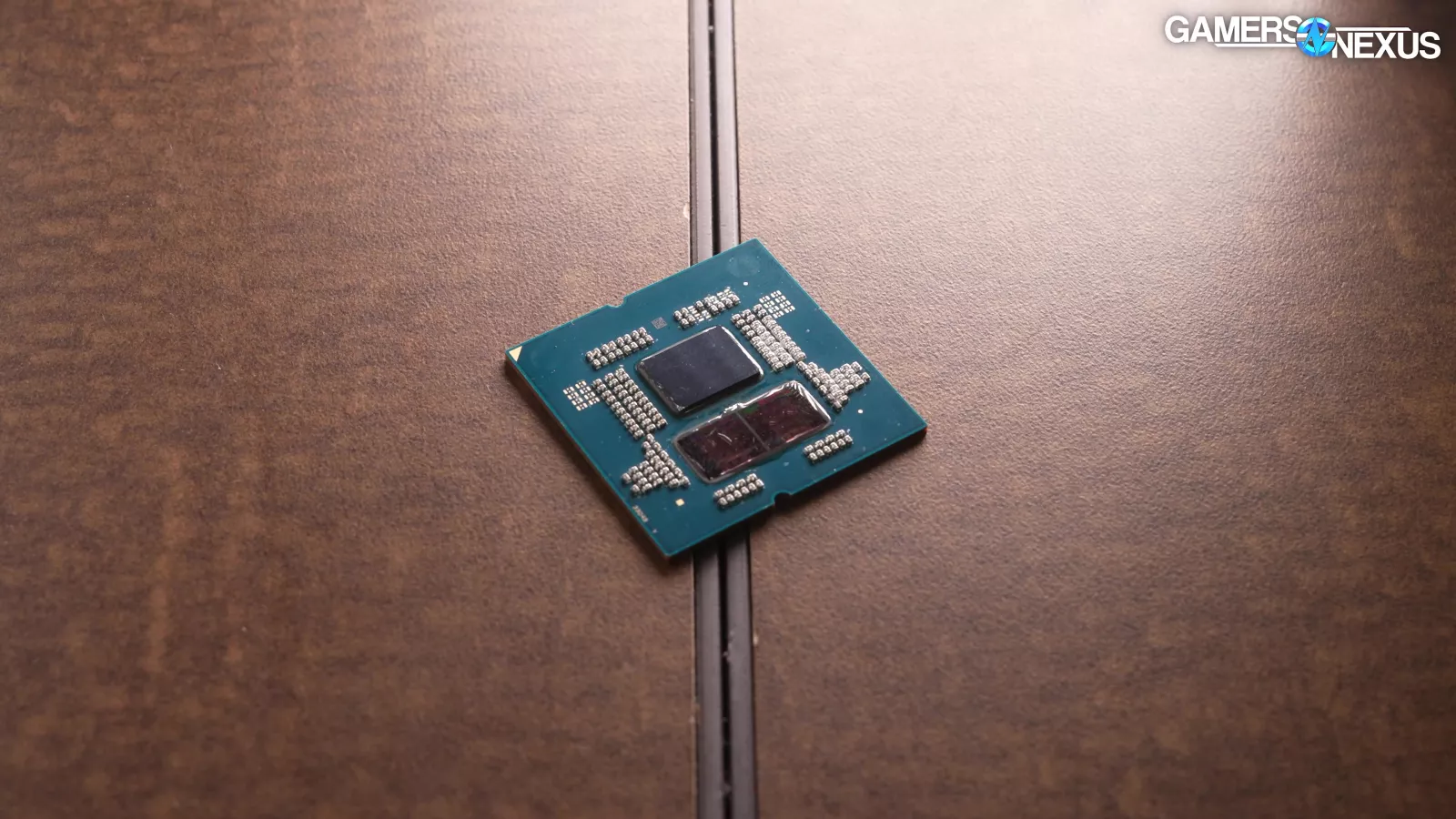
The affected AMD CPUs have two CCDs, or two chiplets along with the I/O die chiplet. CPUs just like the 7800X3D solely have a single chiplet which additionally has the additional cache.
With the 7950X3D (watch our review) and 7900X3D (watch our review), the explanation you’d park cores is as a result of the additional cache is on one CCD. BIOS may be set to favor the CCD with greater frequency or with extra cache, however try to be utilizing the chipset drivers for all of this. If a recreation is bouncing load indiscriminately between cores unfold throughout two very totally different chiplets, it’s doable that efficiency is worse. Core parking is meant to repair this, and usually, it does a fairly good job.
When you have been to power core parking on a CPU that doesn’t require it, it is vitally doubtless that you just harm the efficiency considerably. This might lower it by double-digit percentages. Likewise, not enabling it on CPUs that require it might harm efficiency by double-digit percentages.
We’ll discuss the best way to configure it first, then get into some downsides now that it’s required on the 9950X and 9900X.
Core Parking
There are a number of steps required so as to set this up.
- First, set up AMD’s newest chipset driver with all options.
- Replace Home windows and allow Microsoft’s Recreation Mode.
- Allow Recreation Bar, open the Microsoft Retailer library, and click on on Recreation Bar to verify that it is totally up to date.
- Go to the Management Panel (the actual one, not the Settings app), Energy Choices, and choose the Balanced energy plan. Balanced is required. We usually use Efficiency for our benchmarks, however not for chips that require this. If you wish to, AMD notes that afterwards you’ll be able to go into the Settings app (not the Management Panel), System, Energy, and alter Energy Mode to Greatest Efficiency.
- The system ought to deal with itself after this, however to make sure, reboot, then run this command: “begin /wait Rundll32.exe advapi32.dll,ProcessIdleTasks”.
- Depart the mouse and keyboard alone and let the command end operating. It could actually take a number of minutes, so you might wish to disable sleeping and display screen deactivation beforehand.
- To confirm that every one of that is working, you’ll be able to run the command powercfg.exe /queryprofile scheme_current profile_gamemode CPMinCores in an elevated command immediate. This may both say that no profile is discovered, during which case core parking is off, or it is going to inform you in regards to the core parking configuration. Save this video and this command for the longer term, as for those who ever improve in-socket to a CPU that requires it, you’ll wish to know that issues are working
Recreation Bar is the app that is chargeable for deciding whether or not purposes are video games or not, which then prompts Recreation Mode, which then parks cores. To check it, you’ll be able to open Useful resource Monitor, open Recreation Bar (Win+G), and verify the “Keep in mind this can be a recreation” field. Relaunch Useful resource Monitor, then go to the CPU tab, and half the cores ought to say Parked.
Needless to say Microsoft’s Recreation Bar remains to be an enormous piece of crap, and we have seen the “Keep in mind this can be a recreation” field randomly checked and unable to be deactivated, so play with this feature at your personal threat.
These steps apply solely when shifting TO certainly one of these 4 CPUs. When you boot with certainly one of these 4 CPUs after which later transfer to a CPU that does not require core parking, AMD’s official recommendation is to reinstall Home windows, or “you’ll be able to attempt uninstalling then re-installing the AMD Chipset Driver as a workaround.”
That’s the setup fundamentals. Some BIOS and CPU mixtures may additionally have an choice for core parking habits. It is best to set that to let the Driver do what it does: Drive.
As for different info that you could be need for this assessment, you’ll be able to try our testing methodology notes (discovered within the 9700X review), basics of Zen 5 architecture, product details, and the effectivity deep-dive. For now, let’s get into the information for the 9950X.
Frequency
Frequency – All-Core
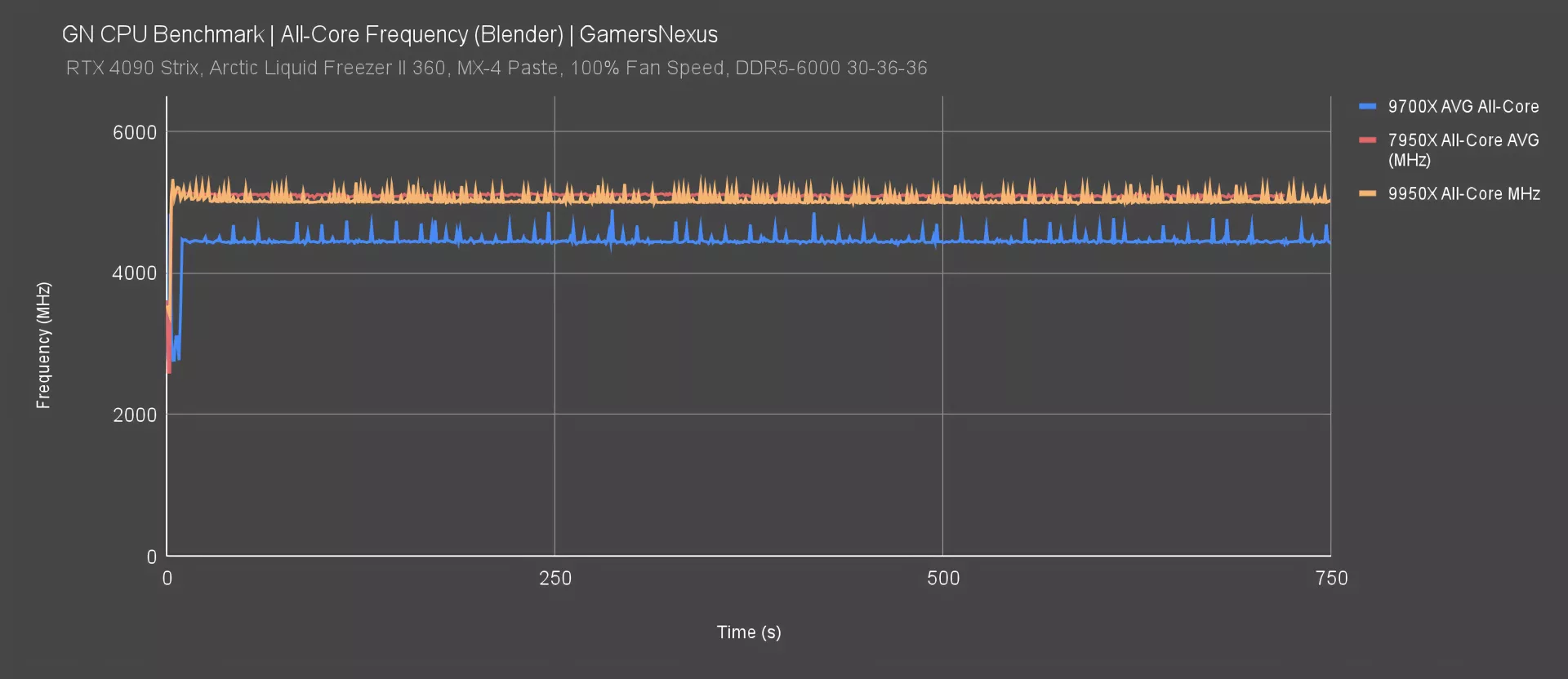
We’ll have a look at frequency first to verify issues are performing as anticipated.
Right here’s the all-core frequency when the CPU is totally engaged on each thread in Blender. The 9700X was round 4500MHz right here, +/- 20MHz. The 7950X plotted round 5100MHz all-core beforehand.
As for the brand new 9950X, its greater energy funds permits it to spice up considerably greater than the 9700X. The 9950X finally ends up across the vary of 5000MHz. It’s spiky, however usually talking, doesn’t have any main dips. It’s a little bit decrease than the 7950X, although.
We’d anticipate that our 9950X ought to usually outperform our 9700X in gaming eventualities primarily based on this, because it’s theoretically in a position to increase greater. The one motive this wouldn’t be the case is that if one thing goes fallacious with the core parking habits.
Frequency – Single-Core
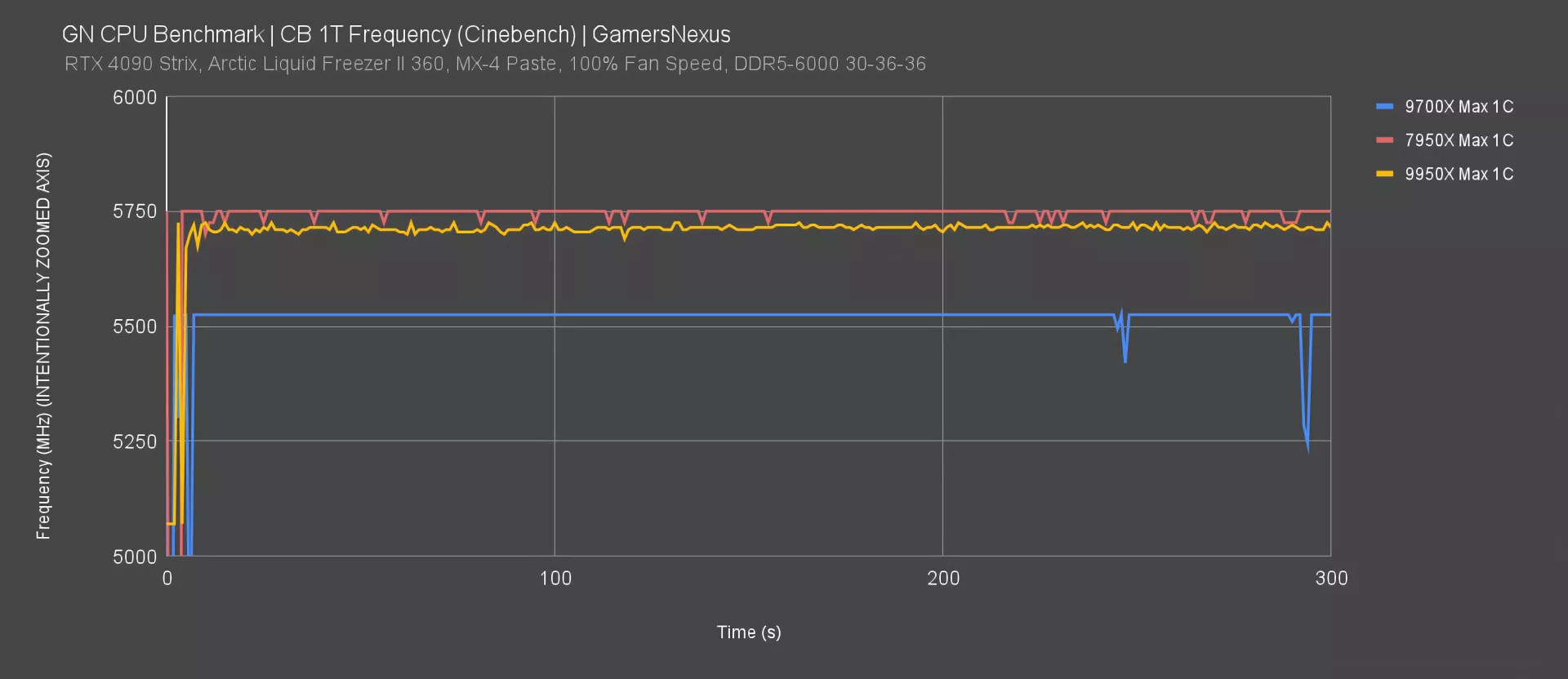
In single-core testing with Cinebench 1T, the 9700X maxed-out at 5525MHz in most eventualities. The 7950X ran at 5750MHz in the identical testing, pushing comparatively excessive.
The brand new 9950X can be on this space, with ours plotting at round 5710-5725MHz for a single-threaded load. So long as there’s architectural uplift, this could allow the 9950X to additionally outperform the 7950X in evenly threaded eventualities.
Energy
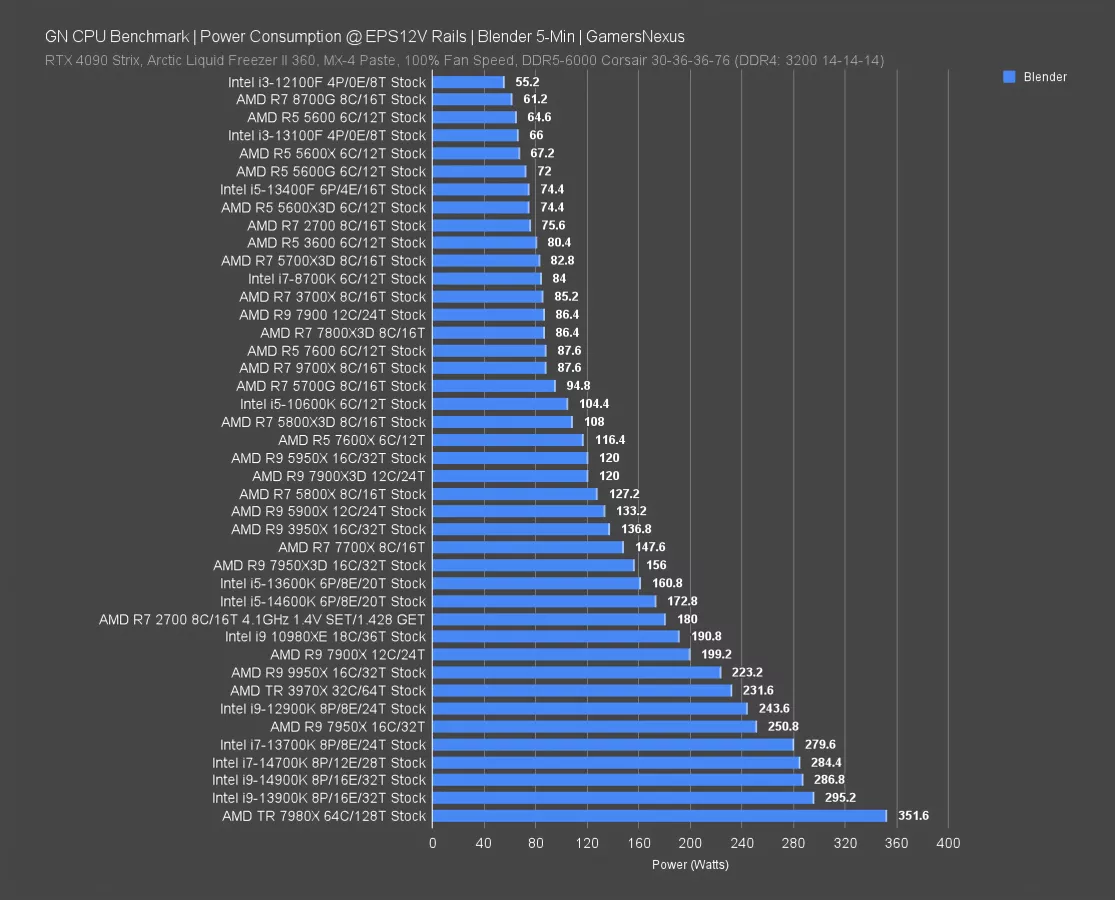
Energy consumption on the EPS12V rails in simply Blender is up now. This isn’t an effectivity chart, simply the height energy consumption in a worst-case situation. You’d use this to assist buffer PSU necessities.
The 9950X pulled 223W on this benchmark, which is down from the 7950X’s 251W that we measured. The 9950X is about 70W under the 13900K right here. Towards the R7 household, the 9950X is pulling about 136W greater than the 9700X and its 87.6W entry.
To date, the 9950X is down from what we measured on the 7950X. In comparison with older generations, energy stays up general: The 3950X (watch our review) pulled 137W on this take a look at with all cores loaded, with the 5950X at a powerful 120W. That’s why you’ll see the 5950X carry out the identical because the 3950X in some benchmarks, however with big energy reductions as a result of high quality of the voltage bin.
Effectivity – Blender
We’re beginning with our effectivity benchmarks now. When you haven’t seen our efficiency deep-dive, positively go verify that out — it’s extraordinarily fascinating and divulges a variety of CPU behaviors, nevertheless it additionally plotted the course for what we’re entering into on this assessment. We’ll run a restricted set of extra effectivity benchmarks on this assessment.
All-core workloads are the place the 9950X belongs, so we’ll begin with manufacturing purposes.
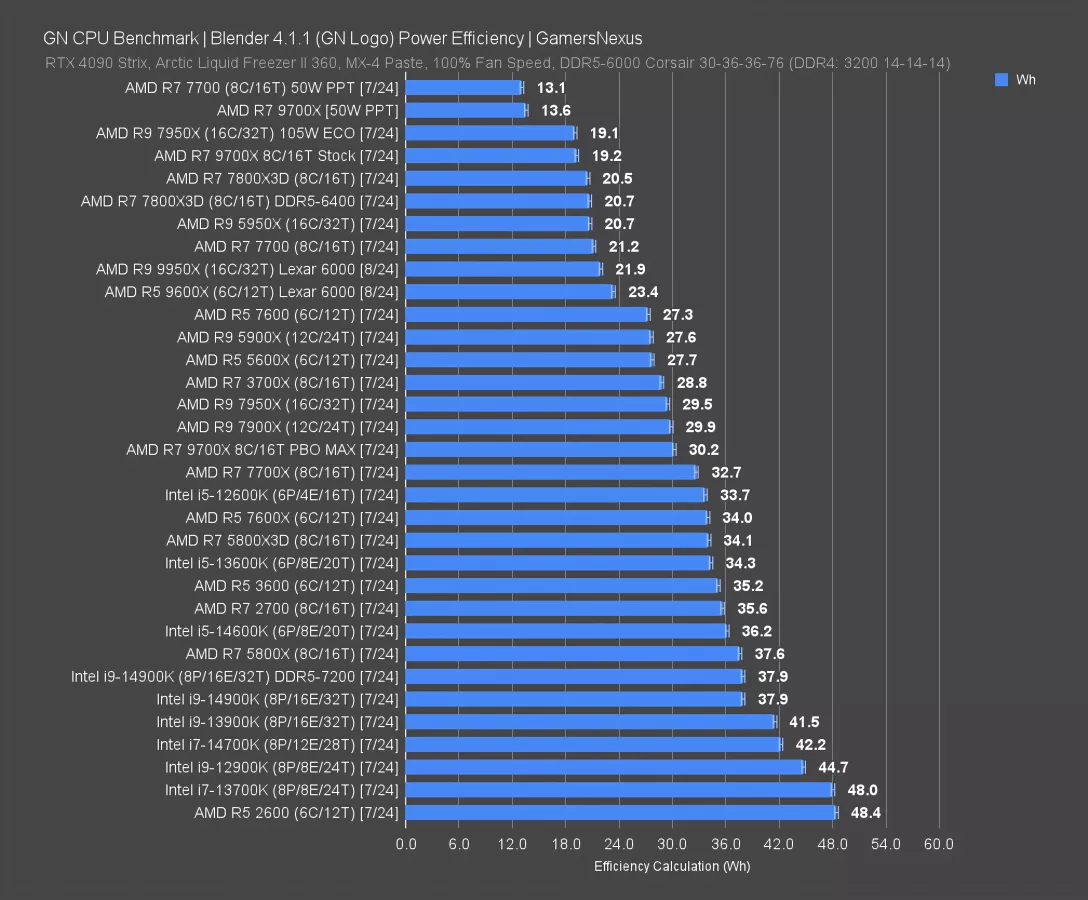
In Blender, the 9950X finally ends up neighbors with the 7700 and is much less environment friendly than the outdated 5950X (watch our review), which was a outstanding chip for its period. The 7950X ranks at 29.5Wh right here, so within the very least, the 9950X improves massively on that: Its enchancment is a 26% discount in Wh measurement for this particular take a look at.
The 7950X with ECO Mode does phenomenally right here, because it at all times has. With 105W ECO, which we discovered to be the best configuration fairly than dropping right down to 65W, the 19.1 consequence has it because the chart chief and simply forward of the 9700X and behind the PPT-limited entries.
AMD continues to enhance in effectivity on this particular take a look at, however as we noticed in yesterday’s content material, we’d like greater than this.
Effectivity – 7-Zip
7-Zip is up now, then video games.
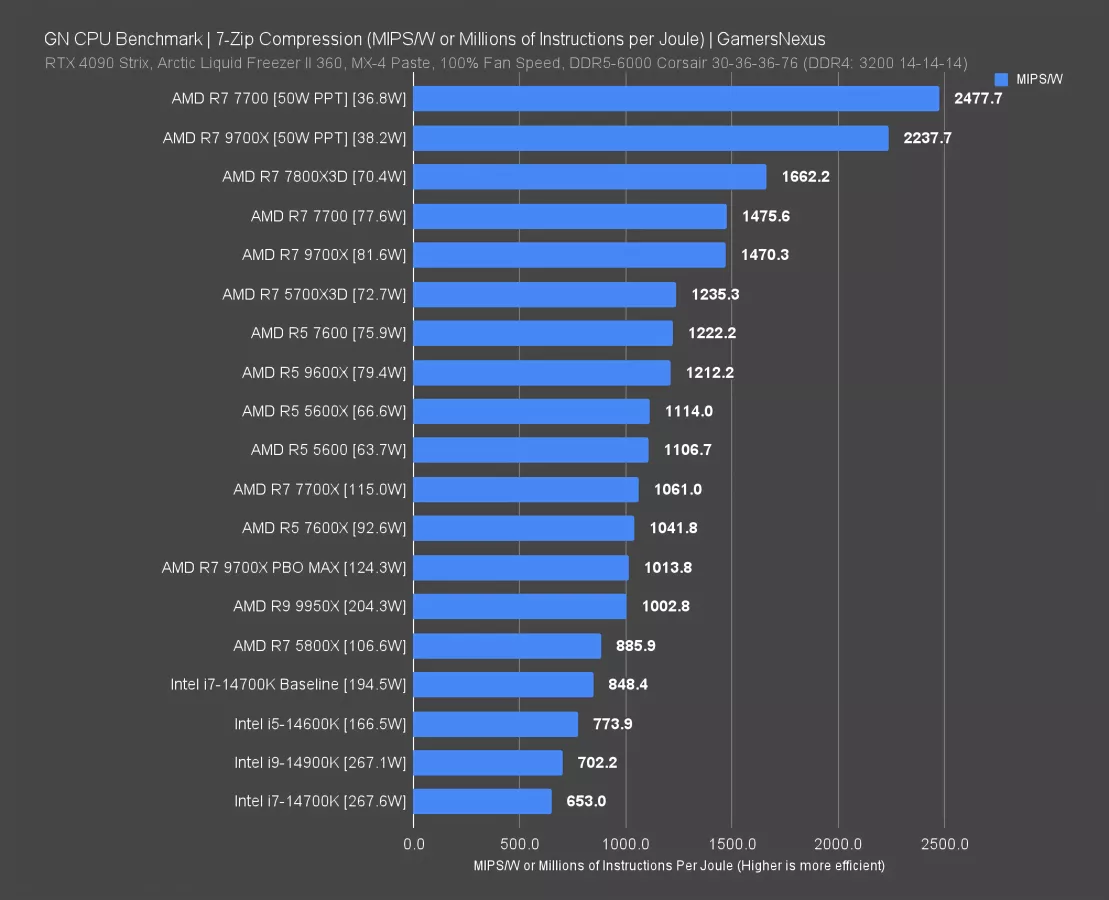
In 7-Zip compression, the 9950X ranked at 1003 MIPS/W, or thousands and thousands of directions per Joule. That has it as one of many least environment friendly on this chart. We haven’t run the 7950X by way of for these assessments but, so we don’t have comparative information. This can be a model new information set.
For issues we are able to examine in opposition to: The 9950X results in about the identical place because the 9700X with PBO blasted and behind the 7600X. A part of this can be explainable by hitting different non-core bottlenecks and limiting its whole efficiency.
Effectivity – Video games (FFXIV)
Now for video games.
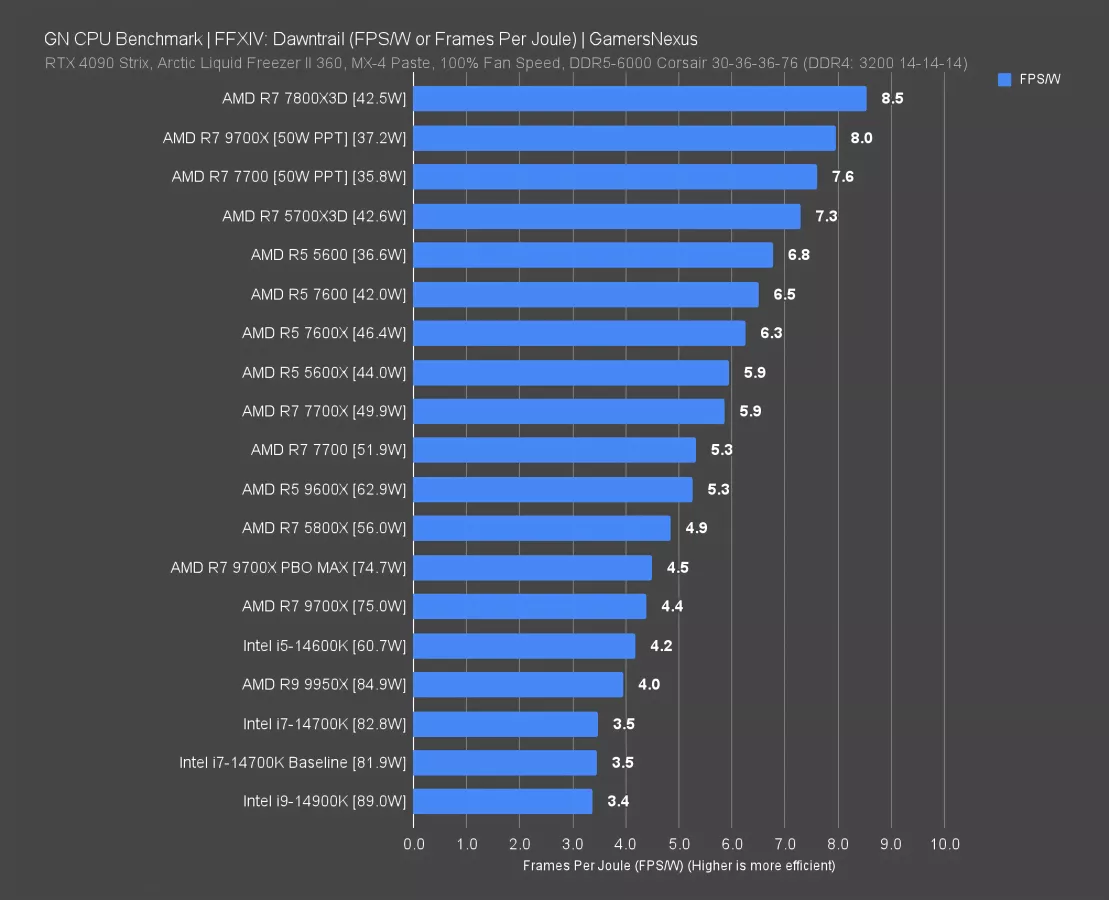
Ultimate Fantasy is without doubt one of the ones that had extra fascinating habits, particularly on a few of the 7000-series CPUs. That’s defined in yesterday’s video.
For the 9950X, the CPU ended up pulling about 85W, or 10W greater than the 9700X, however clearly far lower than what we’d see in all-core work. That additional TDP offers it additional energy funds, regardless that half the CPU is parked. The top result’s general good efficiency in an absolute sense, however much less environment friendly operation. The 9950X outdoes the 14700K and 14900K, however underperforms in opposition to all the things else.
Effectivity – Video games (Phantom Liberty)
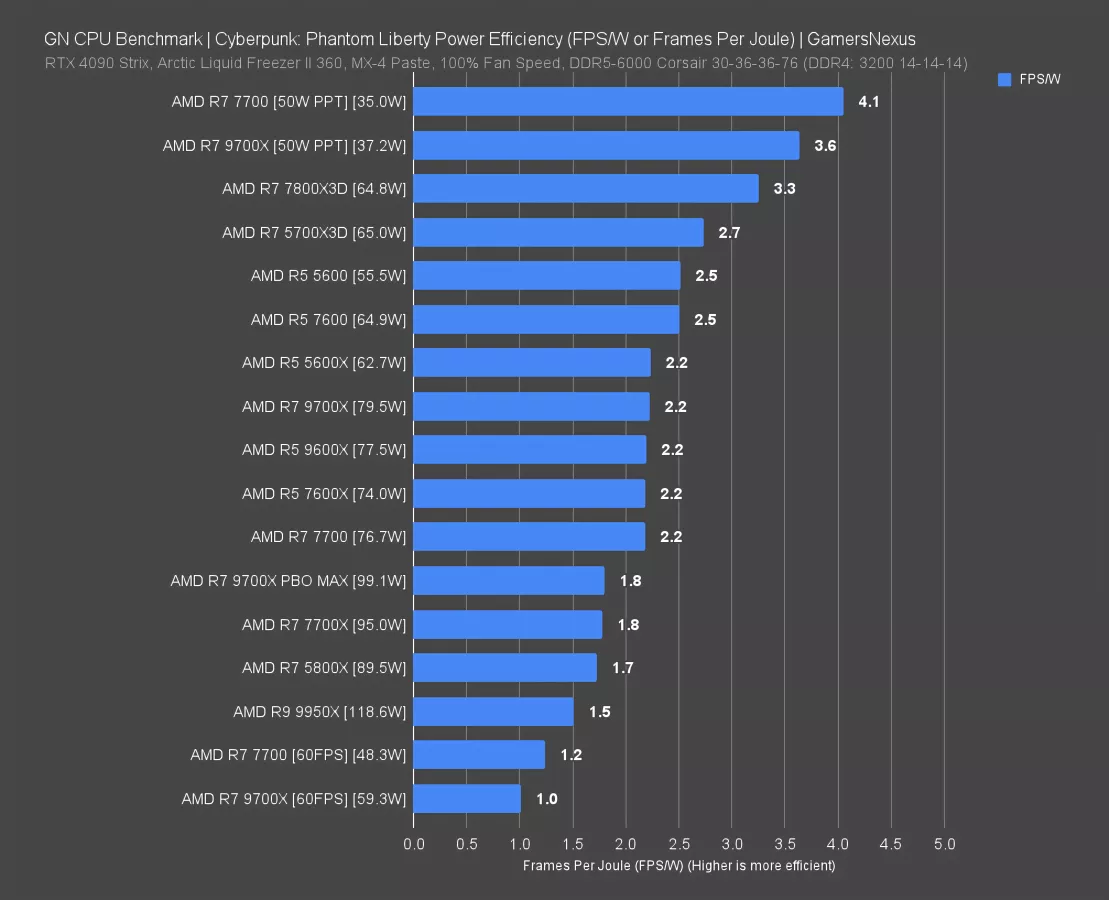
In Phantom Liberty, the 9950X pulled about 119W whereas producing a framerate just like the 9700X. Because of this, its effectivity is thru the ground. This CPU is simply off the far finish of the bath curve in these sorts of video games: The baseline energy consumption to maintain this CPU operational is greater and it has a ton of cores sitting there doing subsequent to nothing. This CPU must be totally leveraged to have a greater consequence, and video games simply don’t actually try this if you want core parking.
Effectivity – Video games (Stellaris)
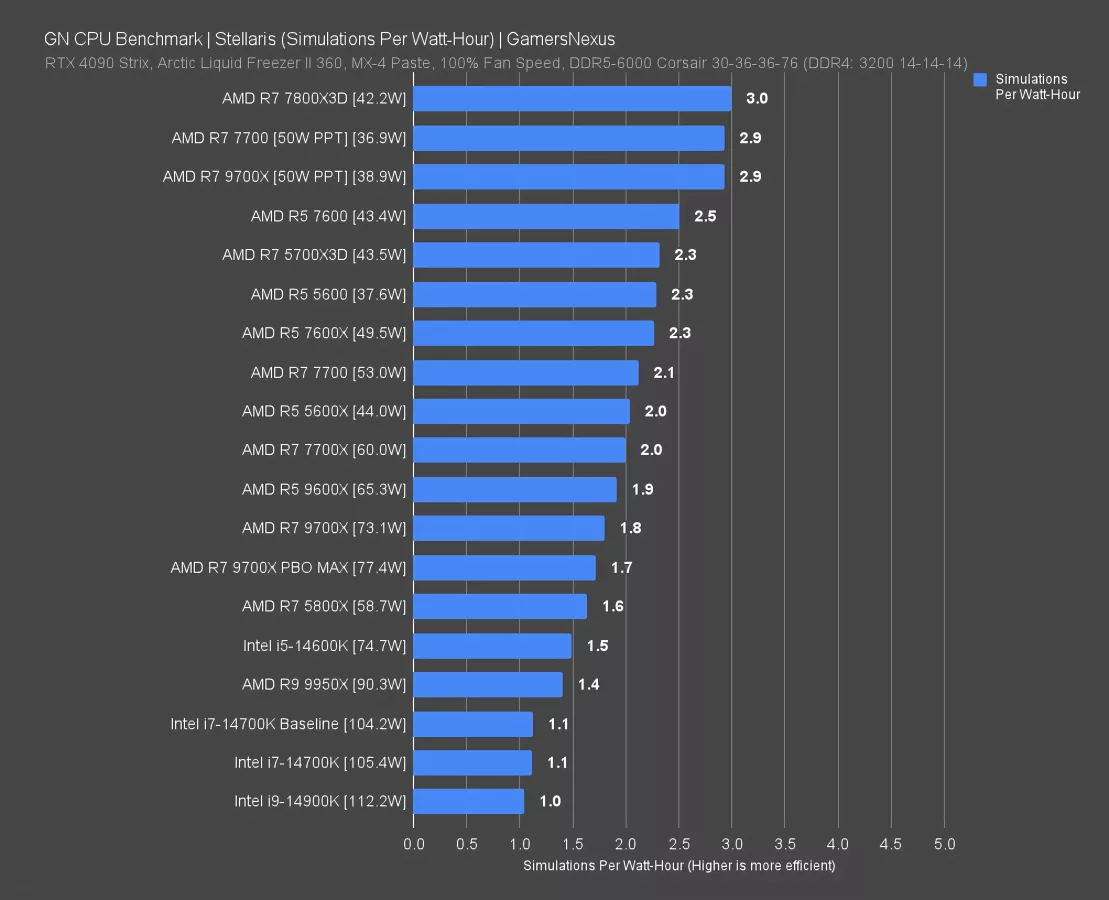
In Stellaris, the 9950X completes 1.4 simulations per watt-hour, which has it under nearly all the things besides the 14700K and 14900K (watch our review)CPUs. The 9700X leads by vital margin, up at 1.8 simulations per watt-hour, with the 7800X3D roughly doubling the efficiency. The one optimistic is that it’s forward of Intel right here.
9950X Manufacturing Benchmarks
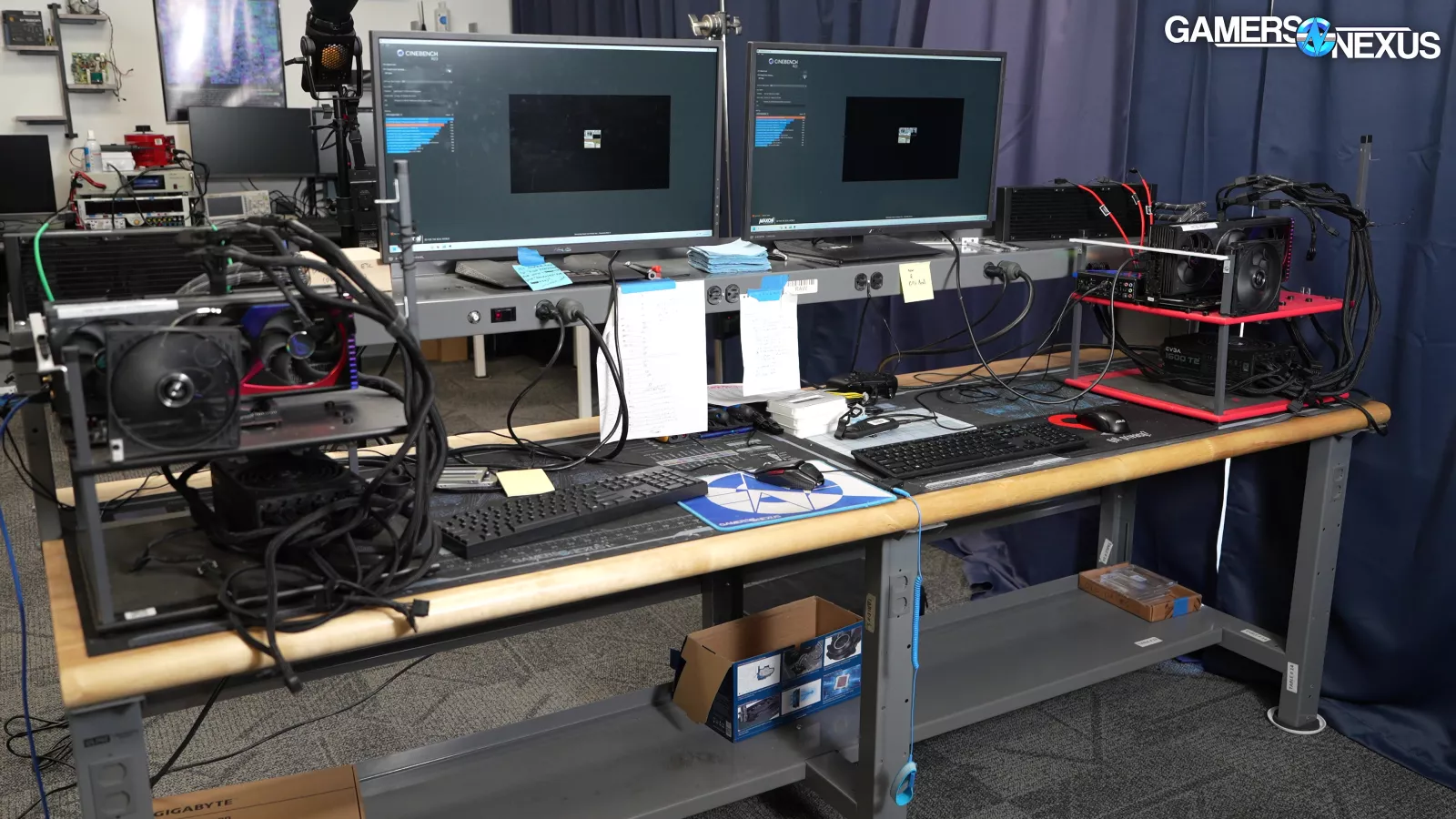
We’re beginning with manufacturing benchmarks for the 9950X since its supposed use case could be for workstation-type duties, adopted by gaming benchmarks simply to verify it’s working as anticipated.
Blender
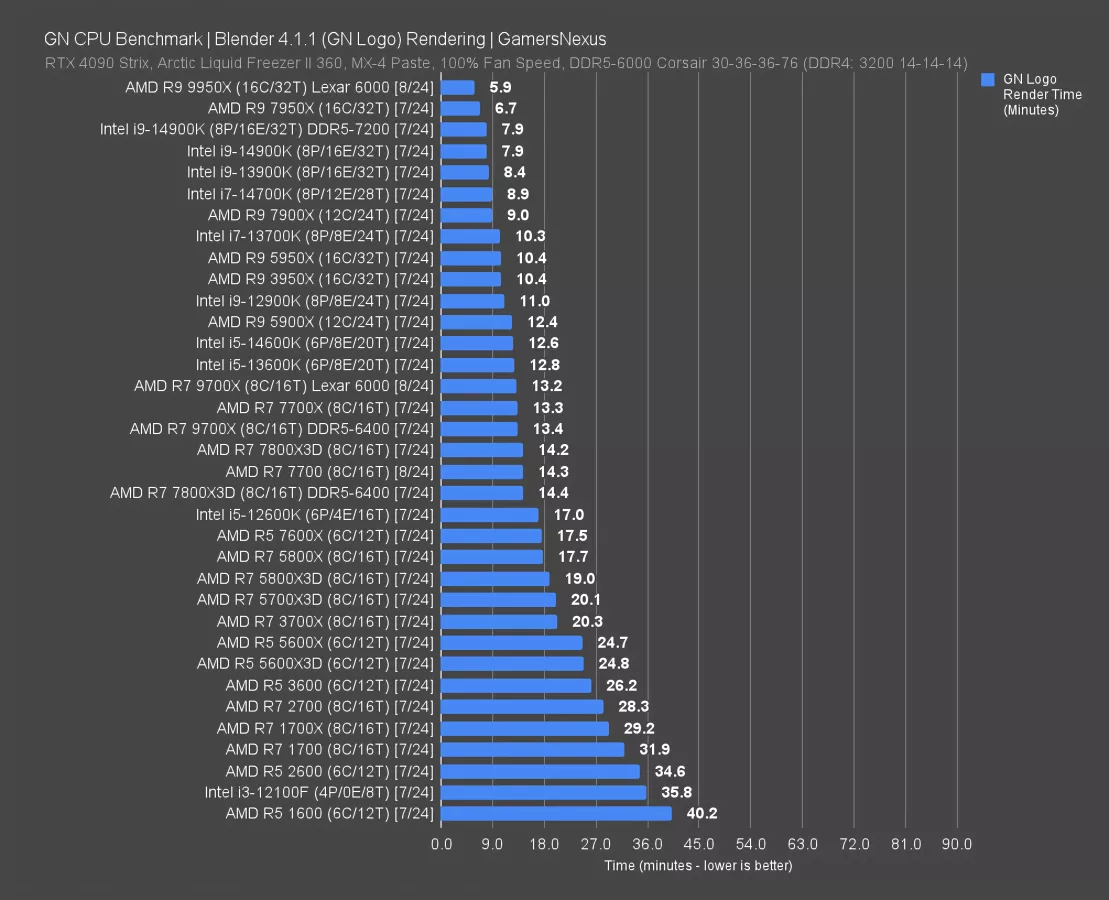
Blender begins us off. The 9950X is the brand new chart-topper for tile-based rendering, posting a complete render time discount of 12% from the 7950X. That’s going to be one of many high beneficial properties we see on this assessment, as this can be a fully-engaged, all-core workload.
Intel’s 14900K required 7.9 minutes to finish the identical work. Relying on launch day pricing and if the 7950X strikes round, it’s doable that it stays the best choice for a machine that mixes workstation and gaming duties when it from a worth standpoint, nevertheless it’ll rely upon value positioning.
Generationally, the 9950X reduces the whole render time required by 43% from the 5950X and 3950X, which require about 10.4 minutes to finish. This isn’t a mistake — they’re simply the identical right here. We talked about that in our unique assessment from years in the past. When you choose to have a look at it from the course of improve in time required, clearly the p.c flips and practically leads to a doubling. We do these comparisons as p.c discount in whole required time.
AMD is at the least shifting the needle on this one. Let’s see if it sustains.
Adobe Photoshop
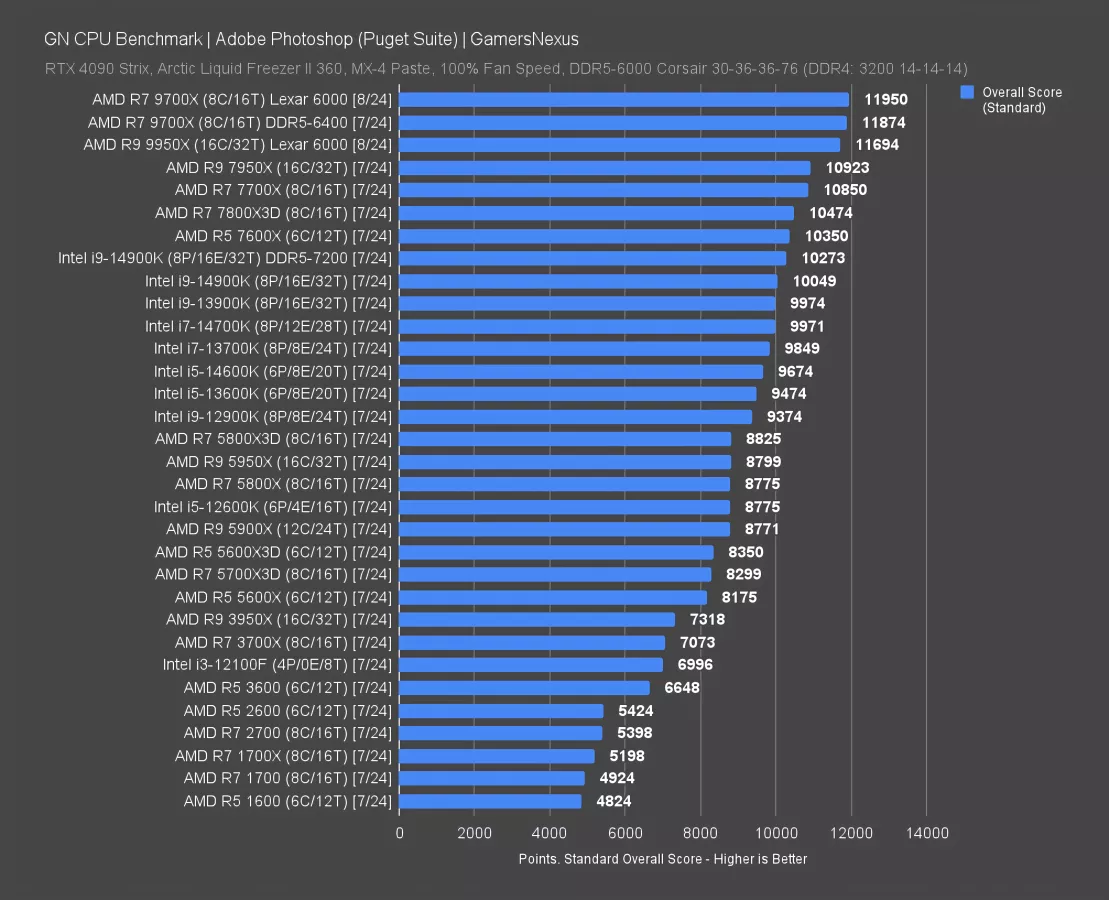
Photoshop is subsequent, examined utilizing the Puget take a look at suite. Scoring is finished as a formulation calculating filtering, scaling, and different sorts of duties throughout the software program.
On this benchmark, the 9950X scored 11,694 factors for Photoshop, which has it under the 9700X by a technicality. These two carried out functionally the identical. Photoshop can make the most of additional cores, however isn’t making sufficient use of the additional 8 cores over the 9700X to matter.
Generationally, we noticed comparable habits with the 7950X and 7700X: They have been inside margin of error of one another. The 9950X improves on the 7950X by 7%, which nonetheless isn’t unhealthy, however actually isn’t an enormous pleasure. That is efficiency we’d anticipate out of a mid-generation refresh. It doesn’t actually really feel sufficient for the way a lot this was marketed as a model new platform to work off of. Versus the 5950X, the 9950X improves 33%. The 3950X offers the 9950X an uplift of 60%. When you’ve been on the 3950X for years now, it’s at the least beginning to appear like you’ll get significant uplift in a few of these duties.
The latest model of this benchmark mixed with the most recent model of Photoshop exhibits AMD’s favorable positioning, whereas older variations confirmed Intel favor. Intel’s first exhibiting is under the 7600X.
Adobe Premiere
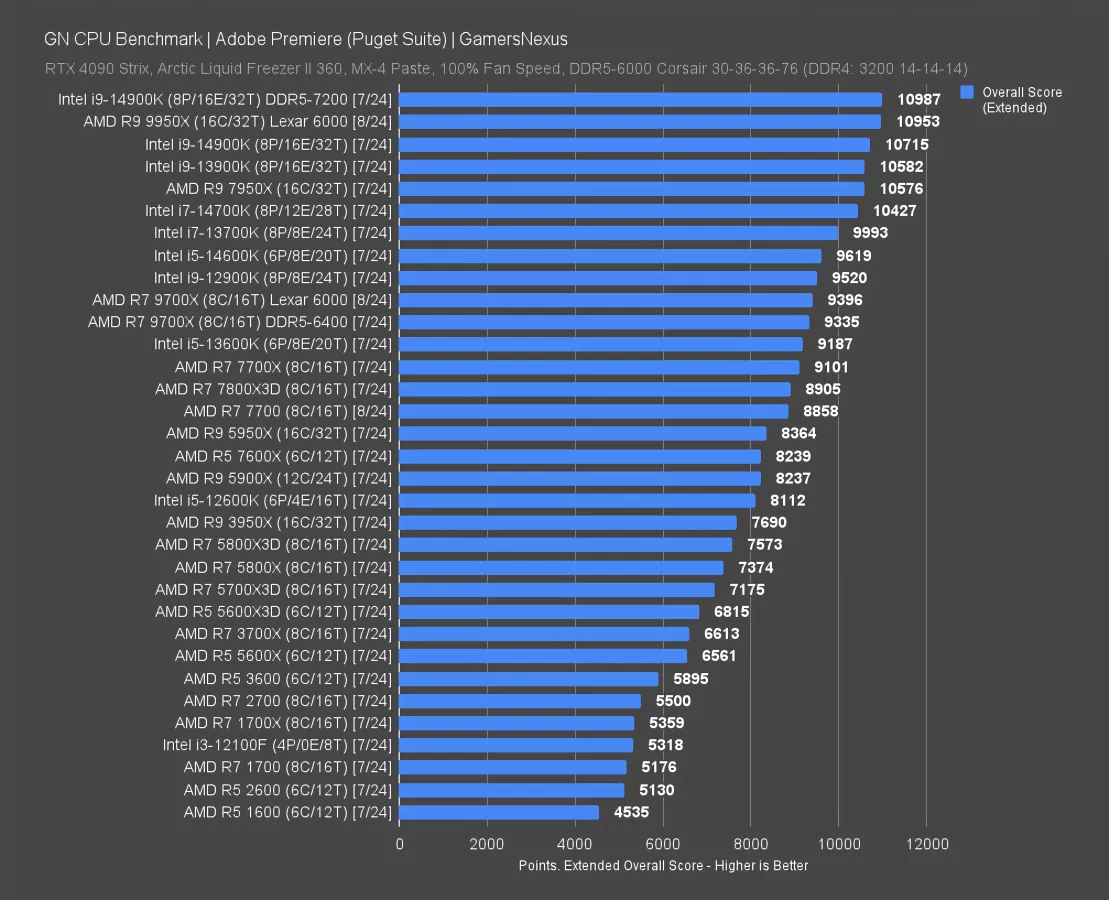
In Adobe Premiere, the 9950X scored nearly 11,000 factors for the prolonged benchmark. The 14900K flanks it with the standardized and quicker reminiscence, however in the end, these are equal. Towards the prior technology, the 9950X improves 31% over the 5950X (which is down close to the 7600X) and 42% over the 3950X.
For comparability, the 5950X — which itself wasn’t at all times an thrilling uplift over the 3950X — posts a 9% enchancment over its predecessor. Anybody anticipating a 7950X-era achieve could be disillusioned: That one is 26% higher than the 5950X.
Intel does significantly better on this take a look at than a few of the prior ones with our present information set. The 14700K (learn our review) and 14600K are nonetheless within the high portion of the chart. We truly usually just like the 13600K and 14600K CPUs for a less expensive choice for this activity, particularly when the 13600K is at its cheaper value, however we’re ready for a few of the smoke to clear earlier than we resume suggestions of them. The microcode remains to be rolling out to boards.
Chromium Code Compile
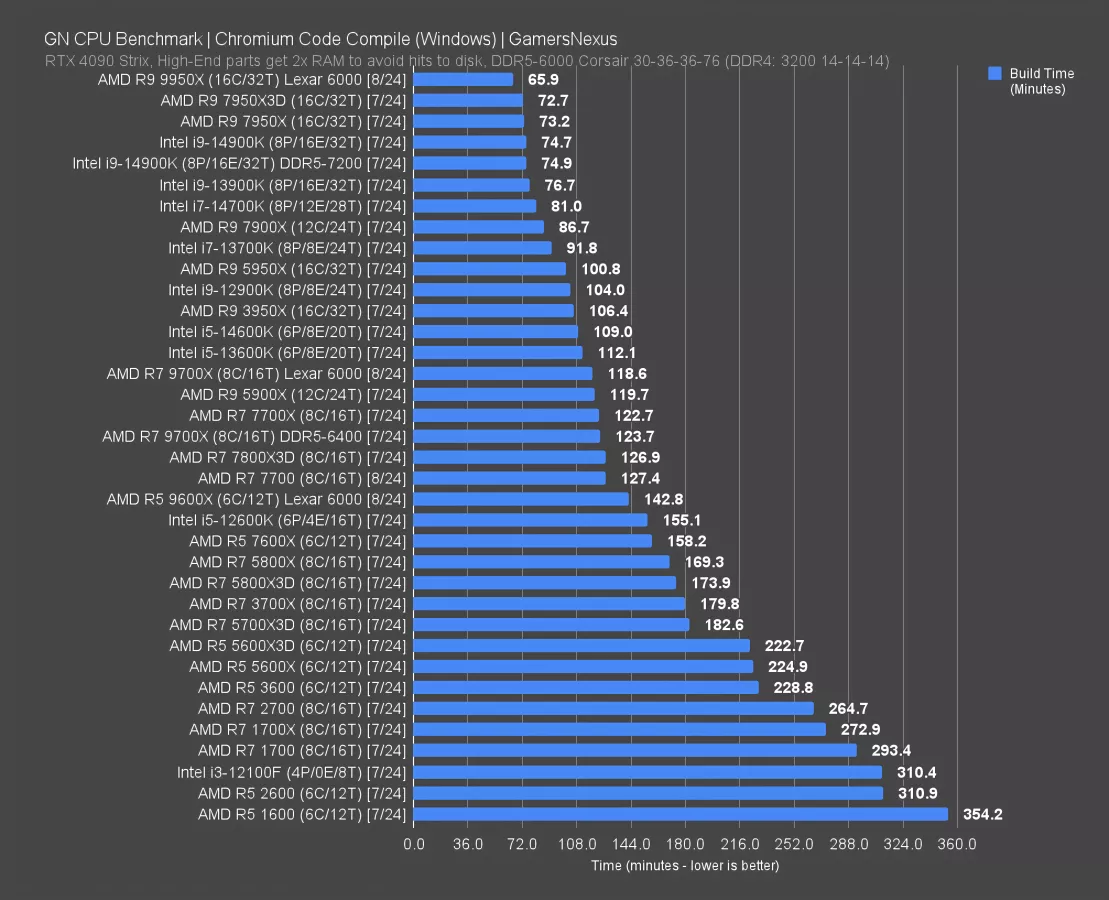
Code compile testing with Chromium is subsequent. This requires a reminder that not all compile workloads behave the identical, similar to anything.
In our take a look at at the least, the 9950X leads all the things. The brand new CPU required 66 minutes to finish the compile, main the 7950X’s 73-minute entry and benefiting from a complete compile time discount of virtually 10%. Clearly, Threadripper could be forward of this, which we’ve examined previously, however we don’t have it rerun for the brand new assessments.
The 7950X was in a position to cut back the compile time required from the 5950X’s 101-minute consequence by 27%, whereas the 5950X solely lowered it from the 3950X’s 106-minute consequence by 5.3%. The brand new CPU is extra just like that period than the whole platform change we noticed with AM4 to AM5. That’s not too stunning.
Intel’s closest entries are the 14900K, which roughly tie with the 7950X. AMD is gaining a long way the place it solely had equivalence earlier than.
7-Zip Compression
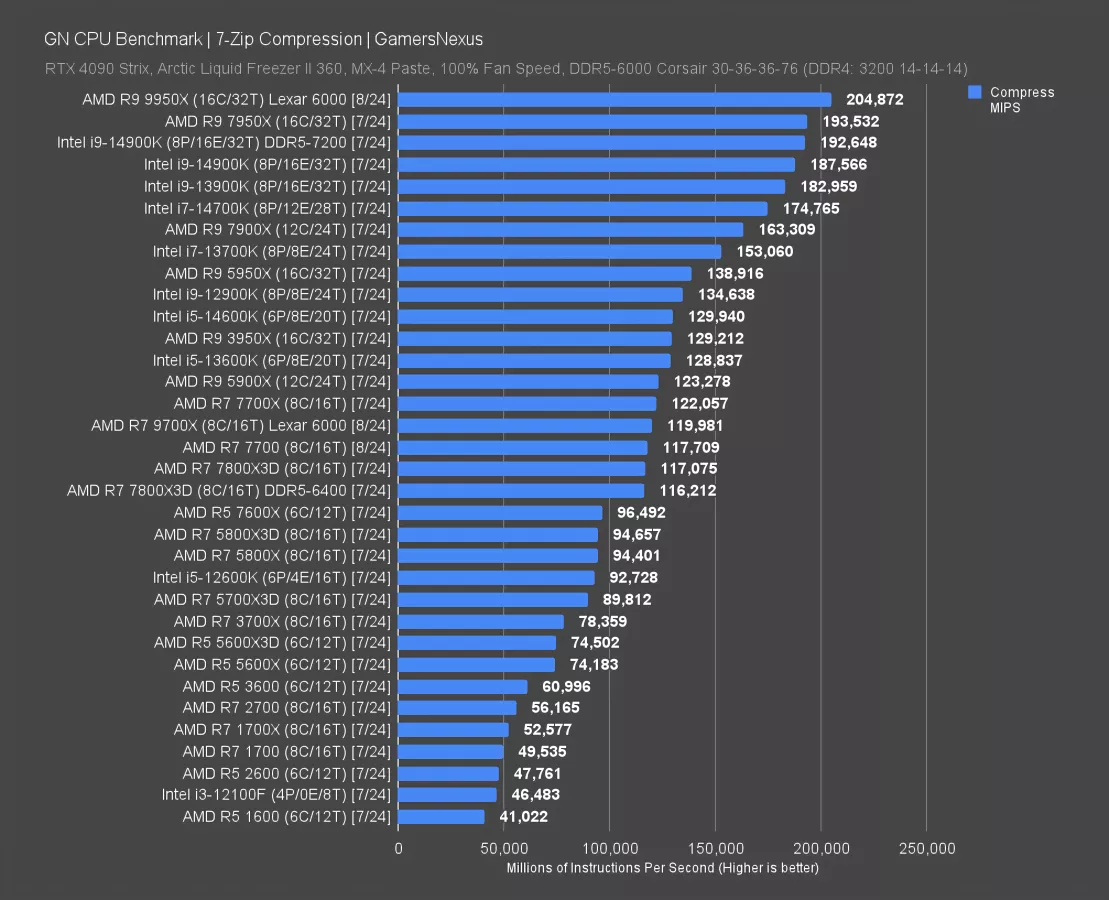
File compression with 7-Zip is subsequent. On this one, the 9950X accomplished 205K MIPS (thousands and thousands of directions per second) when inventory, an enchancment of 5.9% over the 7950X’s consequence. For that very same generational perspective, right here’s the way it traces up:
The 7950X gained 39% on the 5950X, which itself had gained 7.5% on the 3950X.
The beneficial properties are up-and-down, however the 9950X is the bottom of those metrics up to now.
Intel’s 14900K encroaches on the highest of the chart and was practically tied with the 7950X beforehand; once more, AMD advantages from creating some slight distance between itself and the 14900K, no matter Intel’s present issues. If Arrow Lake can do higher than this, Intel might be able to maneuver itself into a powerful spot. It’ll rely if Intel can regain confidence earlier than then.
Towards the 9700X, the 9950X completes 71% extra MIPS. This aligns with the large core rely distinction.
7-Zip Decompression
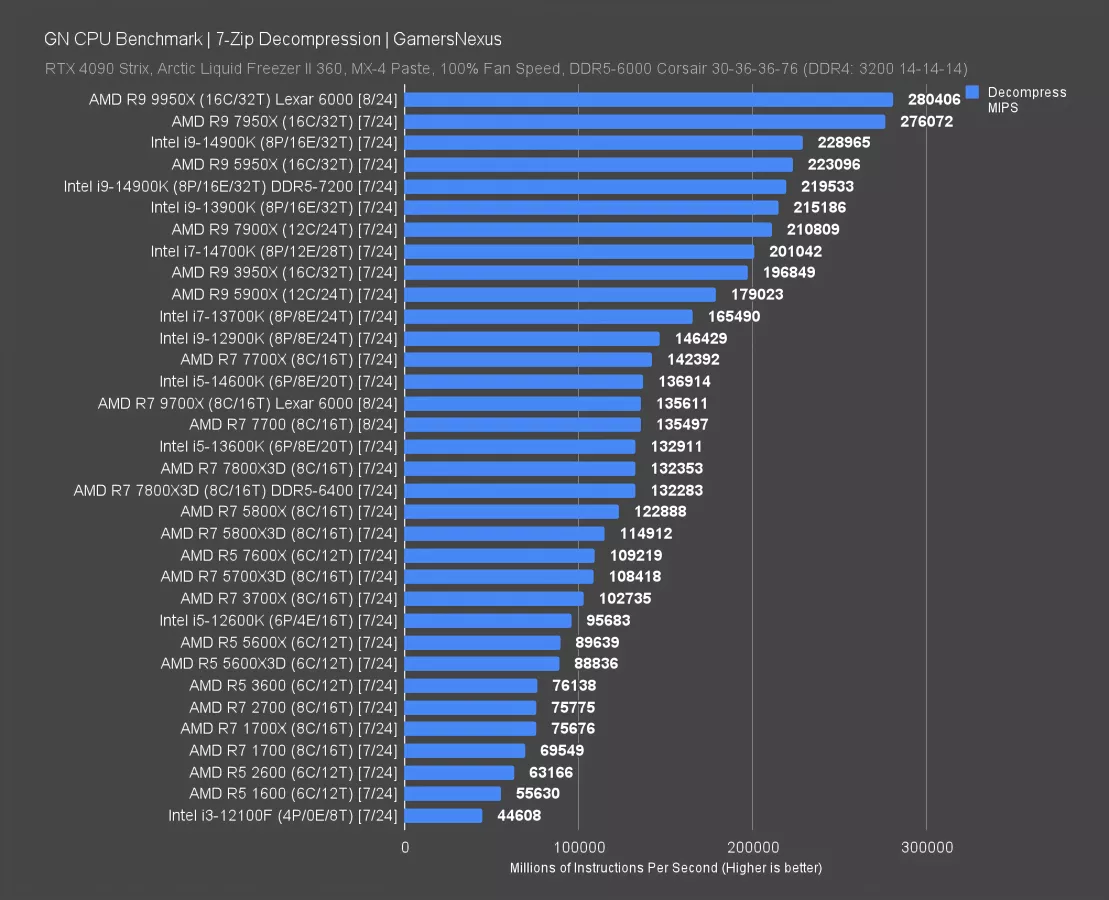
Decompression strikes a few of these CPUs round, however the 9950X stays on the high of the chart. Its lead over the 7950X is just one.6% right here, although we may additionally be operating into reminiscence bandwidth limitations. That’d be a separate take a look at.
The following CPUs are fairly far-off: AMD’s 9950X leads the 14900K and its 229K MIPS consequence by 22%. That’s an enormous benefit.
The 5950X additionally did nicely on this one, shoving itself proper between the 14900K and 13900K. This take a look at clearly favors having a bunch of homogeneous cores.
Towards the 9700X, the 9950X doubles efficiency. It additionally doubles core rely, making this probably the most linear beneficial properties we see.
SpecWS
Spec Workstation is up subsequent. This testing is accomplished utilizing the Spec pre-built benchmarks for varied skilled software program.
Spec LAMMPS
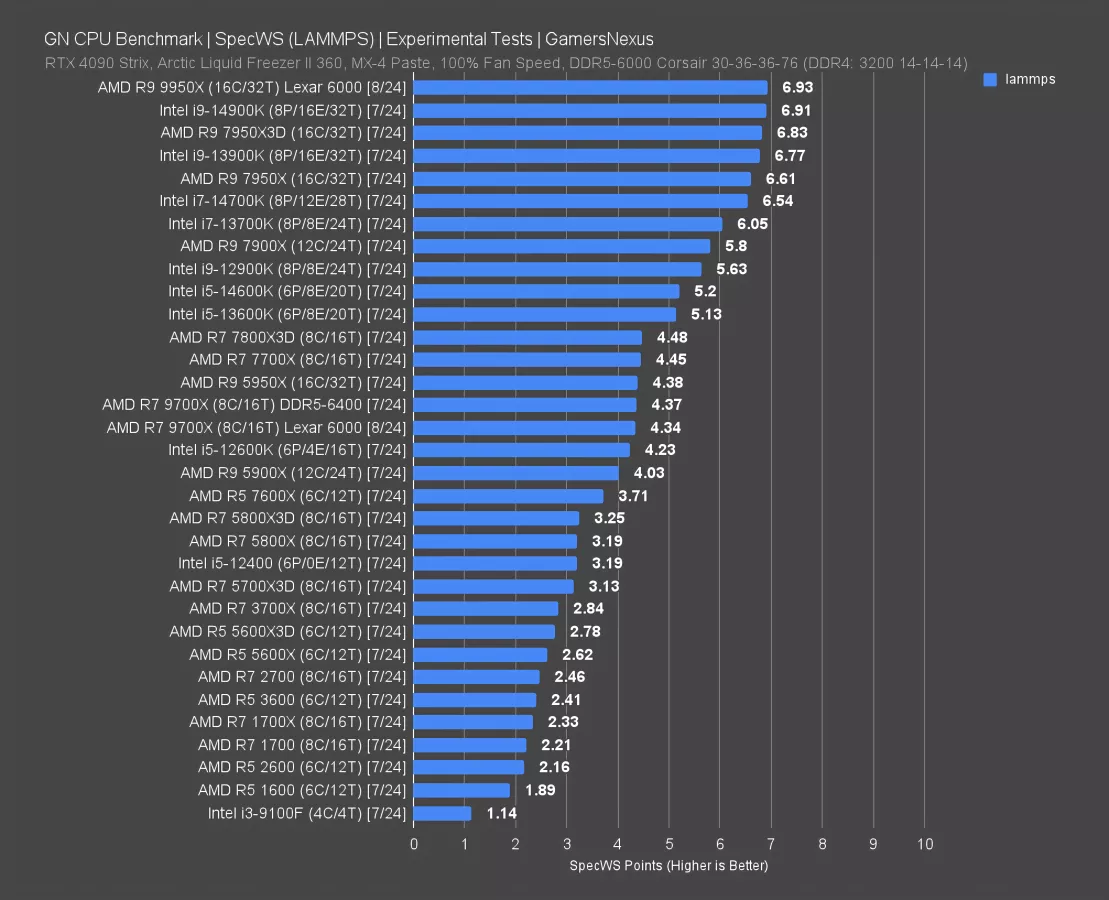
The primary one is for LAMMPS, which is a part of Spec’s biomedical suite.
As examined by Spec, LAMMPS has the 9950X because the chart chief: It’s up at 6.93, main the 7950X’s 6.61 consequence by 5%. That additionally places AMD now forward of the 14900K.
Spec FSI
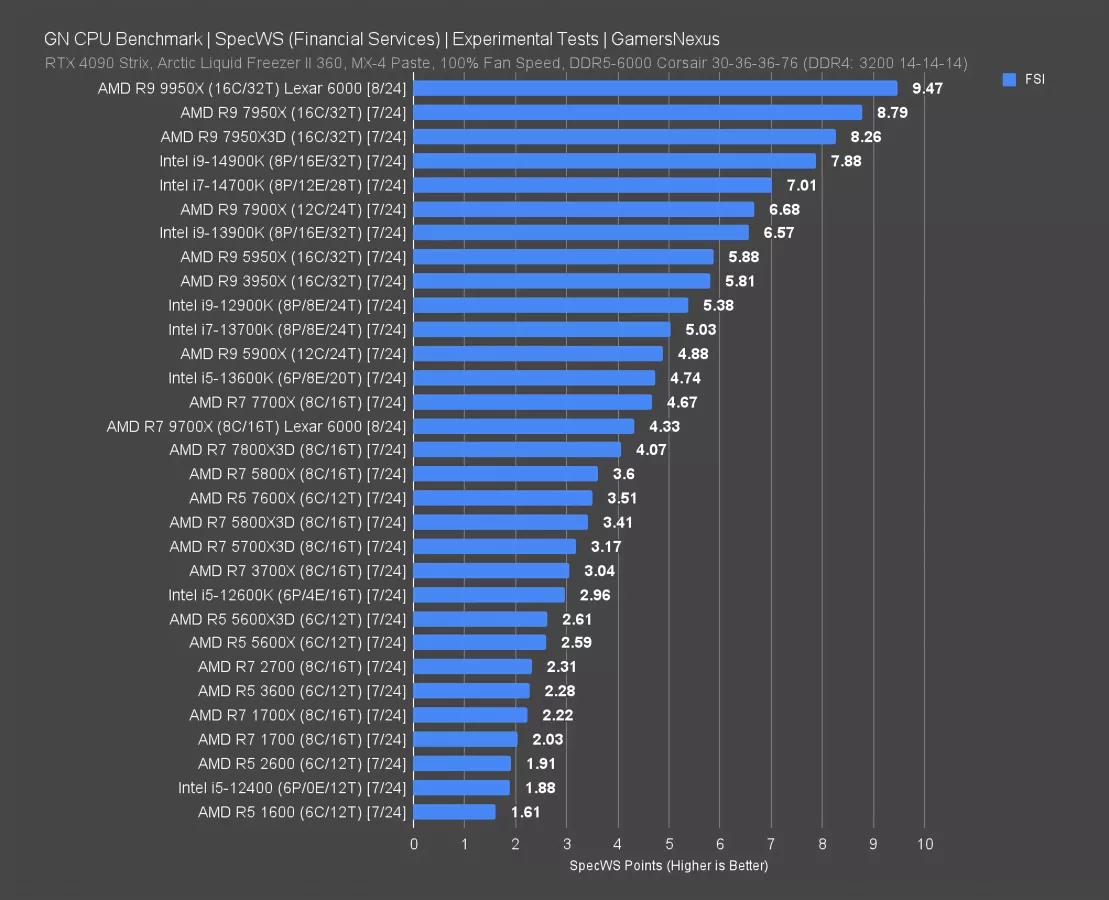
The following one is for the Spec Workstation FSI take a look at, which it says analyzes Black-Scholes pricing fashions, runs Monte Carlo simulations and chance simulations, and runs a binomial choices pricing mannequin. We aren’t conversant in these use instances in real-world environments, however our hope is that the assessments are helpful to the viewers.
Right here, the 9950X finally ends up main the 7950X-non-3D by 7.7%, at 9.47 to eight.79. The lead over the 14900K is 20%. Towards prior generations, the 5950X offers the 9950X a lead of 61%.
9950X Gaming Benchmarks
Gaming is up now. That is much less vital for the 9950X: You shouldn’t purchase these CPUs for a gaming construct solely. Our primary aim right here is to simply be sure it really works correctly and doesn’t chop the framerate in any main methods. We gained’t spend a lot time on every of those charts as we expect that point was higher spent within the earlier manufacturing sections.
Dragon’s Dogma 2
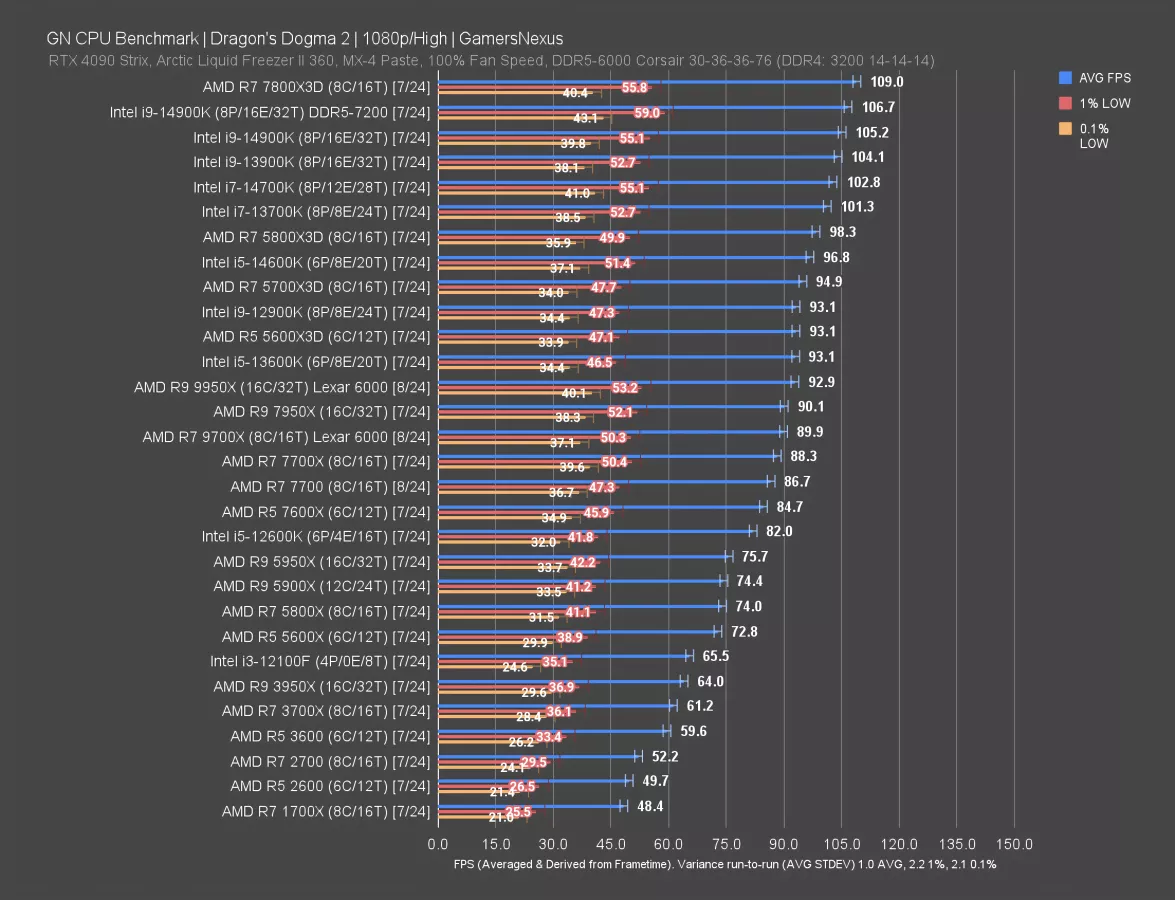
Dragon’s Dogma 2 is up first, a CPU-heavy recreation that got here out this 12 months.
The 9950X is about the identical because the 7950X right here. It’s technically barely forward, and as a optimistic, we’re seeing profit from the 16-core elements on this particular take a look at. That’s at the least good, as traditionally, a few of the 16-core CPUs have had issues in gaming. That was very true in older video games.
The 9950X is unquestionably not value shopping for only for gaming, however neither was the 7950X. On this one, it’s holding an AVG framerate just like a 13600K (watch our review) and 5600X3D (learn our review), each of that are significantly better worth for simply gaming. The lows on the 9950X are good although, which suggests it clears the bar of “working” in a gaming situation.
The 7800X3D (watch our review) stays remarkably good worth for this explicit recreation. Intel’s i7 CPUs on the high additionally do nicely.
You possibly can see that the older 16-core CPUs additionally outdo their generational household by small margins: The 3950X leads the 3700X (learn our revisit) barely and the 5950X leads the 5900X and 5800X non-3D elements barely. That is fairly cool to see as this was uncommon in prior years of benchmarking. Dragon’s Dogma 2 testing appears to be good for this.
Baldur’s Gate 3
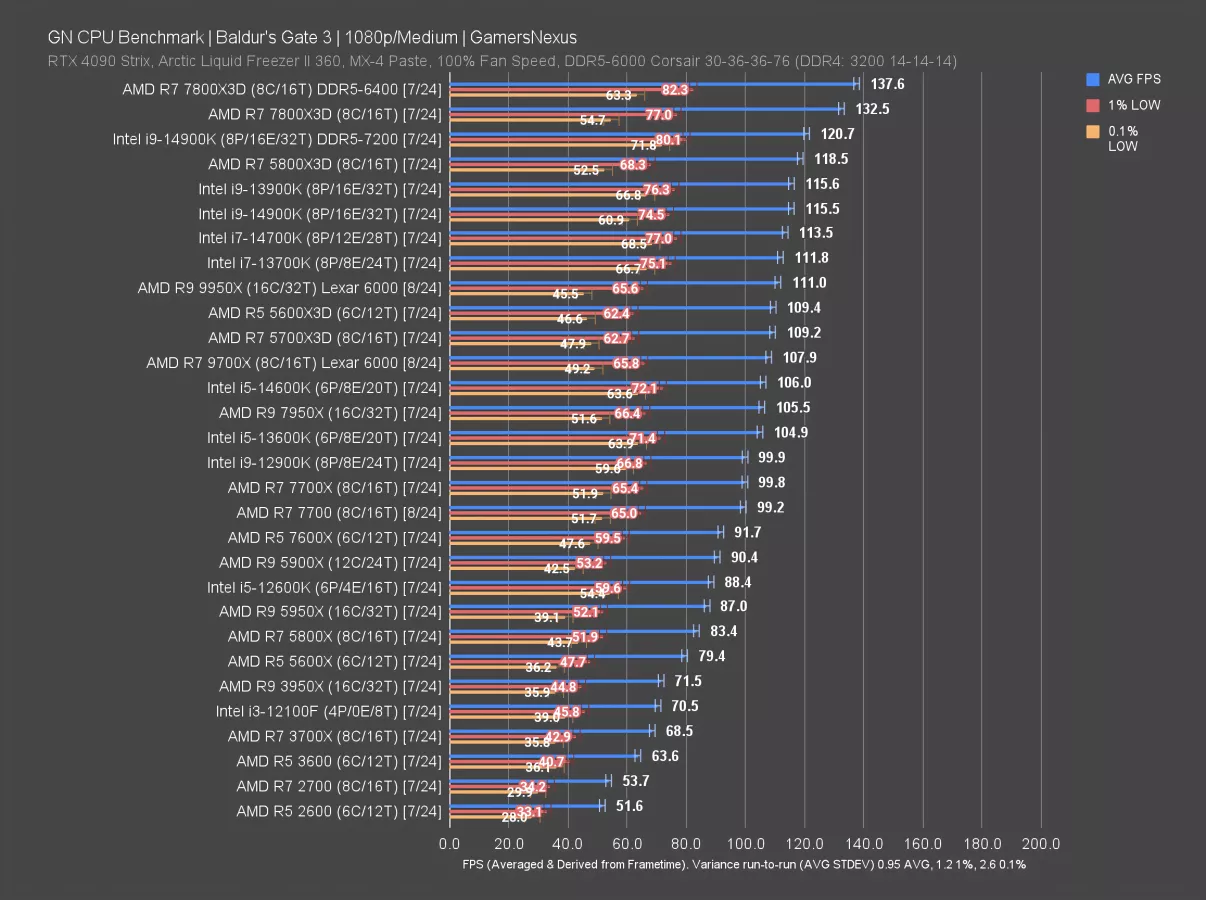
In Baldur’s Gate 3, the 9950X landed at 111 FPS AVG. That has it about tied with the 13700K and barely forward of the 5700X3D. Towards the 9700X, we’re seeing a few 2.9% uplift with the 9950X. Lows are comparable, however with the 0.1% lows technically worse. The achieve over the 7950X is about 5.2% The 3950X permits the 9950X to run 55% quicker, with the 5950X giving it a 28% lead.
As for the 7800X3D with our default reminiscence, it outperforms the 9950X by 19.4%. The 14900K can be up right here at 121 FPS AVG when paired with quicker reminiscence, or down at 116 FPS AVG with out (the place it and the 13900K grow to be restricted).
The 9950X is working higher than we anticipated for Baldur’s Gate 3.
Stellaris
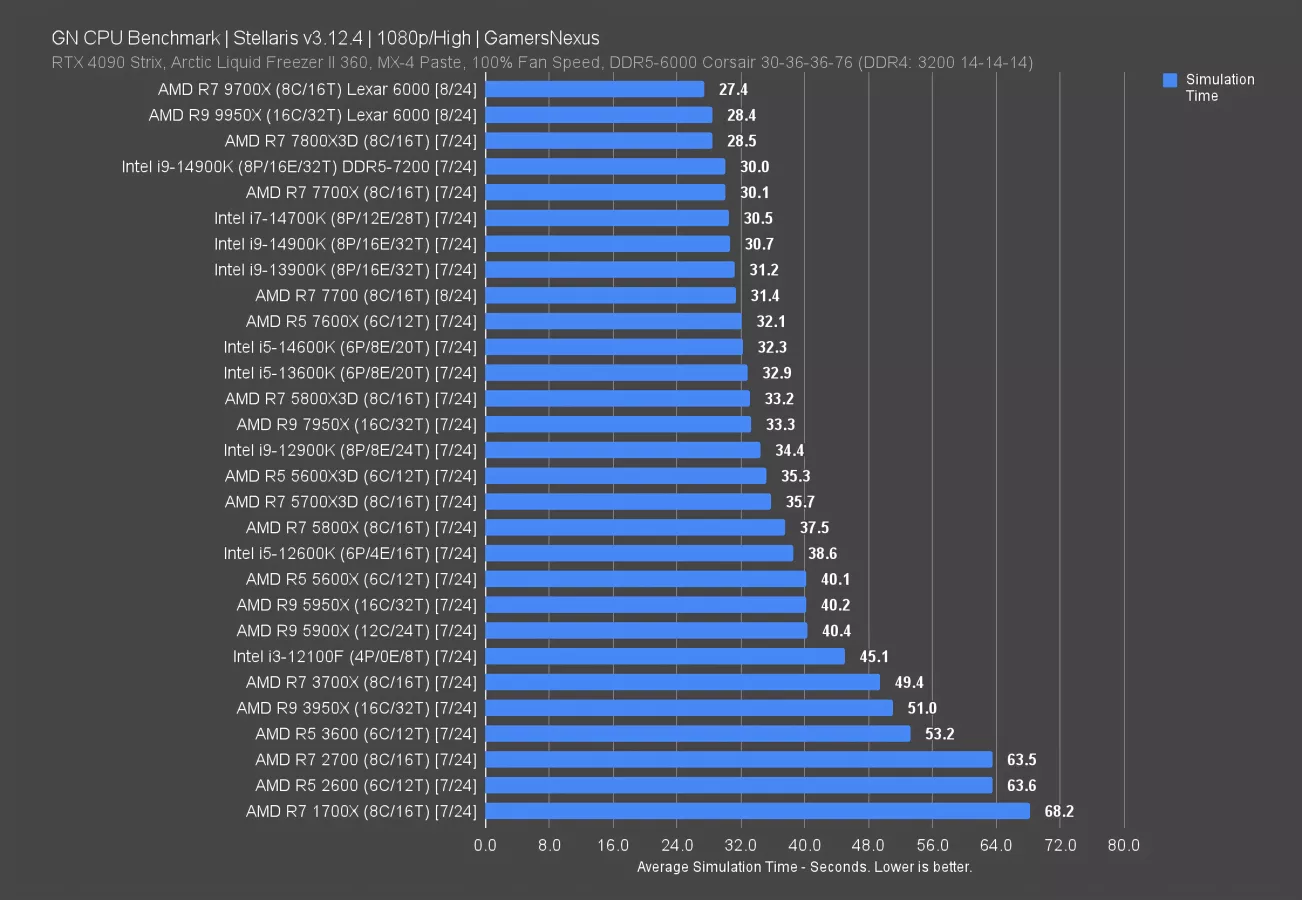
Stellaris posts outcomes which have the 9700X outperforming the 9950X barely. The discount in common simulation time is 1 full second, or about 3.5% time lowered. The 9950X can be tied with the 7800X3D, with this being one of many solely assessments the place we noticed the 9700X leverage its modifications to drag forward. The 9950X has the identical architectural advantages, so it’s up right here as nicely.
Regardless of not bettering over the 9700X, the 9950X at the least improves on the 7950X. The soar from 33.3 seconds to twenty-eight.4 seconds begins to grow to be noticeable for longer play periods.
Again within the 5950X period, we are able to see that there was no actual differentiation between it and the 5600X or 5900X. The 3950X was truly a little bit bit worse than the 3700X. This is sensible for these CPUs, as they sacrificed extra frequency together with their core rely will increase.
Intel’s presence begins on the 30.5-second mark with the 14700K and 14900K, that are about the identical.
FFXIV Dawntrail
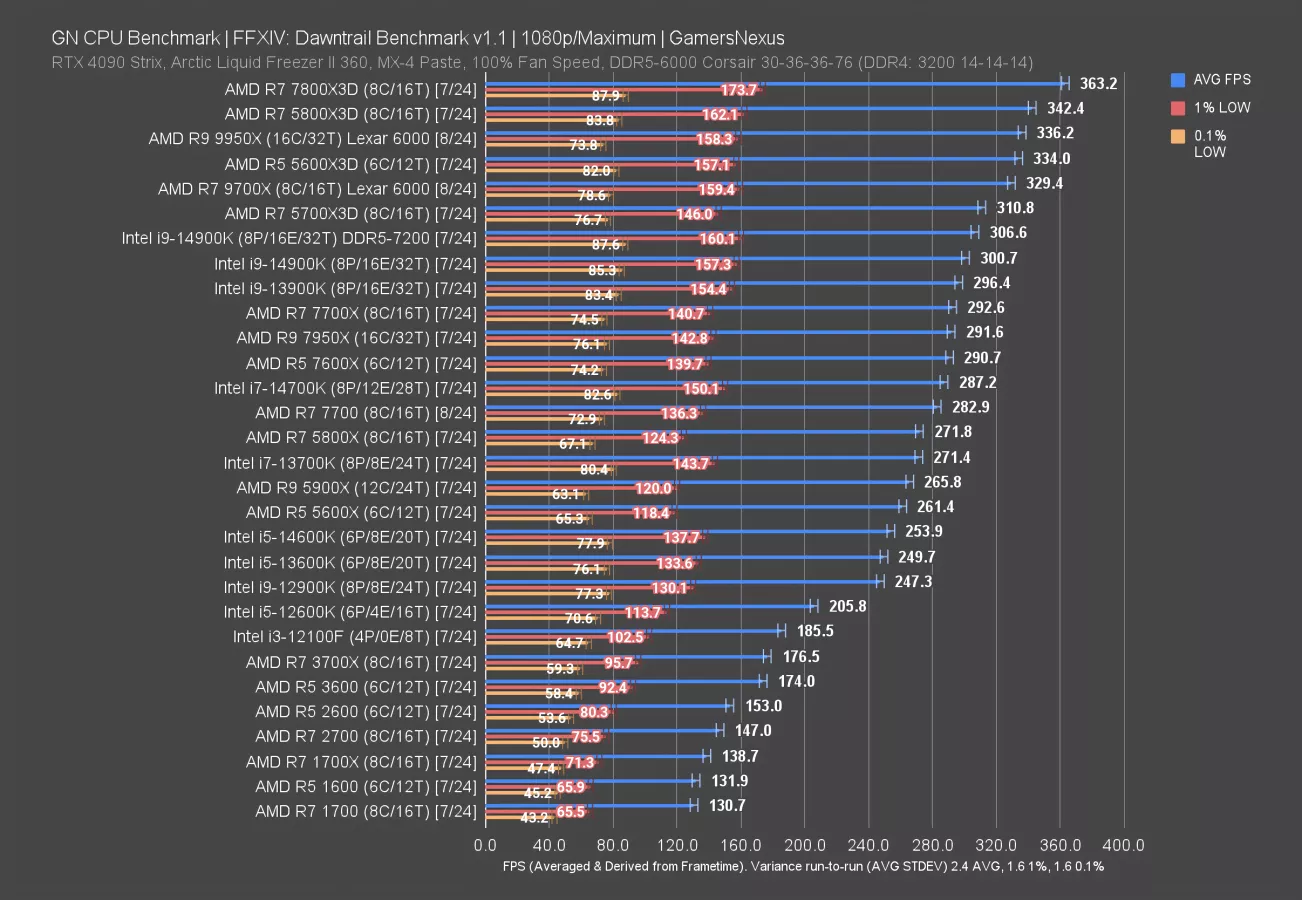
Ultimate Fantasy 14: Dawntrail has the 9950X at 336 FPS AVG, which is a considerably noteworthy lead over the 9700X of two%. It’d be insane to spend this cash on it for simply gaming, nevertheless it’s at the least monitoring higher and we appear to be previous the outdated period of excessive core-count elements floundering, like what we noticed with the unique Threadripper 1950X (watch our review).
The 7800X3D stays the clear gaming chart chief.
Dawntrail Frequency
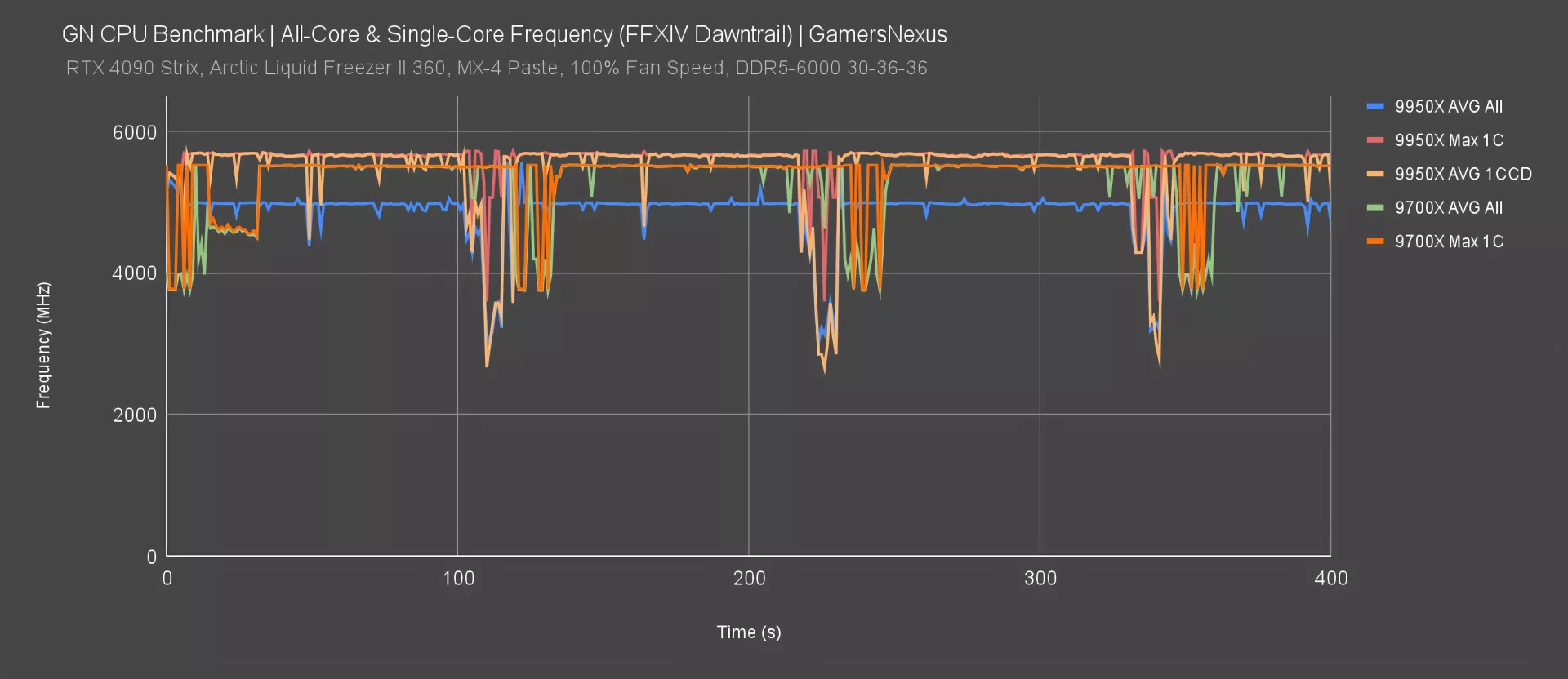
To higher perceive what’s occurring in Dawntrail, we plotted the frequency of the 9950X and 9700X throughout this workload. We discovered that the 9950X’s all-core common was about 4975-5000MHz, which is decrease than the 9700X’s all-core common of 5500MHz [however that’s as a result of it’s averaging an inactive CCD. We’ll have a look at that quickly. You possibly can see that the 9700X’s all core is slightly below its most single core frequency.
On the identical time, the 9950X is ready to increase its most core greater, as much as 5670-5700MHz. At occasions, that’s round a 150MHz benefit over the 9700X, which explains the efficiency we’re seeing in Ultimate Fantasy.
If we plot the typical frequency for simply the 8 cores which are energetic, we see it aligns with the max — that helps even additional clarify the habits. The 9950X is simply boosting greater in all places.
F1 2024
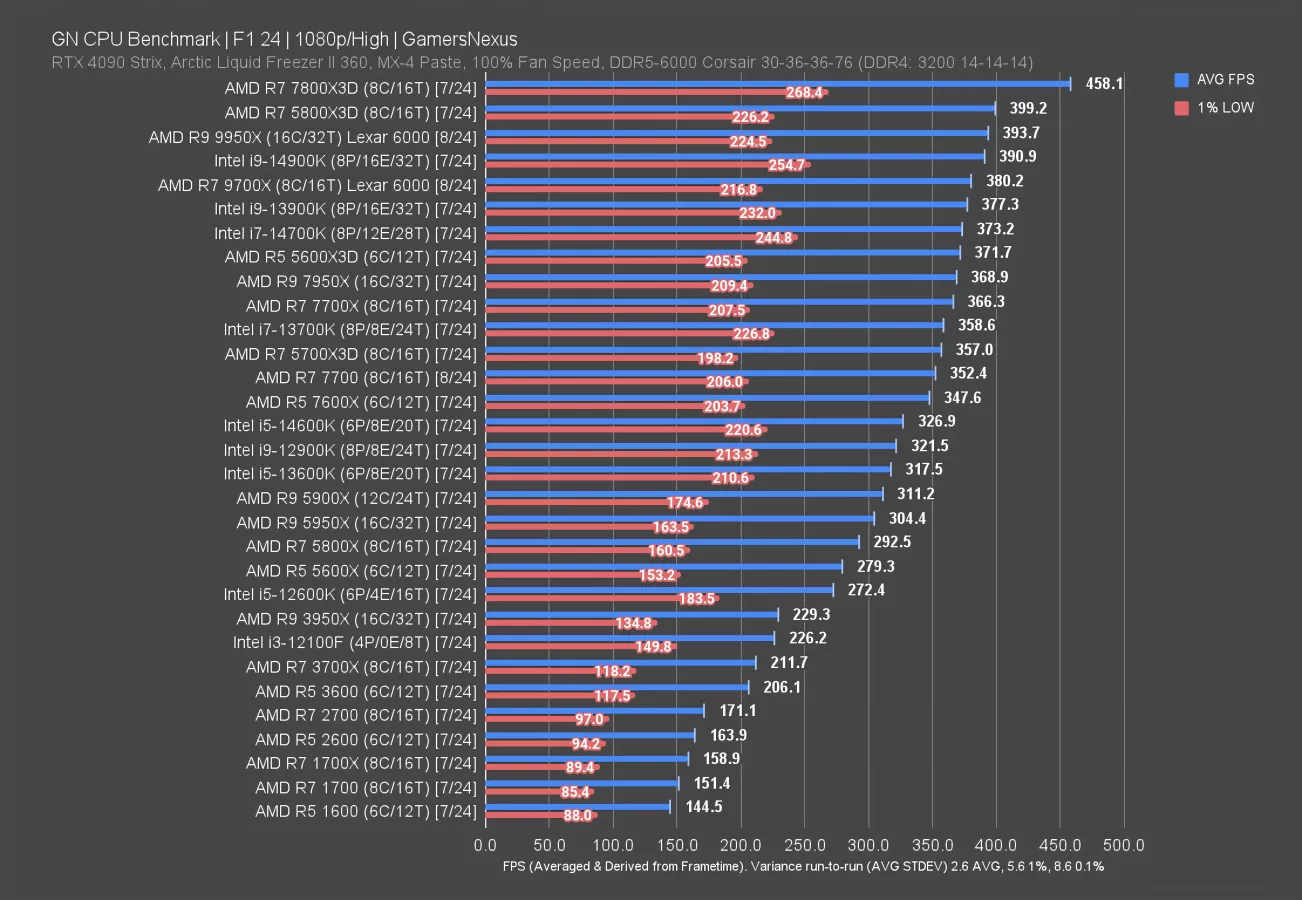
Now for F1 2024. F1 had the 9950X at 393.7 FPS AVG, with the 9700X at 380 FPS. That’s a few 3.5% distinction between them. One word: Now we have noticed extra variable habits on this take a look at on the 9000 CPUs as in comparison with the 7000 sequence, which we expect has to do with the change in reminiscence package that we’re utilizing. As we mentioned final time, we are able to’t use our normal Corsair DDR5-6000 package for the 9000 sequence because the platform has some points operating it on the guide timings we set, regardless of 7000 working since launch. The Lexar package does fairly nicely to match, however shouldn’t be a exact match and has some lowered controls on some timings.
Even with all of that caveated, the distinction stays inside affordable expectations.
F1 2024 Frequency
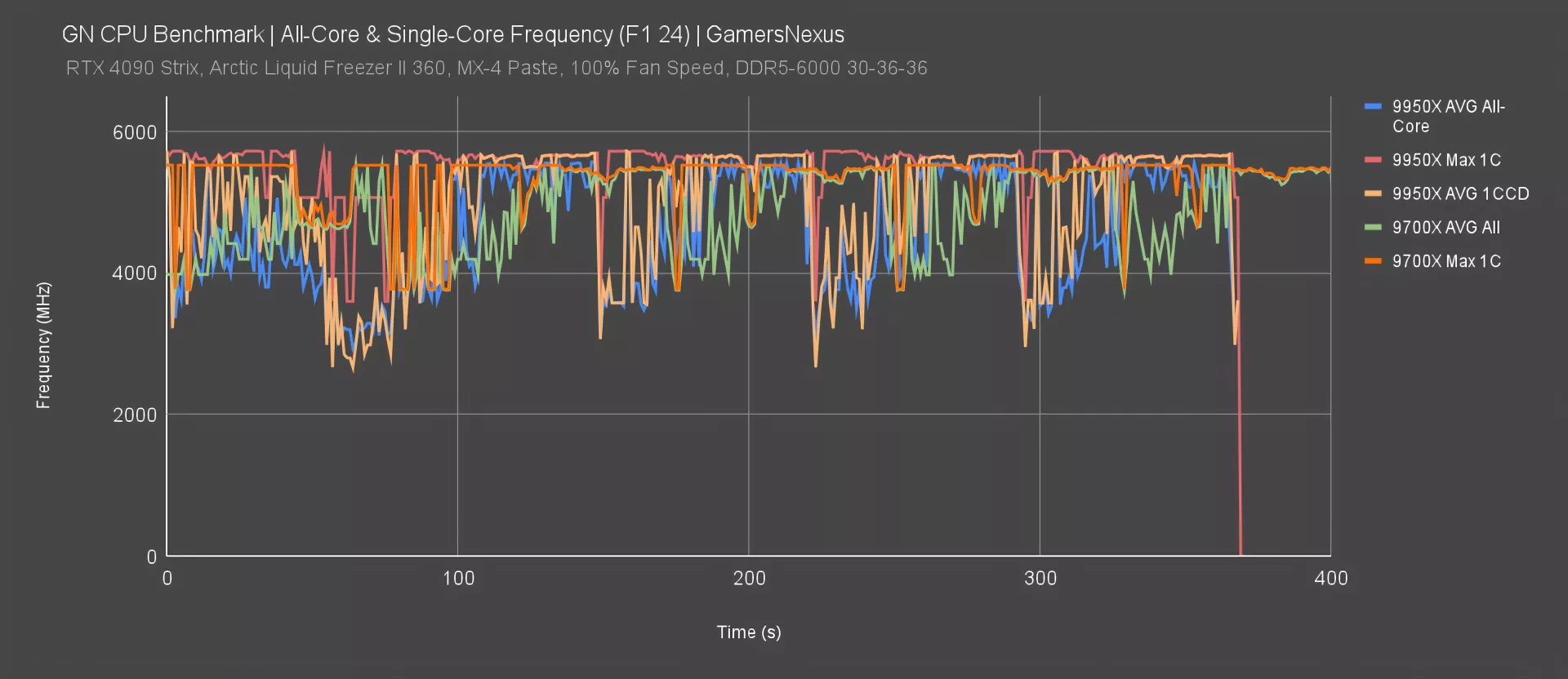
As soon as once more, a fast have a look at frequency exhibits that the 9950X with its most single-core increase is pushing greater than the 9700X, with the single-CCD increase additionally operating typically proper alongside the max single core at any given interval. The 9700X’s common is ceaselessly considerably decrease than that of the 9950X, serving to clarify this bigger 3.5% hole on this explicit title.
9950X Conclusion

We’re going to maintain the conclusion actually quick. We’ve been operating at full steam forward for per week and there’s a ton of content material on this subject already.
The 9950X has the next TDP than the 9700X, so it will probably increase greater than the 9700X. This does make it “much less environment friendly” in some video games. When it comes to gaming, the CPU is simply not as environment friendly as nearly some other fashionable AMD CPU.
AVX-512 is a energy for Zen 5, which turns into extra related on these “mini-HEDT” CPUs. That’d be an enormous motive to purchase a 9950X as an alternative of a 7950X, as we noticed in Blender the place there’s an enormous effectivity uplift but additionally a efficiency enchancment.
We predict it boils right down to this:
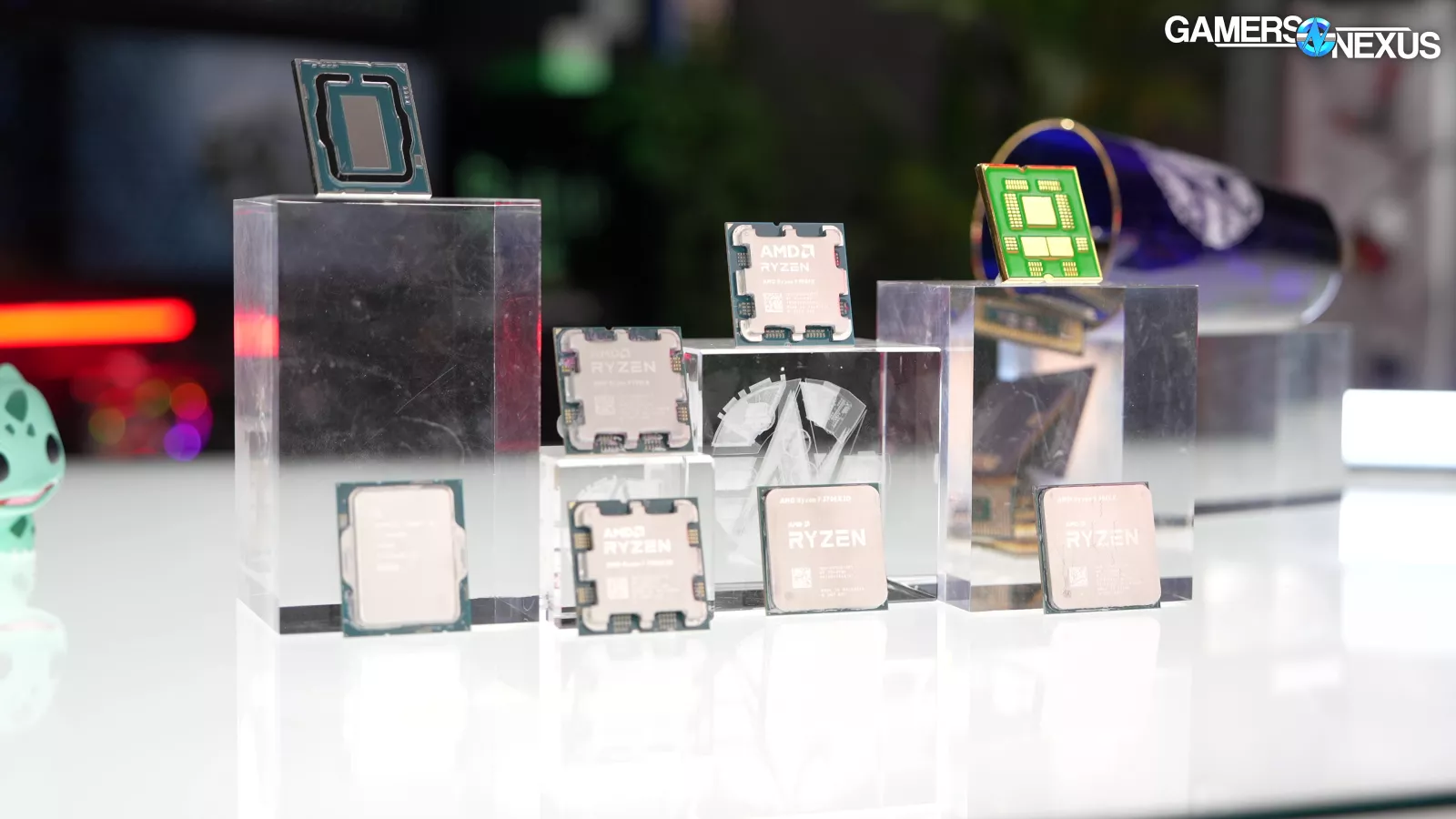
For gaming, you’d purchase a 7800X3D. For manufacturing workloads with no explicit deal with AVX-512, and you’ll analysis your purposes for that, we expect the 7950X is much better worth. These CPUs usually tend to be beneath a full, all-core workload than the R5 and R7 CPUs, so that you’re extra more likely to profit from the lowered energy we noticed in sure all-core workloads (however not all). That mentioned, the 7950X is $520 now. That makes the 9950X 25% dearer for what is usually comparable efficiency or perhaps 12% higher outcomes on the high-end.
Usually talking, we’d advise in opposition to the 7950X3D and as an alternative in favor of the 7800X3D. You possibly can find out about why in our prior opinions, however principally, most workstation purposes we take a look at can’t make use of the additional cache. They underperform versus the 7950X however do profit from the upper frequency of the 7950X non-3D.
On the optimistic facet, the 9950X did higher in gaming than we anticipated. You actually shouldn’t purchase it for gaming primarily, however the truth that it’s at the least commonly matching or very barely outperforming the 9700X is sweet. General, the 7950X is usually a greater worth. The 9950X is at the least value contemplating for those who’re doing a model new from scratch construct for a workstation kind of atmosphere however the factor so that you can actually analysis and take note of is the kind of software you utilize. Whether it is actually closely threaded, it’s operating all cores at 100% all the time like in Blender and/or if it’s an AVX512 software, you usually tend to profit from a 9950X in a approach that at the least may begin to matter versus a 7950X. If these issues aren’t the case then, we expect, the higher worth is to purchase the 7950X as an alternative.